
The 18 clubs and their 2025/26 home grounds
The 2025/26 Ligue 1 field contained eighteen clubs. Lorient, Paris FC and Metz joined the division from Ligue 2, and Paris FC used Jean Bouin for its top-flight home programme. This is a fixed guide to that season's football geography, checked on 1 October 2026. It should not be read as an automatically updated list of the clubs playing in the current campaign.
| Club | Ground location | 2025/26 home stadium |
|---|---|---|
| Angers | Angers | Stade Raymond Kopa |
| Auxerre | Auxerre | Stade de l’Abbé-Deschamps |
| Brest | Brest | Stade Francis-Le Blé |
| Le Havre | Le Havre | Stade Océane |
| Lens | Lens | Stade Bollaert-Delelis |
| Lille | Villeneuve-d’Ascq | Decathlon Arena – Stade Pierre-Mauroy |
| Lorient | Lorient | Stade Yves-Allainmat – Le Moustoir |
| Lyon | Décines-Charpieu | Groupama Stadium |
| Marseille | Marseille | Orange Vélodrome |
| Metz | Longeville-lès-Metz | Stade Saint-Symphorien |
| Monaco | Monaco | Stade Louis-II |
| Nantes | Nantes | Stade de la Beaujoire – Louis-Fonteneau |
| Nice | Nice | Allianz Riviera |
| Paris FC | Paris | Stade Jean Bouin |
| Paris Saint-Germain | Paris | Parc des Princes |
| Rennes | Rennes | Roazhon Park |
| Strasbourg | Strasbourg | Stade de la Meinau |
| Toulouse | Toulouse | Stadium |
The league's 2025/26 fixture announcement establishes the season's field, while the archived stadium list provides a useful cross-check of the venues. The map links above locate grounds by name and municipality. They are orientation links, rather than confirmation that a particular future match will take place there.
A club's familiar city name is not always the precise stadium destination. Lille's ground is in Villeneuve-d'Ascq, as the municipal venue page confirms. Lyon's Groupama Stadium is in Décines-Charpieu. Looking up only “Lille” or “Lyon” can therefore leave the final part of a journey unresolved, even if the regional orientation is correct.
Metz supplies another example: Stade Saint-Symphorien is listed in Longeville-lès-Metz. The club label remains Metz, but a stadium-address search provides more useful directions than a city-centre pin. Conversely, PSG and Paris FC share the Paris city label yet have separate grounds and separate ticketed events. A city pin cannot decide which entrance belongs to your booking.
Several venues are known by both a long official name and a shorter everyday one. Le Moustoir, the Beaujoire and the Vélodrome remain recognisable names even when a fixture listing uses a fuller designation. Compare the stadium itself and the location, rather than assuming two differently written names always describe different destinations.
The table intentionally leaves out capacity rankings. A nominal capacity does not tell you how many seats are on sale for a particular fixture, which areas are open or where visiting supporters will enter. For an actual visit, the home club's event information is the next source to consult. First identify the right ground; then check the match-specific arrangements.
How to read the league's geography
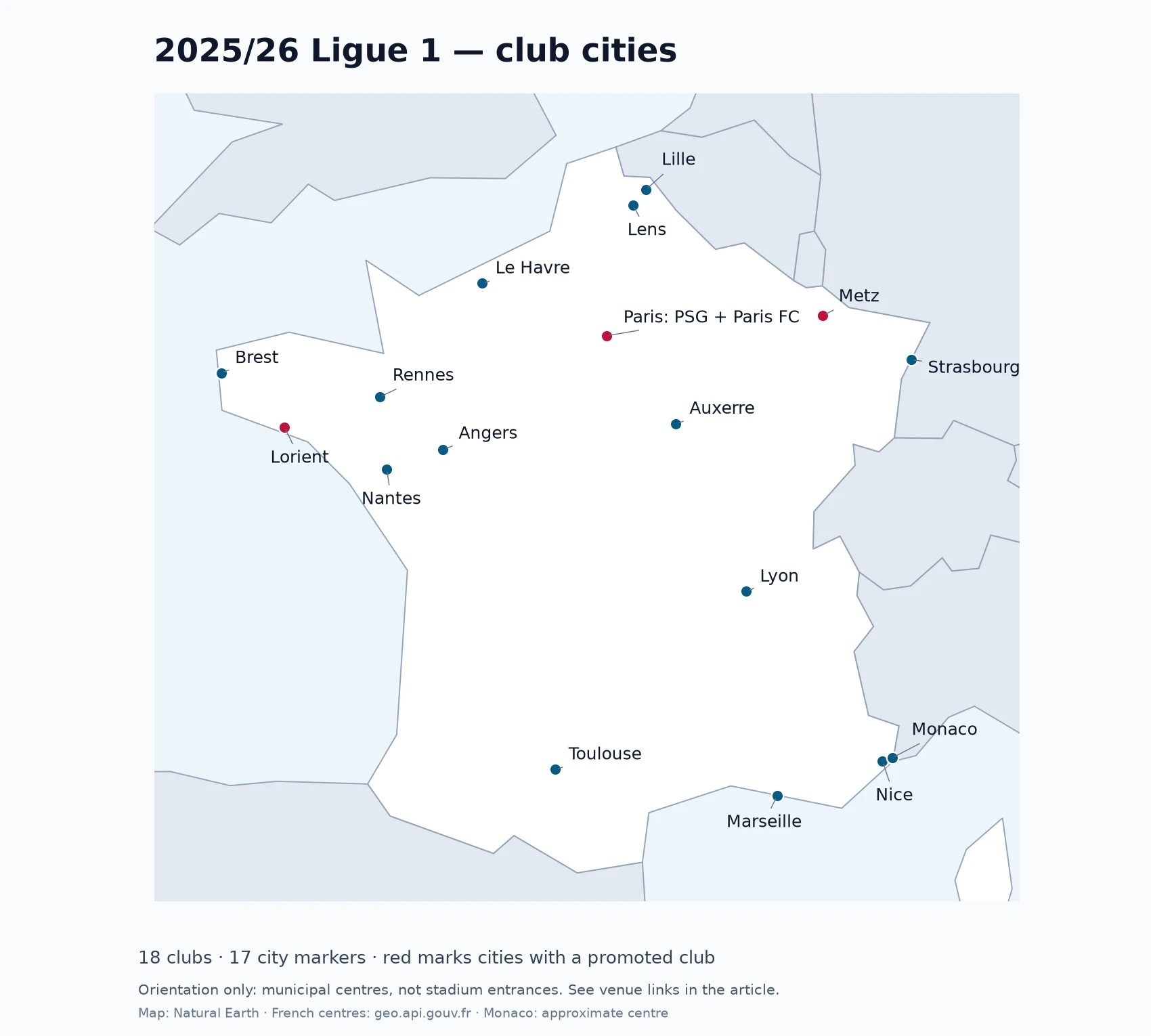
The map below groups clubs by their familiar cities. Its markers use geographic centres for orientation, rather than stadium entrances; Paris has one marker for two clubs. That distinction matters at different scales. A France-wide view helps you understand where the league is spread, while the venue links in the table help you find the actual destination once you have chosen a match.
Northern and eastern clubs form different local clusters
Lille and Lens form a clear northern pair. Their positions make a northern football itinerary an understandable starting point, although a close-looking pair of dots says nothing about whether both clubs are at home on the dates you have available. A traveller needs the fixture list before turning that geographical relationship into a booking.
Le Havre belongs in the Normandy part of the picture. Metz and Strasbourg sit farther east, while Auxerre provides a Burgundy reference point and Lyon lies farther south along the Rhône side of the country. These are useful orientation groups, not a promise that every journey within a group is short or direct. Drawing one large circle around “northern France” would hide distinctions that become important when choosing accommodation.
Paris is particularly easy to misread on a national map. The two club names represent eighteen league members overall, yet their shared city produces only seventeen city markers. Enlarging the Paris marker would not solve the last stage of the trip: the ticket still needs to identify Parc des Princes or Jean Bouin. Likewise, the Lille and Lyon labels identify the football cities, while their stadium municipalities appear in the lookup table.
The Atlantic side and the Mediterranean are separate journeys
Brest, Lorient and Rennes give the western side of the league a Breton cluster. Nantes and Angers form another useful pair around the Loire area. Toulouse sits inland in the southwest; it should not be mentally folded into the Mediterranean group simply because it is a southern club. Marseille, Nice and Monaco supply the league's Mediterranean orientation.
The scale is worth respecting. In its 2025/26 travel comparison, Ligue 1 identified Brest's trips to Nice and Monaco as journeys exceeding 1,000 kilometres. That is evidence of the league's geographical spread, rather than a train timetable or a claim about the route an individual supporter will use.
For a football weekend, start with a region you actually want to visit and then see which club has an appropriate home fixture. For a longer trip, compare complete journeys between venues, including the final connection from your arrival point. A national map can reveal an appealing sequence of cities; only confirmed fixtures and actual transport options can make that sequence workable.
What promotion changed for 2025/26
A league map is a record of membership, so promotion and relegation change its meaning even when most familiar clubs remain. The three arrivals for 2025/26 were Lorient, Paris FC and Metz. Their routes into the division were different, and separating those routes explains why simply copying the previous season's map would have produced the wrong list.
Lorient and Paris FC took the direct places
Lorient finished as Ligue 2 champions and Paris FC as runners-up, taking the two direct promotion places. The league's final-round report recorded Lorient's 5–1 win over Martigues and Paris FC's 2–0 victory over Ajaccio. Those were second-division results establishing their entry into the next top-flight season, rather than results from the 2025/26 Ligue 1 campaign itself.
For the map, Lorient added another western destination alongside the Breton clubs already in the division. For a supporter considering that part of France, Le Moustoir became a top-flight option again. That does not mean every western club could conveniently be visited on one weekend: the addition expands the choice of destinations, while the calendar determines which choice fits a particular trip.
Paris FC changed the capital's representation more dramatically. Paris now supplied two league members, but a national map still showed the same city position. A map that marked cities without listing clubs could therefore conceal one of the season's most useful changes for visitors. The accompanying club table is essential because it identifies the second team and its own home venue.
Metz came through the play-off against Reims
Metz completed the trio through the promotion/relegation play-off. The official 29 May 2025 report records a 3–1 away victory after extra time and a 4–2 aggregate success over Reims. Metz entered Ligue 1 and Reims dropped into Ligue 2. The return-leg score alone is not the full tie result.
That outcome explains why Metz belongs on this season's eastern part of the map and Reims does not appear in the eighteen-club table. Reims remained a recognisable French football destination, but recognition is not the test for inclusion. This guide follows the actual division membership for the stated season.
It would also be a mistake to use the promotion route as a ready-made prediction of how enjoyable a stadium visit would be or how a team would perform. Direct promotion and a play-off win establish entry; they do not describe the atmosphere, ticket availability or subsequent league record. To connect the map with what happened on the pitch, use the separate 2025/26 final-table review. The geography answers where the clubs were, while the season review answers how their campaigns finished.
Paris FC's move is the stadium detail to get right
Paris FC is the clearest reason to attach a season to a stadium guide. Finding a club on an older map does not establish where its later home matches took place. For 2025/26, the correct venue in this list is Jean Bouin. Charléty belongs to the club's previous home arrangement and should not be carried into this season's table.
Jean Bouin replaced Charléty for the top-flight season
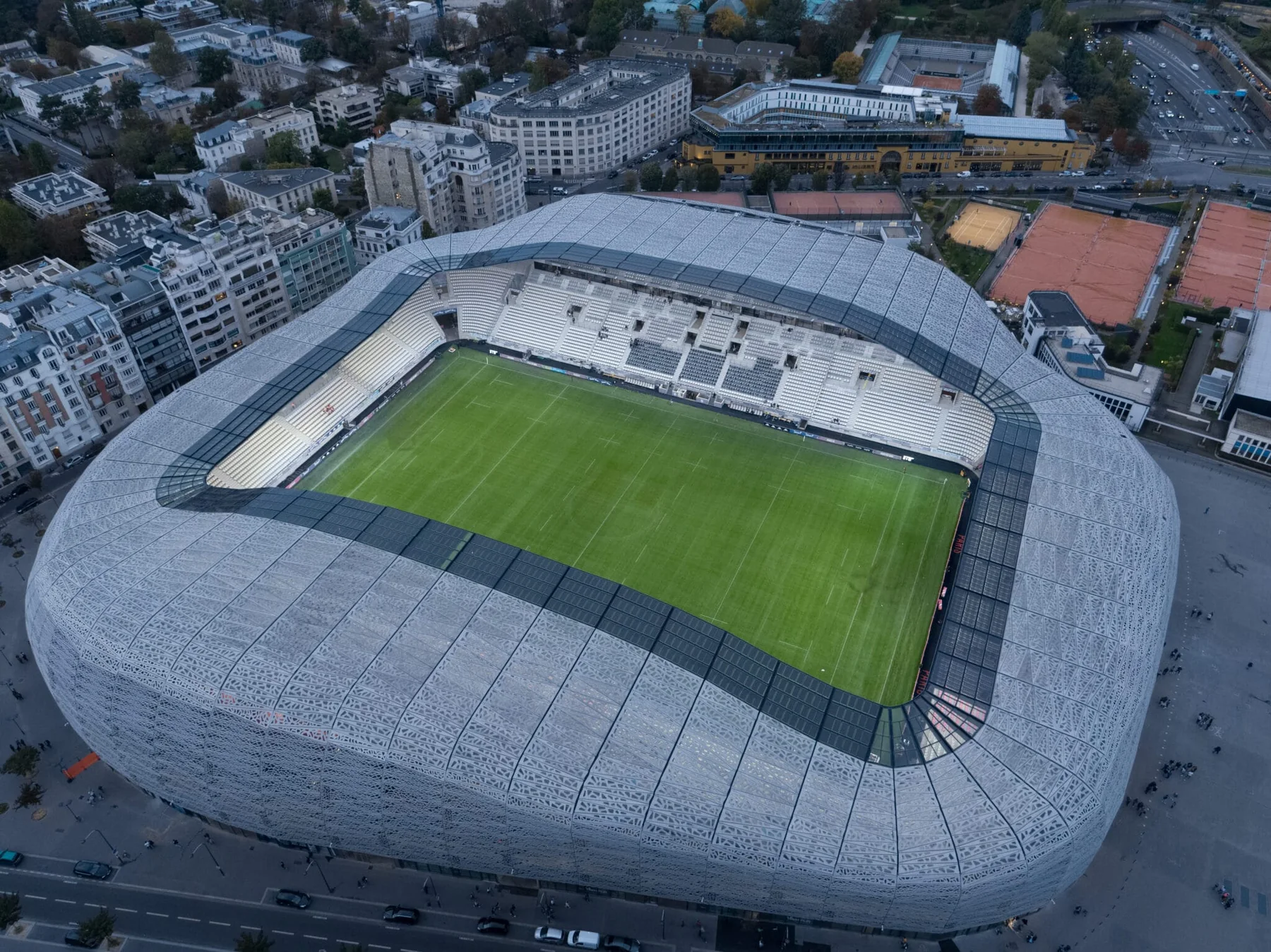
In its 12 February 2025 announcement, Paris FC confirmed an agreement to make Jean Bouin its home from the start of 2025/26 until at least 2029. Stade Français remained the resident club and principal user. The arrangement brought Paris FC football into a stadium also associated with rugby.
That shared use matters when interpreting photographs and event listings. An image of Jean Bouin with rugby markings still depicts the right stadium, but it does not show a Paris FC league match. Similarly, a listing for another event at the venue does not establish the details of a football fixture. Identify the event as well as the place.
The move also changes the practical value of an old supporter account. A description of arriving at Charléty may be perfectly accurate for the writer's visit while being unsuitable for a 2025/26 Paris FC home fixture. The useful question is not whether the account is authentic, but whether its date and venue match the game you are researching. Keeping the season visible prevents a convincing older description from becoming a misleading direction.
Two Paris clubs do not mean one matchday destination
PSG's venue is Parc des Princes, which the club's official stadium page places in Paris's 16th arrondissement near Porte de Saint-Cloud. Jean Bouin and Parc des Princes are neighbouring venues, yet they remain different grounds hosting separately ticketed events. A booking for one should never be treated as admission to the other.
Before planning a capital visit, read the home club, opponent, stadium and date together. Then check the time and the stand or gate shown in the booking information. “Football in Paris” is useful as a broad travel interest; it is too vague to identify the match you have paid to attend. The distinction is especially important when a search result gives prominence to a stadium photograph instead of the event name.
A two-club city offers more possible home fixtures, but it does not guarantee a double-header weekend. Both calendars need checking, and even two home games require separate tickets and a workable schedule. Treat the proximity as a geographical advantage you may be able to use, rather than a promise about dates, ticket access or the experience inside either ground.
Turn the map into a workable football trip
A good stadium itinerary has two scales: the journey into the football city and the journey to the ground itself. Use this season's map to understand the first, then switch to the home club's practical information for the second. For any future visit, also confirm that the club and venue remain relevant to the fixture you intend to attend.
Choose the exact stadium before arranging transport
Write the stadium name and municipality beside the match before looking for accommodation. This is particularly useful for Lille, Lyon and Metz, where the familiar club name and the ground's municipality differ. Choosing a hotel by the football city's name alone leaves an unanswered question about how you will reach the stadium and return after the game.
The club's access information can resolve details a national map cannot show. PSG's Parc des Princes practical guide, for example, supplies the address, transport references and entrance map. Those details belong to that venue. They should not be transferred automatically to Paris FC simply because both clubs appear under Paris.
Look at the end of the journey as well as its beginning. The station or airport you reach is not the stadium gate, and the route after the final whistle may have different practical constraints from the daytime arrival. Check actual services for your dates and allow room for the ordinary processes of entering and leaving a large event. This guide does not supply fixed travel times because a location alone cannot establish them.
Confirm the fixture and ticket before fixing a weekend
The 2025/26 list is historical. For an upcoming trip, move from it to the current fixture schedule and the home club's event page. Verify the opponent, venue and confirmed local kickoff time. A round appearing under a weekend date is not by itself proof that your selected game starts at a particular hour on Saturday.
Next establish how you will obtain the appropriate ticket. Our Ligue 1 ticket guide helps you find official channels, but the club's own listing remains the place to check the event you are buying. If you are travelling with the away support, consult that club's match-specific arrangements too; a general home-ticket listing may not answer your situation.
Only then fit transport and accommodation around the confirmed event. For a proposed two-match trip, repeat the same process for both games before relying on the short distance between cities or stadiums. Keep the return journey visible in the plan. The map supplies the geographical possibilities; checking each complete event turns one of those possibilities into a trip you can actually follow.
Keep this season separate from the current club list
The season label is the most useful safeguard when using a football map. This guide answers who played in Ligue 1 in 2025/26 and where their home grounds were. It does not automatically change when clubs move between divisions or when a later stadium arrangement is announced. A historical guide remains useful because it preserves the context of that campaign.
If your question is who plays in the division now, use the 2026/27 teams guide. If your question is how those current clubs are performing, use the 2026/27 standings. The team list establishes membership; the table measures results within that membership. A club moving several places in the table has not moved to another geographical location or entered a different division halfway through the league campaign.
The completed 2025/26 table answers another question again: what the clubs in this map earned on the pitch. Their locations explain the setting of the season, but they do not explain every outcome. A long away journey cannot by itself establish why a team lost, and a neighbouring ground cannot establish which side was tactically stronger. Opponents, performance and the circumstances of the match provide the football evidence.
For a supporter researching an old away day, retain this season's club and venue pairing. For someone arranging a new visit, move to the current fixture and confirm its ground. For someone comparing campaigns, put the season beside each list before comparing the names. Those three uses can begin with the same map, but they require different next steps.
The lasting value is a clear reference: eighteen clubs, seventeen represented cities, specific home venues and a documented change at Paris FC. Start with the club you want to find, use its stadium link for the location, and let the date of your football question determine whether to continue into historical results or current match information.
Loading comments…