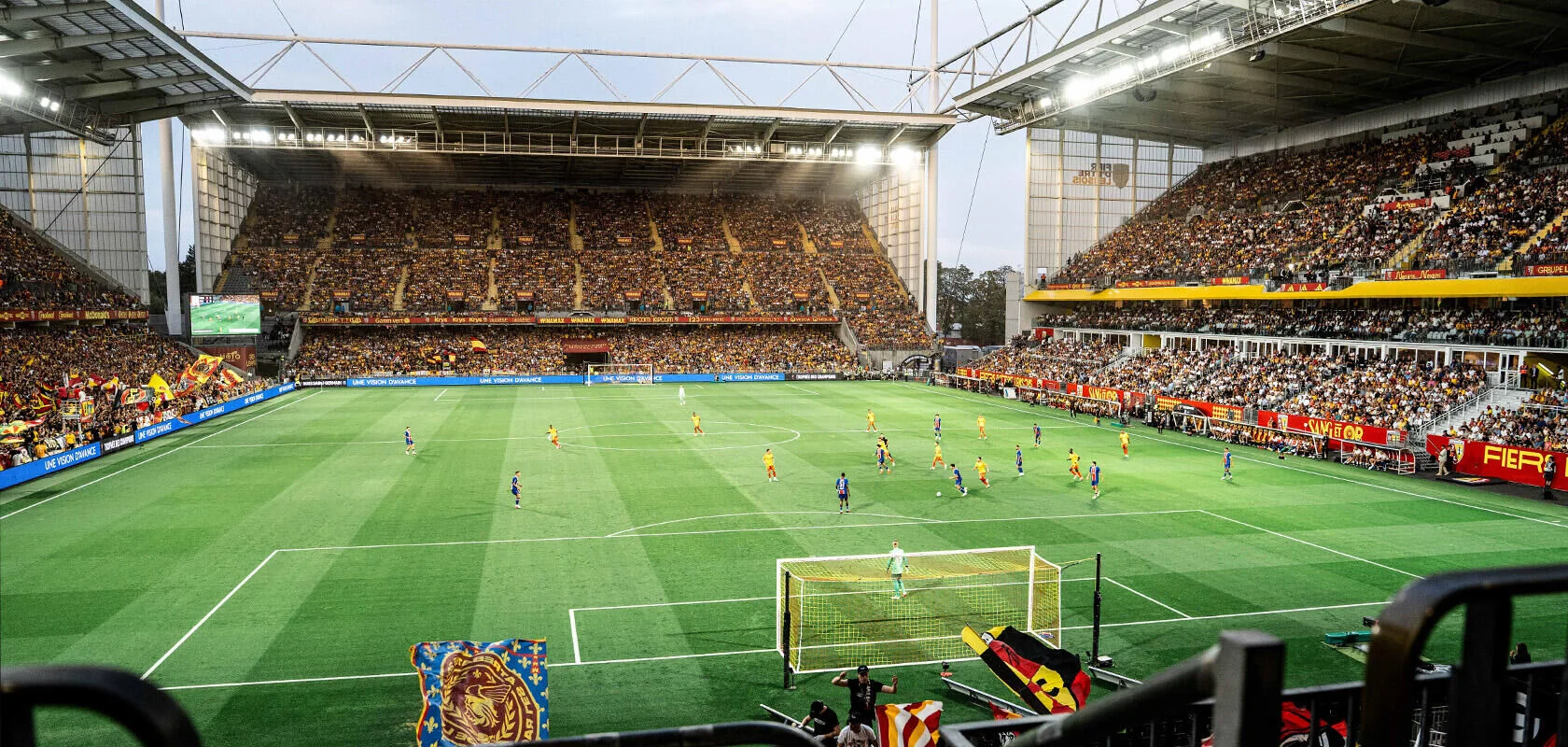
RC Lens is the Sang et Or club of northern France, famous for Bollaert-Delelis, its mining-region identity and the Derby du Nord against Lille. For a first match, understanding the stands, colours and halftime song is as useful as recognising the badge. This guide explains that culture and points you toward the club’s current ticket and stadium information.
RC Lens belongs to the mining country of northern France
RC Lens is Racing Club de Lens, the football club of Lens in Pas-de-Calais, northern France. Its familiar red and gold colours, the Bollaert-Delelis stadium and the rivalry with Lille belong to a regional identity that is older than any current player or league position. Understanding that setting makes a first Lens match more meaningful than simply recognising the badge.
The club’s foundation history starts with local students playing football and the creation of Racing Club Lensois in 1906. This was a community football project before it became a professional institution. The founders’ early playing colours were green and black, connected to the Place Verte and the local coal industry.
The mining relationship subsequently became much more than a symbolic association. In its 2025 mining-heritage statement, the club records ownership by the Compagnie des Mines de Lens from 1934 to 1969. The stadium itself was built through the mining company, with 180 miners involved in its construction. The connection therefore ran through land, labour and the organisation of the club, rather than merely through a later marketing slogan.
That history explains why references to the mining basin recur around Lens football. They express a relationship between the team and the communities that sustained it. A modern professional squad changes through transfers and coaching decisions; the home supporters’ regional memory remains. It gives the club a source of continuity even when its sporting fortunes move between divisions or different generations of players.
It would nevertheless be misleading to assume every supporter is a miner or to turn the whole city into a historical stereotype. The contemporary fanbase includes people with many occupations and backgrounds. Mining heritage is a shared reference, not a membership requirement. For a visitor, recognising its importance is more useful than pretending to know the personal history of everyone in a red and gold scarf.
The connection is also maintained through deliberate club activity. In August 2025, Lens announced a partnership for the 2025/26 season with the Centre Historique Minier at Lewarde to transmit the region’s heritage, including visits by club teams. That dated initiative shows how the history is introduced to players who may arrive from elsewhere. It does not require them to have grown up in the mining basin to understand the people they represent.
This gives Lens a distinctive place within the broader Ligue 1 club landscape. Its reputation cannot be reduced to stadium noise alone. The venue, colours and songs all carry parts of the same local story, and that story helps explain why following the Racing is a source of identity as well as an interest in the week’s result.
Understanding Bollaert-Delelis and its four stands
Why the stadium carries two names
Bollaert-Delelis is the home of RC Lens, not a neighbouring club or a separate team name. The club’s official stadium account dates its inauguration to 18 June 1933. Félix Bollaert, associated with the mining company and the project’s creation, gave his name to the ground after his death in 1936.
André Delelis’s name was added after his death in 2012. The long-serving mayor was among the figures involved in rebuilding the Racing after the mining company withdrew and the club faced its 1969 crisis. The full stadium name thus connects two different chapters: the industrial resources behind the original ground and the civic commitment that helped preserve the club.
That is more informative than treating the name as a commercial label. Supporters saying “Bollaert” are usually using the familiar shorthand for the same stadium. A ticket naming Bollaert-Delelis does not send you to a newer ground somewhere else. Historical accounts using Félix-Bollaert also refer to this venue’s earlier name.
The ground’s present official capacity is 38,223, but capacity alone tells a visitor little about the experience of a particular ticket. Its four stands have distinct locations and uses. The important choice is where you will watch from, whether the section is seated or standing, and which supporter allocation your booking belongs to.
Choosing between the kop and the other stands
The official stand guide identifies Marek-Xercès, Lepagnot, Trannin and Delacourt. Bollaert’s defining arrangement is the lower Marek kop along the side of the pitch, with Xercès above it. Unlike a conventional end behind a goal, this places a core of active support beside the length of the playing surface.
| Stand | Useful orientation |
|---|---|
| Marek-Xercès | Side stand; lower Marek kop, upper Xercès. |
| Lepagnot | Opposite side; includes press and hospitality facilities. |
| Trannin | End stand; includes family areas and the traditional visitor sector. |
| Delacourt | Opposite Trannin; active standing support in the lower section. |
For a first visit, “best seat” depends on what you want from the match. Someone studying the team’s shape may prefer an elevated side view, which makes distances between defensive and midfield lines easier to follow. A supporter seeking sustained participation may value an active section more highly. Neither preference makes the other a lesser football experience.
Standing, flags and nearby supporters can affect what is visible at different moments. If uninterrupted sight of the pitch matters, inspect the precise tier and section before buying rather than relying on the stand name alone. Lower and upper parts of the same side can give noticeably different perspectives on the far touchline and the spaces behind defenders.
Travelling away fans should follow their own club’s allocation and instructions. The description of Trannin as the traditional visitor location is orientation, not an invitation to buy any available home ticket in that stand. Family, home-support and visitor areas serve different purposes within the same larger structure.
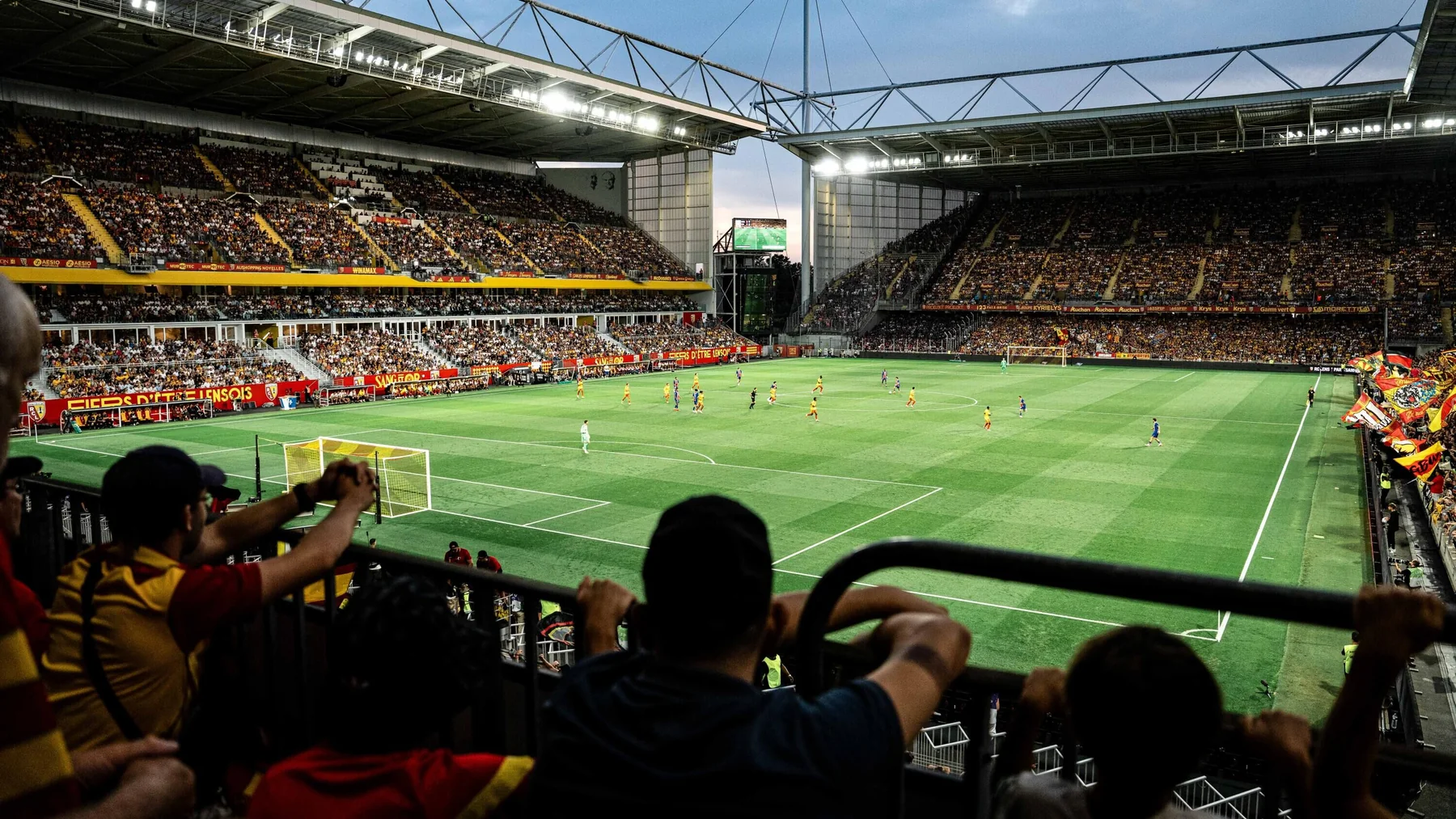
These choices also explain Bollaert’s television character. Crowd activity can come from a sideline as well as from the ends, so a broadcast angle may catch red and gold movement directly behind passages of play. The atmosphere is distributed through an identifiable stadium layout, not produced by an anonymous noise track.
Sang et Or: the colours, songs and crowd rituals
Les Sang et Or means “the Blood and Gold”. It is the nickname tied to Lens’s red and gold colours, not a second club competing in the same city. You will hear it in coverage and see it on scarves, banners and descriptions of the team. “The Racing” and “the Sang et Or” commonly refer to the same football institution.
Red and gold were not the original 1906 colours. In its official colour-centenary account, Lens dates the change to 1924 and connects the choice to Spain’s flag and the historical Spanish presence in Artois. That is the club’s stated historical explanation; the literal English translation of the nickname alone does not establish a different story about miners’ blood.
Colours can carry several associations once generations of supporters adopt them. Their significance today is not limited to the circumstances of the first kit. Red and gold identify the side on the pitch and the people supporting it in the stands, and provide a common visual language when individual designs, manufacturers and sponsors change.
The crowd’s role is acknowledged within the club’s own presentation of Bollaert: number 12 is not worn in tribute to the supporters as the twelfth player. That symbolism expresses the importance of support. It should not be confused with a statistical claim that noise alone determines a result or that playing at Bollaert guarantees a home victory.
The mining memory behind Les Corons
The best-known musical connection is Pierre Bachelet’s “Les Corons”, a song about the mining region. The club’s February 2025 tribute explains that supporters had sung it since the 1980s and that the whole stadium joined in on 19 February 2005, four days after Bachelet’s death. It describes the song as a collective halftime ritual at home matches.
The timing matters. A halftime song belongs to a moment when the crowd has already experienced the opening period: a lead, a setback or an unresolved contest. It reconnects the football afternoon with something shared beyond that immediate score. For a newcomer, staying attentive through the interval can therefore reveal a part of Lens culture that highlights packages focused only on goals may miss.
The song’s place at Bollaert is also different from a chant invented to mock a visiting opponent. It expresses memory of a community and its work. That gives it meaning on an ordinary league day as well as on a major European night. You do not need to know every word before visiting to recognise why the collective response matters.
Follow the supporters’ lead respectfully and enjoy the rhythm of the occasion. The atmosphere is part of attending the football, alongside the match itself; a phone clip can preserve a moment, but watching the crowd and game together explains how that ritual fits into the whole afternoon.
Why Lille is Lens’s defining rival
A regional rivalry with a long cup history
Lens’s defining rivalry is with LOSC Lille, the Derby du Nord. It brings together two major northern football identities, but the clubs are not from the same city or even the same department: Lens is in Pas-de-Calais, Lille in Nord. Regional proximity supplies a setting for the contest; decades of football supply its weight.
Lille’s official rivalry retrospective explains that northern derby football once included several other local opponents. The Lens–Lille rivalry developed within that wider landscape rather than appearing fully formed at either club’s foundation. That history is more useful than a simplistic claim that every person in the two cities belongs to opposing social classes.
One major early landmark was the 1948 Coupe de France final. Lille beat Lens 3–2 at Colombes, with Lens then a second-division side. A meeting on that national stage gave the rivalry a memorable contest beyond an ordinary regional fixture. It also showed that cup football could bring the neighbours together despite their different league levels.
The connection gives supporters a reference point across generations. A derby is a test against a familiar rival, not merely against whichever team occupies the nearest place in the current table. Winning can carry a particular emotional value even when the season’s larger objective is European qualification, survival or a cup run.
That extra meaning is best understood through football and local identity, rather than through assumed hostility between all supporters. You can appreciate the rivalry without adopting stereotypes about the cities or treating a visitor as an enemy. The contest is between clubs on the pitch; the crowd’s commitment supplies context for its importance.
What a derby result does and does not tell you
The cup meeting on 4 January 2022 illustrates how a derby can acquire its own story. Lille led 2–0 through two Amadou Onana goals, but Seko Fofana scored twice for Lens, including the late equaliser. The match finished 2–2, and Lens advanced 4–3 on penalties. The official Lens report records Fofana’s decisive shootout kick and Wuilker Faríñez’s save from Renato Sanches.
That match is remembered as a Lens success, but its score needs both parts: the draw in the game and the shootout victory that decided qualification. Calling it simply a 4–3 match would erase the comeback and confuse penalties with goals scored during play. It did not award Lens three league points, because it was a Coupe de France tie.
The sequence also shows why the emotional force of a derby should not replace analysis. Lille’s early two-goal lead still had to be protected; Lens still needed actual chances and finishing to recover. A strong crowd cannot supply an equaliser without the players executing it, and a rival’s reputation cannot prevent a late change in the match.
For a future meeting, look at the relevant teams and season rather than expecting the 2022 scenario to repeat. Coaching, player availability and form change. The rivalry explains why the fixture matters to supporters; it does not forecast its score.
Keep the current league results and standings alongside that historical context. A derby win can be an important moment, while the table remains the broader measure of a league campaign.
Planning a first Lens match without relying on old stadium advice
Begin with a specific home fixture, then look for an official ticket that suits your group and preferred section. A stadium guide’s old price range does not establish the tariff for a new opponent, competition or seat category. A historical statement that Bollaert rarely sells out is equally poor evidence of today’s availability. The current sale is the useful information.
The club’s official ticketing platform is the starting point. Sales can include priority periods before any remaining places are offered more widely: the 2026/27 European campaign announcement gives a dated example. An announced fixture does not mean every section is immediately available to every buyer.
Lens also has a club resale service. Check that channel when an initial sale has no suitable seat, but treat any return to sale as availability dependent. The platform provides a club-run process; it cannot create an unlimited supply of tickets. For a group, finding one available seat is also different from finding several together.
Read the exact entry instructions attached to the ticket, including the stand and access method. Save access to the official account or app before reaching the gates. A picture of a confirmation is not a substitute for understanding which valid ticket format the club requires. If you need accessible facilities or are travelling in an away allocation, arrange the relevant booking through the appropriate club channels.
For the journey, the current stadium access page describes the 2026/27 shuttle arrangement from the Arena Stade Couvert at Liévin and the CRVO parking site in Lens. It also explains the app-based QR access. Use that guidance for the actual match rather than assuming that a parking area shown on an old map is open to any driver.
Confirm the kickoff before planning the return journey. The today page helps identify the immediate league programme, and the Ligue 1 ticket guide explains the wider buying process. European and cup games belong to different competition schedules, so check the ticketed event itself as well as the club name.
If no suitable match ticket is available, a stadium visit is a separate option. The club links to the tourism office’s Bollaert Tour, which offers guided visits and publishes bookable dates. A tour is not match admission, and its route can change with stadium activity. Check the published accessibility information before booking.
Allow time to experience the ground as well as the game. Knowing why the stands carry their names, what red and gold means, and why the crowd’s song matters gives you something to recognise from arrival through halftime. The strongest first visit combines a workable booking with an understanding of the club and community behind it.
Loading comments…