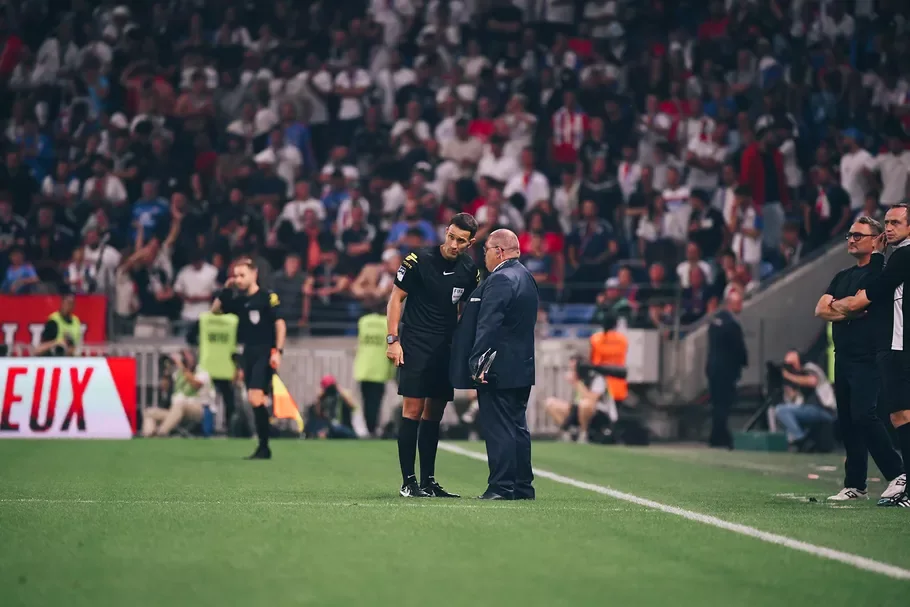
Lyon's 4–0 win over Rennes on 19 September 2026 was temporarily interrupted because of an insulting banner aimed at Saint-Etienne, Lyon's rival. Warnings to remove the display were followed by a break that sent the teams to the dressing rooms. Reports put the interruption at about 13 to 15 minutes. Play resumed, so this was a completed match rather than an abandoned fixture.
The incident raised a second question beyond why the players left: would comparable conduct lead to comparable interventions elsewhere? Lyon captain Corentin Tolisso called for consistency while expressing frustration that the pause disrupted a strong first half. Understanding that argument means separating the banner's target, the officials' authority, the captain's opinion and any later disciplinary decision. This account uses information verified through 1 October 2026.
What interrupted Lyon's win over Rennes?
Lyon's match against Rennes at Groupama Stadium on 19 September 2026 was interrupted over an insulting banner aimed at Saint-Etienne. The problem came from the stands rather than a disputed goal or a player injury. The teams briefly returned to the dressing rooms, then came back to complete the fixture. Lyon won 4-0. For a viewer who encountered a “suspended” score during the evening, that last distinction is essential: the label described an interruption, not the final outcome.
The warning, the dressing-room break and the restart
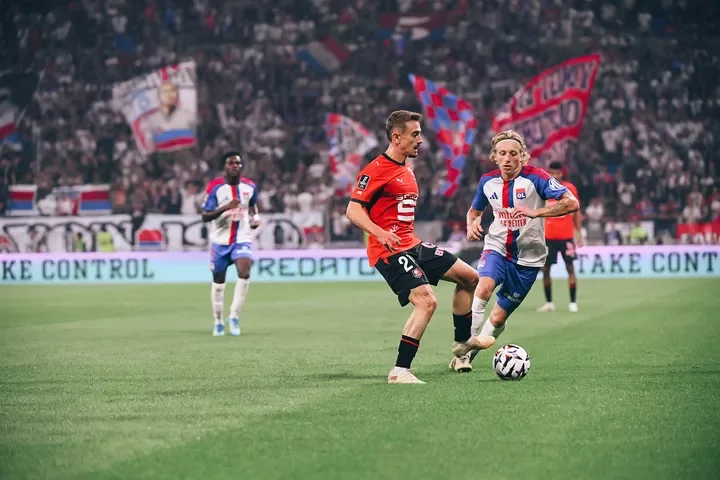
The official Rennes match record puts the stoppage in the context of a difficult first half. Ernest Nuamah scored in the seventh and thirtieth minutes, giving Lyon a 2-0 lead. The record then describes a banner-related interruption involving the refereeing team and delegates, a return to the dressing rooms, and resumption. Lyon retained the two-goal advantage at half-time.
beIN Sports reports that the stadium screens reminded supporters that insulting messages were prohibited, and that players and match officials left the pitch temporarily. The visible warning matters because it explains why this was more than an ordinary pause in play. The stadium was being asked to remove a source of disruption before the football continued.
Reports use different durations. The readable introduction of Le Progrès' report says thirteen minutes; Rennes' timeline says play resumed fifteen minutes later, and GOAL describes fifteen minutes. The accounts agree on a substantial first-half interruption. They do not provide a single independently verified clock measurement, so an approximate quarter-hour is a more useful description than treating one figure as unquestionable.
After the restart and interval, Lyon extended the lead through Zachary Athekame in the forty-eighth minute and Corentin Tolisso in the seventy-sixth. The completed score establishes that the fixture resumed successfully. It does not tell us that every spectator understood the announcements, or that the delay carried no inconvenience. Those are different questions from whether the football result stood.
Why Saint-Etienne was involved in a Rennes fixture
The banner's target was Lyon's regional rival, not the visiting Rennes team. That is why reading the incident only through the two clubs on the fixture list can be confusing. A supporter display can address an absent rival while another opponent is on the pitch. The match being interrupted was still Lyon–Rennes; Saint-Etienne did not become a participant in the game because its name appeared in the stand.
Contemporary reporting describes a vulgar Spanish insult rather than a football slogan about the immediate contest. There is no need to reproduce it to understand the dispute. The relevant question is what officials did when an insulting display remained visible, and why those watching felt the response was appropriate or disproportionate. Calling it an anti-Saint-Etienne banner identifies the target without making unsupported claims about the beliefs of every supporter in the stand.
The wider rivalry explains why the message appeared, but it does not settle whether the intervention was justified. A display may be familiar to those participating and still create a problem for organisers, players or other spectators. Equally, a report of an offensive message does not by itself establish violence, racial abuse or a specific disciplinary offence. To understand the event fairly, keep the observed trigger, the officials' response and the later arguments separate.
Who can stop a match over a stadium incident?
The useful distinction is between the person who draws attention to an incident and the person who controls play. A captain speaking to the crowd is visible on television, but that does not make him the decision-maker. Likewise, a warning delivered through a stadium loudspeaker communicates a demand; it does not give the announcer independent authority to determine the match's outcome.
The referee's authority and the delegate's role
The general legal starting point is IFAB Law 5. It gives the referee authority to enforce the Laws of the Game and to stop, suspend or abandon a match for offences or outside interference. The referee also records incidents and provides a report to the relevant authorities. That establishes a power to intervene beyond ordinary tackles and offside decisions. It does not, on its own, tell us which description should be attached to this particular banner.
For the Lyon incident, 20 Minutes' on-site account identifies delegate Jean-Marc Roybier as raising the problem with referee Mathieu Vernice, who informed the captains. It also reports an announcement describing the banner as discriminatory. That wording belongs to the reported intervention; it does not establish that the display contained a racist or homophobic message. An insulting rivalry banner should not be assigned a more specific category without evidence.
The LFP's accessible 2025/26 competition regulations provide useful background, with a clear version limit. Article 549 describes interruption for serious incidents, potentially including a return to the dressing rooms. It allows a crisis group to be activated by the referee, delegate or public authority, while assigning the final sporting decision to the referee, subject to an exception for serious public-order risks. This previous-season document should not be presented as a verified, complete account of the rules applicable in September 2026.
The reporting therefore explains how the intervention reached the pitch, while the general Laws explain who controls the game. Neither supplies a published ruling that resolves every disagreement about proportionality. A reader can accept that officials have a stopping power and still ask for a clearer explanation of its use. Those are compatible positions, and treating them separately makes the debate more precise.
A temporary interruption is different from abandonment
Leaving the field can look final, particularly to someone following a score notification without commentary. Here, however, the players returned and completed the match. There was no need to infer an awarded result from the score at the moment of the break. Lyon's second-half goals and the final whistle belong to the same fixture that had been interrupted.
IFAB Law 7 distinguishes lost playing time from abandonment. It provides for allowance for time lost through other causes, including outside interference. Its abandoned-match provision also leaves room for competition rules or organisers to determine an outcome other than replaying the match. A pause lasting roughly a quarter of an hour therefore does not, by itself, establish an automatic replay, forfeiture or points penalty.
For a spectator, the immediate question during a break is whether play will resume. The later question is whether an incident leads to disciplinary action. These operate on different timelines. Completion answers the first question for Lyon–Rennes; it does not settle the second. Equally, a warning about possible abandonment is evidence of what officials were trying to prevent, rather than proof that abandonment ultimately happened.
What does Tolisso's consistency argument establish?
Tolisso's reaction is more nuanced than a headline suggesting that he simply opposed stopping the game. In Foot Mercato's mixed-zone reporting, the captain supported intervention but asked for comparable treatment across matches. He also explained that the break had arrived while Lyon were playing well at 2–0. The complaint combined a principle about consistency with an immediate sporting concern about losing momentum.
The same report says he declined to disclose the content of his conversation with supporters. We should therefore resist filling that gap with an imagined agreement, threat or promise. The visible attempt to resolve the situation is enough to explain his involvement. His account of speaking to the delegate expresses his experience of the exchange; it is not a substitute for an official incident report.
A claim of uneven enforcement needs comparison. To establish that Lyon received different treatment in a materially equivalent situation, it would be necessary to examine other incidents and the officials' responses. A clip of a hostile chant elsewhere may start that investigation, but it rarely supplies everything needed to finish it. Was the message comparable? Were demands to remove it ignored? Did the behaviour continue after warnings? What conditions did officials consider at the time? Without those details, a collection of clips can illustrate frustration while leaving the central allegation untested.
That is why the captain's position should be attributed to him. His call for consistency is a legitimate subject for discussion, but the available accounts do not prove a league policy of targeting Lyon. Nor does the absence of such proof mean spectators must accept unclear explanations. A league can be asked to communicate its threshold and the reasons for an intervention without first being accused of a demonstrated campaign against one club.
There are also two different kinds of consistency at stake. One concerns the standard applied to the message: which displays or chants require action? The other concerns the response after that standard has been crossed: when are warnings sufficient, when do players leave, and what permits a restart? This is an analytical distinction rather than a finding about an unpublished LFP instruction. It helps explain why repeating that insults occur in many stadiums does not fully answer how a particular intervention should proceed.
The football outcome gives the complaint context without deciding it. Tolisso eventually scored Lyon's fourth goal, and Rennes' own match account includes Adrien Thomasson's admission that the visitors had been dominated across the game. Rennes did not turn the enforced break into a comeback. That observation is narrower than saying the interruption had no effect: the winning team still experienced an unwanted pause, and thousands of people still waited for clarity.
A convincing discussion can therefore hold three points together. The banner triggered a real intervention. Lyon's captain wanted similar incidents handled consistently. The resumed match produced a decisive Lyon victory. None requires an unsupported conclusion about the motives of the officials, and none makes the other two disappear. Keeping those points separate gives supporters a stronger basis for asking precise questions about future decisions.
What is confirmed about discipline and the next match?
The most important date for this part of the story is the reporting cutoff: 1 October 2026. A prediction made immediately after the match should retain its original status until an actual decision is verified. That is particularly important when a possible punishment would affect people who already have tickets. A confident headline is insufficient evidence that their stand will be closed.
Reported expectations versus a published punishment
Lyon Foot's 20 September report discussed potential sanctions, including a possible closure of the north stand. Those were expectations about what might follow. They were not a published LFP order specifying a sanction, affected seating areas or an effective date.
The strongest specific official update available here is the LFP's disciplinary publication of 23 September. Its Lyon–Rennes entry withdraws Noah Nartey's yellow card following review of the images and the referee's report. The publication does not announce a banner-related fine or stand closure for Lyon. It lists the next commission meeting for 14 October. That notice is not a promise that the Lyon banner issue will be decided on that date.
The yellow-card decision concerns an individual incident on the pitch. It cannot be used as evidence that the league punished the banner, cleared it, or closed a separate stadium case. Sharing the same fixture name does not make two disciplinary subjects interchangeable. The same caution applies to a punishment listed elsewhere in the publication for a different club: its existence does not transfer its terms to Lyon.
As of the cutoff, a later verified order concerning this banner has not been established for this article. The appropriate conclusion is limited: we can explain the interruption, identify the official card correction and describe the reported possibility of further action. We cannot supply a confirmed fine, a number of closed matches or a section closure from those materials.
Lyon's own reaction also belongs in the record, with its attribution intact. In Lyon Foot's 22 September account of the club statement, OL regretted the interruption and reaffirmed respect and fair play, including within rivalries. That is a statement of the club's position. It is not the disciplinary commission's verdict.
What spectators should verify before returning
Anyone planning another visit should check the latest official club message and the information attached to their booking, rather than make a travel decision from an early sanctions forecast. A later decision, if one is issued, needs to be read for its practical scope. The stadium name alone is not enough: the relevant details are the stand or seating blocks, the competition, the affected match and when the measure takes effect.
Those details can change the meaning of an announcement considerably. A suspended punishment is different from a closure that applies immediately. A measure concerning one section does not automatically mean the whole ground is closed. A report about an earlier fixture also does not tell a supporter whether a ticket for a later match has been replaced, moved or cancelled. Such consequences require the club's actual ticket instructions.
Use OL's official ticketing service for the booking and club communications for match-specific access updates. Our Ligue 1 ticket guide explains the broader buying process, while the fixture schedule helps identify the game concerned. An interruption from September should not become an assumed restriction for every future match at the venue.
For people simply trying to understand the original broadcast, the answer is already clearer. Lyon–Rennes was temporarily stopped over an insulting anti-Saint-Etienne display and the response to demands to remove it. It resumed and ended 4–0. The remaining discussion concerns how interventions should be applied consistently and what, if anything, the disciplinary authorities subsequently order. Those questions deserve their own evidence rather than an invented ending to the match report.
Loading comments…