
Checked 30 October 2026, before Lille–Lens. Florian Thauvin has a credible case for France consideration after scoring and creating the winner in Lens’ comeback against Paris FC. His club form explains the renewed discussion; a recall still depends on the role and balance the selector needs. Here is what the performance, the statistics and his own comments actually support.
What did Thauvin actually say about France?
Thauvin made his ambition clear after Lens beat Paris FC: he wants to play for France again, and the prospect of working with Zinédine Zidane appeals to him. In the interview collected at Bollaert-Delelis by Eloïse De Mester, he connected that ambition to his existing history with the national team. This was a player expressing a wish after an influential performance, rather than announcing a conversation that had guaranteed selection.
His remarks also acknowledged that the decision belongs to the coach. That distinction matters when a headline turns a post-match answer into an apparent demand. Wanting the opportunity, believing his football supports the case and actually receiving a call-up are separate steps. The evidence from Lens makes the discussion worthwhile; it cannot complete the final step on the selector's behalf.
There is an important chronological correction for anyone returning to the story after several years. Thauvin already came back to France in 2025. The FFF's player record lists 13 senior appearances and two goals, with his latest appearance on 16 November 2025 against Azerbaijan. Describing October 2026 as the end of an uninterrupted absence since 2019 would therefore misidentify the current question. This is about earning another opportunity after that return.
The supportive comments beneath the Lensois interview show that some Lens supporters see a strong international case. They are a small discussion beneath a club-focused story, so they cannot establish what all French supporters think. The more useful response is to examine the football argument they are making: whether the goals, creativity and responsibility he shows for Lens would meet a need in a France squad.
That is the standard used here. Thauvin's form warrants consideration, but consideration is not an automatic starting place. Assess the role, the opposition and the type of contribution France would need from him. Those questions give the recall debate more substance than either dismissing a 33-year-old on age alone or treating a memorable club performance as an instruction to select him.
The Paris FC comeback showed two different attacking weapons
The setting makes the performance more meaningful than an isolated highlight. Lens were at home, but Paris FC arrived with 14 points from seven league matches and a share of the lead, according to the club's official match centre. Lens had also played in Bruges three days earlier. A comeback against an opponent enjoying a strong start was useful evidence of influence under pressure, rather than simply a comfortable favourite collecting expected points.
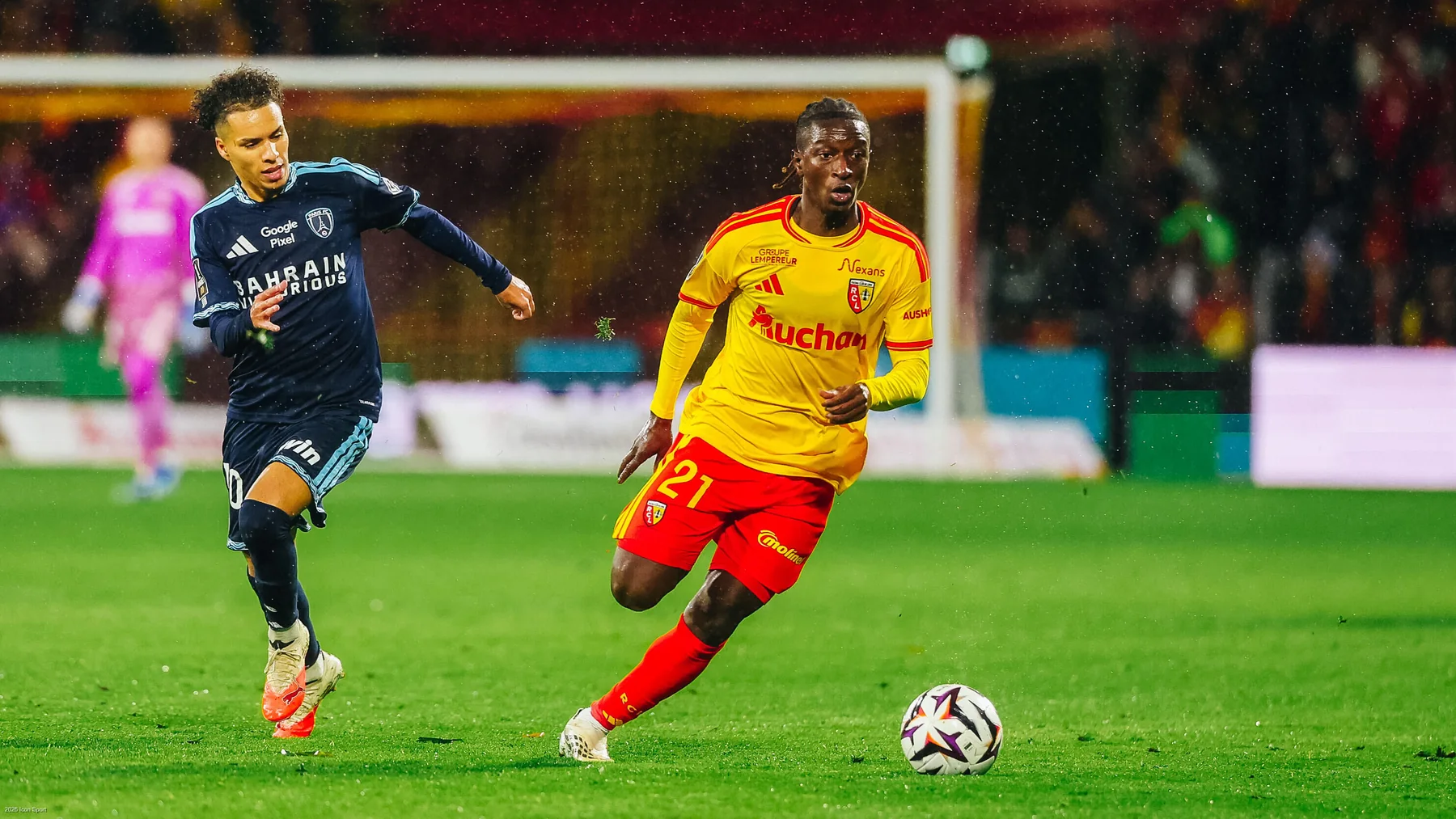
A left-footed finish to bring Lens level
Paris FC led at the interval after Luca Koleosho's first-half stoppage-time goal. Lens' response after the hour began with Matthieu Udol switching play towards the right. Thauvin combined with substitute Thorgan Hazard, received the return and moved onto his left foot to finish. The official Lens report describes both the combination and the strike; reducing the goal to individual inspiration would leave out how the opening developed.
The sequence illustrates the attraction of a left-footed attacker receiving on the right. He can threaten the outside route while keeping a shot towards the centre available. A teammate returning the ball adds another decision for the defender: follow the passer, protect the shot or recover towards the penalty area. This is a tactical reading of the recorded move, rather than a claim about every attack Thauvin makes.
It also gives the recall argument a useful distinction. The finish shows execution, but the exchange shows he can work through another player instead of requiring every possession to become a dribble. That combination matters when assessing whether a club's leading creator could contribute alongside other demanding attackers in an international side.
The final pass that turned a draw into a win
The winner required a different action. Lens' report places Thauvin in the left channel, delivering a firm cutback. Florian Sotoca let the ball run, and Hazard controlled and finished. Thauvin had helped bring Lens level as the scorer; now he supplied the pass that let a teammate settle the game. The outcome depended on those complementary decisions, including Sotoca's movement and Hazard's finish.
beIN SPORTS' coverage identified the occasion as Thauvin's 300th Ligue 1 appearance. A goal and an assist made the milestone memorable, but the stronger football point is the variety: he affected the score through finishing and through service. Defenders facing that combination have more to consider than protecting against a single favourite action.
One home match still has limits as an international audition. It demonstrates useful attacking tools in a successful Lens performance; it does not establish that the same spaces or combinations will appear for France. The selection question begins with those tools and asks how to reproduce their value in a different team.
Read the season numbers in the right competition
Thauvin's strong start has generated several different statistical summaries. They should not all be treated as the same measure. The league's Matchday 8 review, published on 26 October, credits him with seven league assists in 2026/27. The post-match Lens account also gives seven assists from eight league appearances. Le Parisien's 25 October report pairs that assist total with four league goals.
The official Lens player profile, checked on 30 October, likewise lists four goals and seven assists from eight appearances. It identifies three of those goals as penalties. Taking responsibility from the spot is valuable, but four total goals should not be described as four goals from open play. That distinction sharpens the analysis of what his shooting and chance creation contribute.
There is also a genuine disagreement within league-only coverage: Le Parisien's assists table displayed eight when checked on 30 October. The two figures should be attributed rather than quietly blended. The dated official round-up is the basis for the seven-assist figure here; these pages do not establish why another table gives eight. That uncertainty does not erase the underlying point that his start combines scoring with substantial creative output.
A separate figure in the Lensois interview coverage is six goals and eight assists in 12 appearances across all competitions. That is a broader set of matches. Dividing those six goals by eight league appearances would produce a misleading rate, because the goals and appearances would no longer describe the same competition. A European or domestic cup contribution can strengthen the overall form discussion without becoming a Ligue 1 goal.
Even a correctly defined assist tally needs context. An assist records a successful final connection to a goal; it cannot explain every pass that helped create the opportunity. Conversely, an excellent delivery that a teammate fails to finish will not provide the same reward in that column. That is why the Paris FC sequences are useful alongside the totals: they show the type of decision behind the contribution.
Eight league appearances remain an early-season sample. They can make a persuasive case for closer attention without supporting a confident prediction of his eventual full-season total. For comparisons with other France candidates, use the same competition scope and period, then consider role and minutes. Our Ligue 1 statistics guide explains how to keep those comparisons meaningful.
Where would he fit in France's attack?
There is a new selector to persuade. The FFF appointed Zidane in July 2026 to succeed Didier Deschamps. Thauvin's 2025 return is relevant experience, but it cannot guarantee a place under a different coach. The question is how his present strengths could complement an international side, rather than whether he deserves a reward for topping a particular statistical column.
A creator needs the right surrounding movement
The Paris FC match offers a practical starting point. Thauvin's combinations worked because other players supplied different things: Udol moved the ball across the field, Hazard exchanged passes and attacked the finish, and Sotoca allowed the winning delivery to reach its target. A creator is more dangerous when teammates give defenders several problems at once. Take away the width, the run or the player occupying a central defender, and the same passer may have fewer useful choices.
For France, that makes the surrounding roles part of the assessment. If Thauvin receives between the touchline and the centre, someone needs to stretch the defence or threaten behind it. If several attackers all come towards the ball, their technical quality alone will not guarantee space. A possible role should therefore be judged alongside the proposed striker, the other wide attacker and the support from midfield. These are conditions for a fit, rather than a prediction of Zidane's next formation.
The starting lineup is only one possible use. A squad can also need a player capable of changing the final pass when an opponent defends deep. Thauvin has a dated example of making a short France appearance count: the FFF's October 2025 Azerbaijan match report records his arrival from the bench and subsequent goal, after linking with Théo Hernandez. That does not promise a repeat, but it shows why a substitute role can be a serious sporting contribution.
Selection also depends on the work without the ball
Goals and assists leave another part of the argument unanswered. A national-team attacker must fit the way the side presses, covers passing lanes and recovers when possession is lost. An isolated chase can be energetic yet unhelpful if the rest of the team cannot support it. Likewise, protecting a dangerous counterattack may require a player to hold a position instead of following the ball.
Lens' performance against Paris FC was collective in this respect. The club report highlights the midfield's pressure and the team's control of territory, alongside Thauvin's attacking contribution. That context should prevent the recall debate from treating him as though he created every opportunity independently. Our Lens squad guide explains the surrounding roles in more detail.
There is no basis here for inventing an individual sprint total or declaring him a better defensive option than a named rival. The fairer test is whether his movement supports the team's plan throughout an appearance, including quieter spells. If his attacking value comes with a workable collective balance, the case strengthens. If the proposed role merely duplicates something the squad already has, a strong club run may still leave him outside the final selection.
Experience helps only if the present level holds
Thauvin's age gives the discussion an obvious storyline, but it is a poor substitute for assessing the player. His official Lens profile confirms he is 33. That number alone establishes neither that his best football is behind him nor that experience has made every part of his game better. The relevant question is what he can still execute, repeatedly, in the role the team needs.
After the Paris FC game, he described feeling exceptionally strong in his football. Hazard's on-site interview also praised his captain's leadership and daily work. Those are useful perspectives from the player and a teammate. They should be understood as their assessments, rather than an independent measurement of his physical level against every earlier season.
The comeback supplies a more concrete way to discuss maturity. Lens were behind, yet the decisive contribution did not consist solely of Thauvin trying to finish every attack himself. He combined for the equaliser and later supplied the winner. Choosing when to take responsibility through a shot and when to serve another player is relevant leadership on the field. It can be evaluated through actions, rather than inferred simply from wearing the armband.
His international honours provide background too. The FFF records the 2013 Under-20 World Cup and the 2018 senior World Cup in his career. They explain his attachment to France, but a youth title and a senior title describe different competitions and stages of development. Neither medal requires a later coach to select him regardless of the current team's needs.
Experience becomes an advantage when it improves a decision under present pressure: managing a difficult spell, understanding a substitute's movement or staying useful without constant possession. It can also help a player accept a smaller role than the one he holds at his club. Those are plausible reasons to consider an experienced attacker. They still need to appear in his football across different match situations. The recall argument is strongest when it rests on that continuing contribution, with his career explaining the player rather than deciding the selection.
What should supporters watch next?
The next useful evidence is another complete performance. Watching only the moment when a goal is scored makes a recall debate swing too easily between certainty and dismissal. Follow how Thauvin gets involved before the decisive action: where he receives, whether he can turn, which teammate makes the next run and how quickly he becomes useful again after releasing the ball. Those details help explain whether a strong result reflects a repeatable contribution.
The Lille derby is an away test, not a final audition
As of this article's 30 October cutoff, Lens' next match is away to Lille that evening at 21:05 local time, at the Decathlon Arena–Stade Pierre-Mauroy. The current Lens match centre confirms the fixture and places Lille third on 15 points, two ahead of seventh-placed Lens. Lens arrive with three consecutive league wins. This is an opportunity to sustain a recovery against a nearby rival in the table, as well as a regional rival.
The change from Bollaert to an away ground supplies a different setting for the argument. If Lens have less comfortable possession, watch whether Thauvin can still help them progress the ball and find a useful final action. If he is followed closely, look for the space his movement creates for someone else. If possession breaks down, consider the team's response around him rather than counting only the times he appears in the penalty area.
The derby should add evidence without becoming a one-match referendum. A goal would strengthen the immediate story, but would not by itself settle how he fits France. A game without a goal would not erase the creative work already demonstrated. The more persuasive test is whether the choices remain effective when the opponent and venue change, and whether that effectiveness continues beyond one emotionally charged evening.
For supporters following the sequence, use the live fixture schedule and the current league table. The positions and gaps described here belong to the pre-derby situation. France's next official squad announcement will establish whether the discussion becomes a recall; Thauvin's post-match wish cannot announce that outcome in advance.
The editorial case is nevertheless clear enough now: his finishing, service and responsibility for Lens make him a credible player to consider. The strongest version of that case allows for a defined role, including one from the bench, and recognises the contributions of the players around him. It asks the selector to assess useful football that is happening now, while leaving the actual team balance and final choice to the coach.
Loading comments…