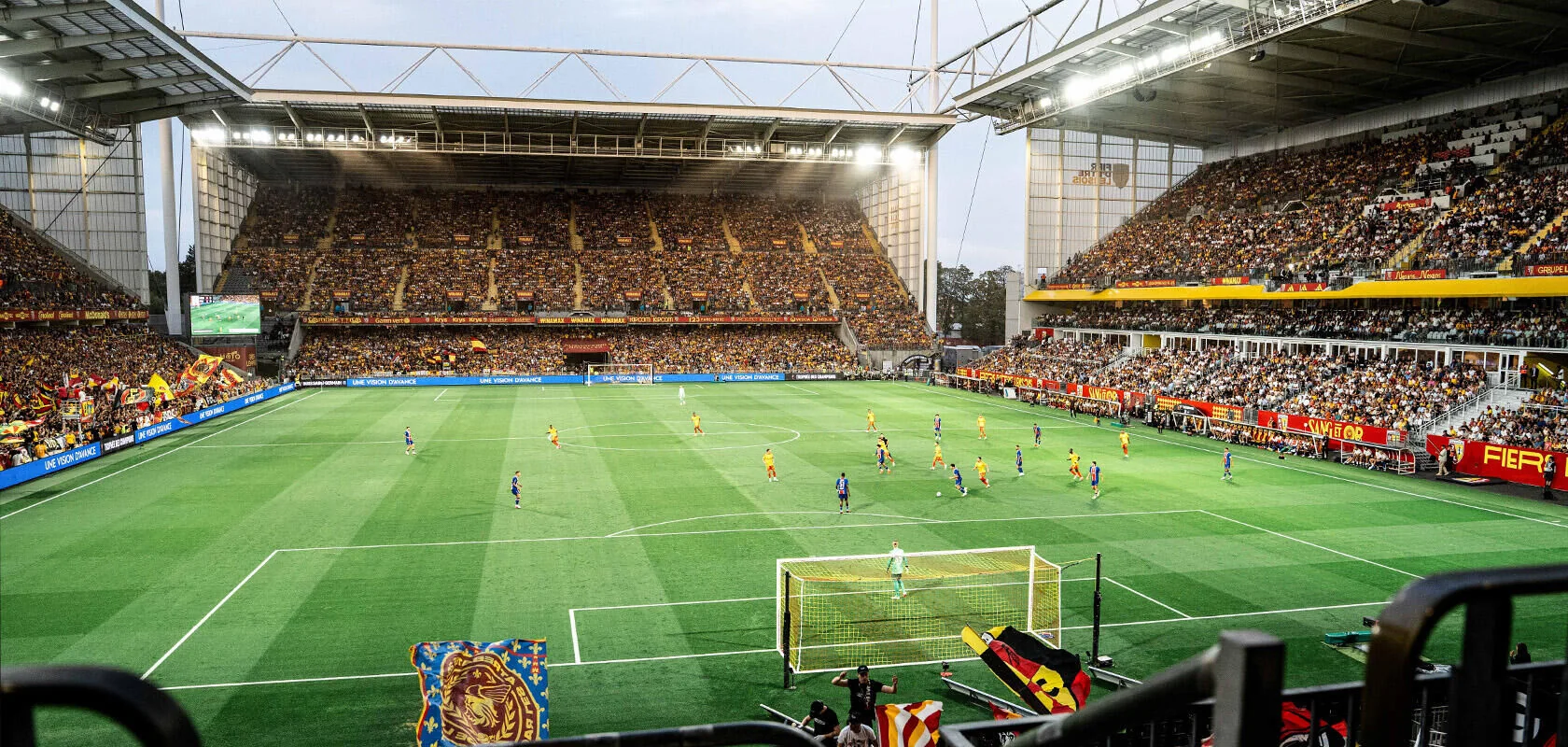
Updated 20 October 2026. RC Lens's 2026/27 squad combines Risser in goal, a flexible defensive group, several central midfield pairings and an attack built around Thauvin's connections with the forwards. Here is who belongs to the current group and what the named players contribute.
The current Lens squad and the players who are actually available
Lens's October squad brings together a young defensive core, experienced wide players and several different attacking profiles. Robin Risser is the reference in goal; Ismaëlo Ganiou and Kyllian Antonio belong to the central defensive group; Yassine Titraoui, Michaël Cuisance and Amadou Haidara are midfield choices; Florian Thauvin connects the creators with the forwards. Understanding the team means putting those names into relationships, rather than assuming that the most familiar eleven automatically form the strongest combination.
The official 2026/27 player directory divides the group into four broad positions and gives loaned players a separate heading. Régis Gurtner, Mathieu Gorgelin and Ilan Jourdren complete the listed goalkeeping group around Risser. The centre-back alternatives include Jonathan Gradit, Samson Baidoo, Maik Nawrocki, Nidal Čelik, Souleymane Sagnan and Jean-Clair Todibo. That depth matters because Lens's recent selections have required three central defenders, so the bench must cover several overlapping duties rather than one substitute for a preferred pair.
On the flanks, Ruben Aguilar, Saud Abdulhamid and Matthieu Udol carry defender labels, while Michał Skóraś appears among the midfielders. Those administrative groupings do not describe their entire match. A wide player can defend beside the centre-backs when Lens retreats and become an extra attacker when possession moves forward. The useful question is where he receives the ball and who protects the space behind him. A directory cannot settle that by itself; the match sheet and the particular opponent supply the missing context.
The coaching context also changed during the season. Lens confirmed Dino Toppmöller's departure on 15 September and named Yannick Cahuzac to take the bench at Monaco. A squad graphic produced before that announcement can still identify players correctly while giving the wrong impression of the current coaching situation. This guide uses the October playing group and dated match examples rather than treating the summer plan as fixed for the full campaign.
Another distinction concerns players who remain Lens assets but are playing elsewhere. The official directory places Rayan Fofana, Rémy Labeau-Lascary, Anthony Bermont and Hervé Koffi in its loaned section. Their connection to the club does not make them immediate alternatives on a Lens matchday bench. At the other end of the pathway, youngster Mezian Mesloub appears with the first-team attackers. His presence offers a development route into senior football, without implying that he has already inherited the responsibilities of an established forward.
Membership is also different from medical availability. In the 17 October win at Troyes, Ganiou left the field with leg discomfort. That dated observation supports checking the next squad announcement; it does not support predicting a return date. The same care applies to every player here. Use the Lens fixtures and results to connect the group to its next game, then read the selected eleven as a set of football choices. Names tell you who belongs; combinations explain what Lens can attempt.
Risser, the back three and the wing-back connections
For a newcomer to Lens, number 40 is the easiest place to begin. Risser arrived in July 2025 after senior loans with Dijon and Red Star, a pathway documented in his official profile. Those experiences put the young goalkeeper's development in perspective: he reached this stage through senior match responsibility at successive levels, rather than moving directly from youth football into an established role at Bollaert.
His job connects closely to the defenders ahead of him. Three centre-backs can spread across more of the pitch when Lens builds possession, offering the goalkeeper several short passing routes. The same spacing becomes a defensive question after a loss of the ball. If one defender has advanced or moved wide, the others need to close the route into the penalty area while Risser judges the space behind them. This is the positional problem the shape creates; it should not be confused with a statistical claim about how often Lens solves it.
The centre-backs and the space they protect
Antonio, Ganiou and Todibo started the October game at Troyes, with Baidoo entering for Todibo at the hour. That concrete selection is more useful than a timeless preferred eleven. It identifies a combination used in an actual match and shows a central defensive replacement within it. Todibo's club page also corrects older squad lists that predate his arrival. Gradit, Nawrocki, Čelik and Sagnan give the wider group more choices, without their directory order establishing a rigid hierarchy.
Consider what an outside centre-back must decide when an opponent receives near the touchline. Following him closely can stop the turn, but it opens a channel towards goal. Holding position protects that channel but may allow an unchallenged cross. The nearby wide player and central midfielder affect which risk is smaller. Ganiou or Antonio should therefore be assessed within that triangle of teammates, rather than judged only on whether an individual challenge was won.
A three-man line can also change its meaning according to the opposing attack. Two central forwards may leave a covering defender free; a lone striker and two aggressive wingers can stretch the same unit across its full width. Risser's position then becomes part of the answer. The keeper cannot simultaneously stand on his line and remove every ball into the space behind an advancing defence. Watching his distance from the central defenders helps explain the intended balance between pressure and protection.
Why Aguilar, Abdulhamid and Udol cannot be read from a position label alone
Aguilar's two goals at Troyes illustrate how far the wide role can reach. One followed a corner and Todibo's touch; the other finished a Thauvin delivery. Both are documented in the club's match report. A player listed as a defender can become the spare runner in the penalty area, especially when opponents concentrate on the named forwards. The threat comes from the timing of the arrival as much as from the nominal position.
Abdulhamid, who replaced Aguilar in that match, gives another option on the right, while Udol adds a distinct left-sided profile. Their selections influence more than crossing. If the wide player stays high, Thauvin can receive inside with a passing option outside him. If he retreats early, Lens gains cover but may leave its forwards facing a larger defensive block.
The opposite flank supplies another clue. A far-side runner joining the striker increases the number of targets; a teammate holding deeper leaves a safer switch of play and better cover against a counterattack. Aguilar's scoring example makes the first possibility visible. The centre-backs and midfielders protecting those runs explain the cost. Lens's wide positions should be read as coordinated movements, with the ball and the opponent determining when a defender becomes an attacker.
Titraoui, Cuisance and Haidara: the midfield combinations
Titraoui gives the midfield a useful point of continuity between recovering the ball and using it. His official biography traces a route from Paradou to Charleroi before his August 2026 arrival in Lens, including experience in a double pivot. That matters for a team using high wide players: the central midfielders must offer passing support without leaving the defenders exposed whenever an attack breaks down.
The choice of partner changes the passing picture. Cuisance brings a left-footed option, so the direction of the first touch and the angle of a forward pass can differ from a pairing of two right-footed players. This does not make one combination automatically superior. It changes which side of the pitch is easiest to access and how the midfielders can open their bodies when receiving from a centre-back. An opponent pressing from one side may make those details decisive.
Haidara provides another senior central choice with experience from Leipzig. His presence allows Lens to change personnel in the middle without necessarily removing an attacking player. That distinction is important when assessing a substitution: refreshing the two central positions can help sustain the team's distances, while adding another forward asks a different player to absorb the defensive work.
The August match against PSG gave one documented combination: Titraoui and Cuisance started, with Bulatović and Haidara introduced later. At Troyes in October, Titraoui began beside Bulatović and Haidara replaced Titraoui. Those are examples of the range within the group, rather than a promise that one pair will always start. The jobs still have to fit together: one midfielder approaching the ball needs a partner positioned to receive beyond the first challenge or protect the centre if the pass is intercepted.
Where Bulatović and Mesloub change the balance
Bulatović is a central midfield option, and his effort against the post at Troyes offers a specific example of that role extending towards goal. A midfielder arriving from deeper can reach the edge of the area after defenders have moved towards the forwards. The possible reward is a shot against a retreating block; the corresponding responsibility is to judge whether enough teammates remain behind the ball.
Mesloub belongs to a different conversation. The official directory places him among the attackers, and the Troyes sheet records him replacing Thauvin. Treating him as another version of Haidara would erase that distinction. His route into the match was through a creative attacking position, while Haidara entered a central one. Both changes occurred at the same stage of the game, but they refreshed different connections within the side.
For supporters, the most revealing midfield moment can come before the spectacular pass. Watch Titraoui's nearest option when a defender steps forward with possession. If Cuisance or Bulatović moves beyond an opposing midfielder, Lens may be able to play through the pressure. If both come towards the ball, circulation can become safer but less penetrative. The value of these combinations lies in creating complementary distances, with Thauvin available further ahead and the wide players stretching the next line.
Thauvin and the forwards: creators, runners and the centre-forward role
Thauvin is the clearest bridge between Lens's passing structure and the final action. The left-footed number 10 can start away from the centre-forward, receive between lines and still arrive to finish. His club biography describes experience on the right, behind the striker and across the attack at Udinese. That versatility explains why a single winger label is too narrow for the job he can perform here.
His decisive actions also run in both directions. At Troyes he helped create goals for teammates; against PSG in the August Trophée des Champions he finished Udol's delivery for the only goal. The common feature is finding an advantageous position in relation to others. When defenders follow Thauvin, a forward or wide runner can attack the gap. When they focus on the striker, Thauvin can become the unmarked finisher. Creation and scoring are connected duties within the same attacking group.
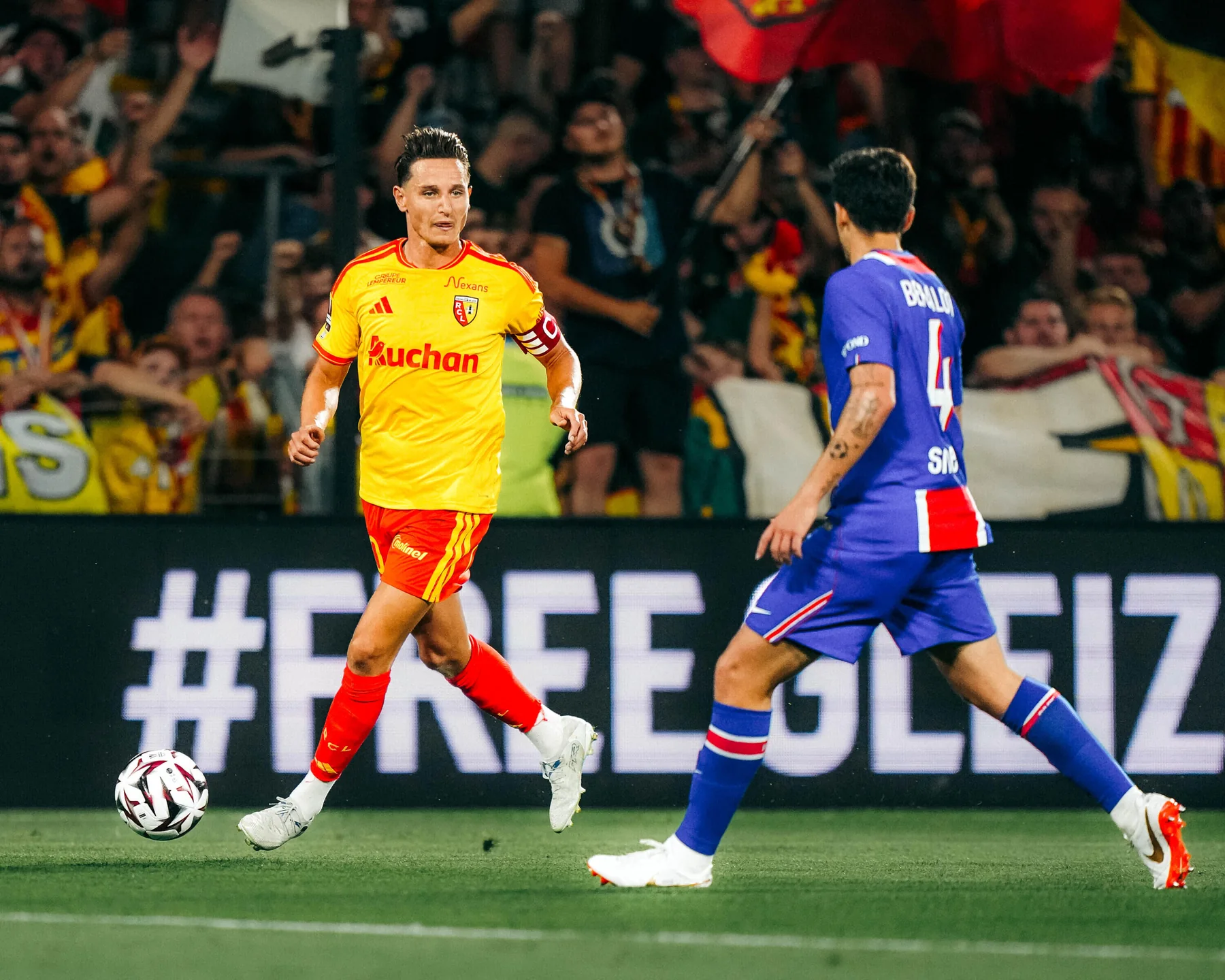
Édouard, Sima and Ivanović offer different selections
Édouard, number 11, supplies a centre-forward option demonstrated by his close-range finish at Troyes. The importance of that action is positional: a promising move on the flank needs someone occupying the dangerous central space when the delivery arrives. If everybody comes short to help with possession, the attacking team can have plenty of passing options and nobody at the end of the move.
Sima, number 19, illustrates another route. In the PSG report he linked with Udol before Thauvin's goal and also combined through the right channel during the second half. Those actions show an attacker contributing outside the final shot. Moving away from the centre can pull a defender out, create a passing angle and make space for somebody else to arrive. The cost is that another player must then fill the area he has vacated.
Ivanović, number 29, adds a further choice. The same August account describes him attacking down the right after a Thauvin pass, while the October Troyes sheet records him replacing Édouard. These examples indicate how he can enter different attacking arrangements. They do not establish a permanent ranking among three forwards. The choice depends on which connections the coach needs: a central target, a runner into a channel, or an additional link around the ball.
Sotoca, Skóraś and Hazard around the main striker
Sotoca gives the group another experienced attacker, and his selection alongside Thauvin and Édouard at Troyes shows why counting strikers from a directory can mislead. Three attacking names can divide pressing, supporting and finishing duties rather than all standing against the same centre-back. One player coming towards midfield can give a teammate space to run beyond, provided their movements are coordinated.
Skóraś broadens the possibilities around them. He appeared in a wide position at Troyes and replaced Thauvin in the August PSG match. That range places him at the boundary between the midfield and attacking categories. His selection can affect where Lens obtains its width and which player moves inside to support the striker. A substitution involving him therefore needs to be read through the positions after the change, rather than through the labels attached to the departing and arriving players.
Hazard wears number 9, but the number should not force every interpretation towards a fixed penalty-area striker. Junior Kadile is another listed attacking alternative. Together with the more established combinations, these options let Lens alter the type of support around its main forward. The test is whether the team gains something specific: an extra receiver between lines, a runner beyond the defence, or stronger occupation of the far side when a cross comes in.
For the next match, start with those relationships. Identify who leads the line, who receives behind him and who supplies width; then compare them with the opposing defence. The current Ligue 1 table supplies the competition context, while the actual Lens team announcement settles the personnel. This squad offers several combinations, and the most informative changes are often the ones that redistribute a job rather than simply replace a name.
Loading comments…