RC Lens and Dino Toppm?ller separated on 15 September 2026 after just four Ligue 1 matches. The club's stated reason was a disagreement over changes it wanted to make to the coaching staff, following a longer assessment of how that staff worked with the squad. Four league points increased scrutiny, but Lens had also won the Troph?e des Champions and its Champions League opener. Yannick Cahuzac was appointed to take the bench for the next match at Monaco. This account reflects information available before that match on 18 September 2026.
What Lens actually announced and what remains unproven
There is a straightforward answer to the headline question, but it is more precise than “four bad games.” In its 15 September statement, RC Lens said that it wanted structural changes to the senior coaching staff after discussions about the squad's life, methods and organization. Dino Toppmöller could not accept those changes, and the club ended his assignment along with those of his two assistants. Lens described the separation as being by mutual agreement. The four Ligue 1 games mark how early it happened, rather than supplying the club's whole explanation.
The official agreement and coaching-staff changes
The choice of words matters because it separates a confirmed event from a familiar football assumption. “By mutual agreement” tells readers how the parting was formalized; it does not tell them that both sides agreed on the merits of every proposed staff change. Lens explicitly said the proposed changes could not be shared by Toppmöller. Its announcement also credited his personal conduct and said that he had waived a substantial part of the compensation due under his contract. That is a detail about the settlement, not a financial figure or evidence of a particular private dispute.
The club did not publish a minute-by-minute account of the meetings, name a single tactical instruction that caused the split, or give Toppmöller's extended version in that release. It confirmed that his two assistants would also leave, which shows why the decision was more than replacing a coach on the touchline while leaving the rest of the operation intact. The immediate successor on the bench was Yannick Cahuzac for the trip to Monaco. A supporter trying to understand the decision should therefore start with the organization of the staff, and only then ask how match results increased the pressure around it.
Lens provided a fuller, but still club-side, explanation two days later. In a 17 September press conference, general manager Benjamin Parrot said the assessment had begun before the Trophée des Champions, and sporting director Jean-Louis Leca described a three-month process of reflection. Both argued that their concerns involved the way the coaching operation connected with established Lens personnel and, ultimately, with the team's performance. That timeline is the strongest public reason to resist the idea that Sunday's draw at Le Mans alone produced Tuesday's split.
Why reported dressing-room claims need attribution
There are more detailed reports about internal relationships. Goal, citing Sport1, reported alleged complaints from players about training and alleged frustration among members of the pre-existing French staff about communication. Those details may help explain why the story attracted so much attention. They are not the same as an official finding, and Lens's public release did not verify the individual claims. The fair formulation is that media outlets reported them, while the club publicly confirmed a disagreement over staff structure and later described poor integration between groups.
That distinction protects the people involved as well as the reader. A coach can fail to establish an effective working structure without every rumor about a dressing room being true. Equally, a club can use an orderly settlement phrase while admitting that its original appointment did not work as intended. The public evidence supports a serious organizational mismatch, but it cannot reveal exactly what each player or assistant privately said. For a fan following the next match, the useful question is whether Lens's replacement structure solves the specific cooperation problem its own leaders have identified. That is testable over time; anonymous-sounding assertions about private conversations are not.
Why four league games did not tell the whole story
The early table gave Lens a reason to ask hard questions, but it did not offer a complete verdict on a new manager. The club's official results list shows a 5–2 home win over Auxerre, a 2–1 defeat at Strasbourg, a 1–0 home loss to Lorient and a 2–2 draw away at promoted Le Mans. That is four points from the first four Ligue 1 fixtures, with eight goals scored and seven conceded. The goals total sounds lively; the sequence is less reassuring. Lens followed an emphatic opening win with two straight defeats and then needed a recovery to take a point from the fourth game.
The mixed competitive record across three competitions
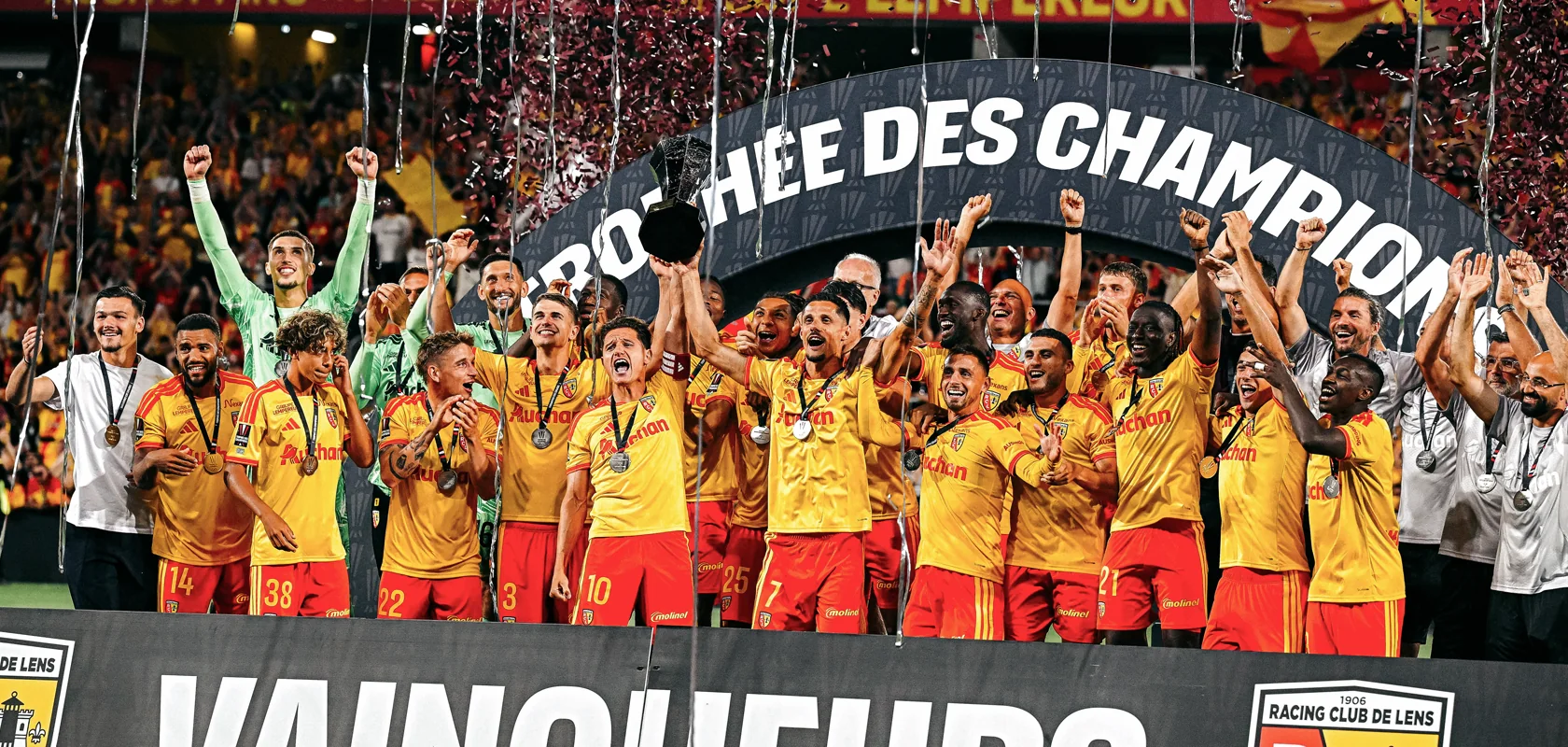
A four-point summary can mislead in the other direction if it erases the work outside the league. On 16 August Lens beat Paris Saint-Germain 1–0 in the Trophée des Champions. They protected their lead after being reduced to ten players before halftime. On 10 September they won 3–2 away to Slavia Prague in their Champions League opener, scoring twice in stoppage time after a late Slavia goal had threatened to leave them empty-handed. Those were significant competitive achievements under Toppmöller, and the Prague comeback in particular showed that the squad could respond to adversity.
They also belonged to different competitions. The Super Cup victory did not add points to the Ligue 1 table, and a dramatic European night did not repair the Lorient league defeat. Conversely, a mixed four-game league run cannot wipe out the two wins. The sensible reading is a team capable of exceptional responses but still searching for dependable domestic performances. That is a more specific problem than calling the appointment a sporting failure after just over three weeks of league play.
Opponent context sharpens the picture. Strasbourg overturned a Lens lead at the Meinau, with the club's match account tracing the swing to second-half goals. The 1–0 loss to Lorient came at Bollaert-Delelis against visitors Lens described as still winless in the league beforehand; the club report emphasized a lack of invention and precision in the attacking third. Neither result alone proves an unworkable coaching structure. Together they explain why club leaders could see a gap between the promise of individual big performances and the repeatable habits they wanted in the league.
The Le Mans comeback and the tactical warning it exposed
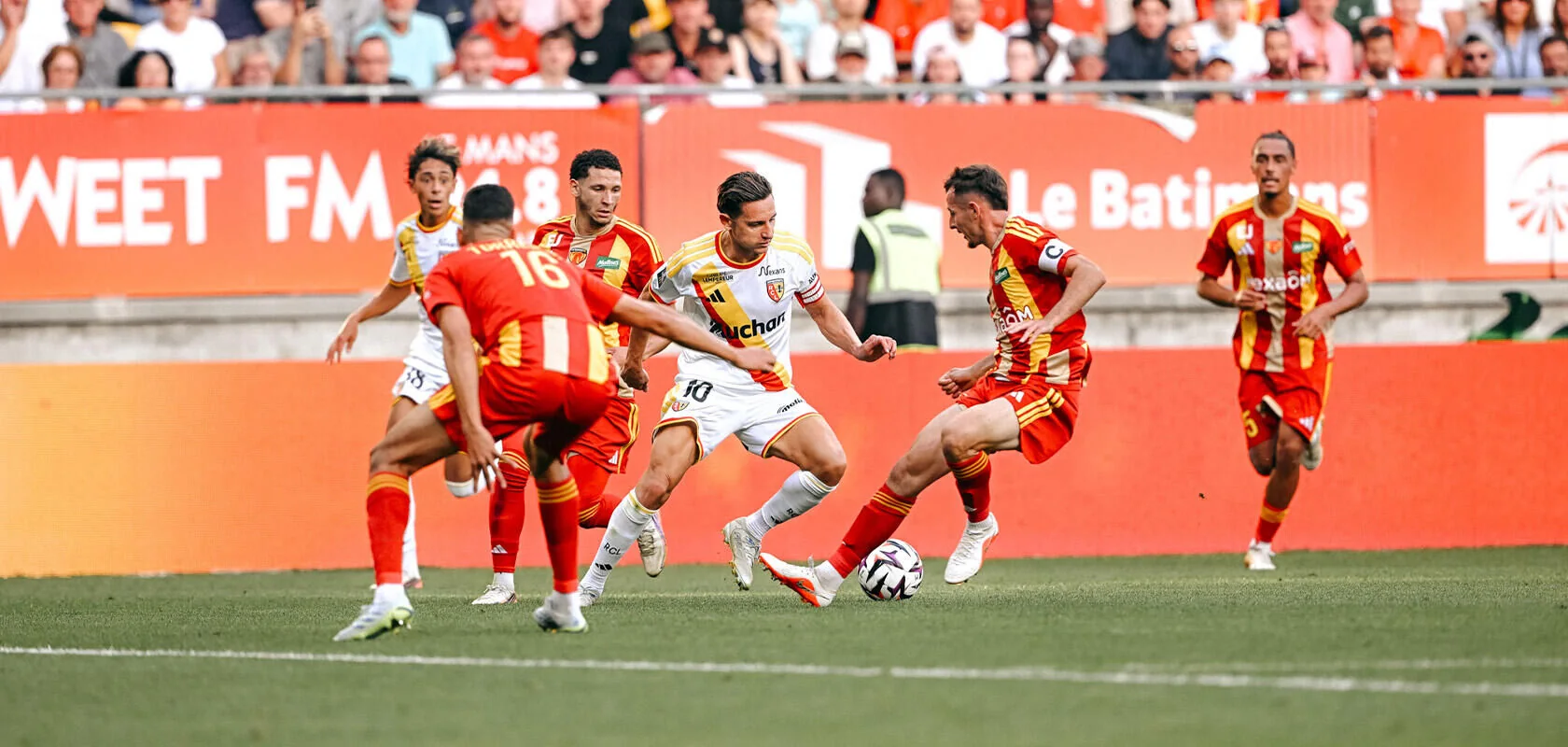
The final league fixture before the split is especially revealing because it supports two interpretations at once. Promoted Le Mans led 2–0 late in the first half on 13 September. Lens's own match report says the hosts' pressing made it difficult to find openings and that Toppmöller changed three players at halftime, switching from a 3-4-3 to a 4-2-3-1. Abdallah Sima had pulled one back just before the interval and Franjo Ivanović equalized soon after the restart. Lens then had the stronger late spell but finished with a point.
One reading is that the coach recognized the problem quickly and made an effective correction. That matters: his team did not simply remain stuck in a losing plan. The other is that a side with Lens's resources began the match poorly against a promoted opponent and needed major halftime repair. A change of shape can be a sign of flexibility and a sign that the initial structure was not working on that afternoon. Treating either interpretation as the entire reason for the separation would go beyond what the club has said.
For supporters, the useful measure is not whether four points looks “good” or “bad” in isolation. It is whether Lens had a clear way to reproduce the energy of the PSG and Prague wins when league opponents set different problems. The Lorient match tested creation against a compact defense; Le Mans tested Lens under pressure from an ambitious home side. The contrast gives the management's concerns a football setting without pretending that a scoreline can reveal every conversation among coaches and players.
The Lens identity argument behind the decision
Lens's leaders used the language of identity, which can sound vague until it is tied to actual choices. The club had just completed a 2025/26 campaign in which it finished second in Ligue 1, qualified for the Champions League and won the Coupe de France. Its farewell to Pierre Sage credited that work before he left for Crystal Palace. Toppmöller therefore inherited an ambitious side with standards formed by success, not a blank project that needed any kind of result to count as improvement. A coach entering that environment had to build his own methods while preserving enough shared habits for players and staff to work coherently.
The club was not opposed to a new voice in June. It appointed Toppmöller on a deal announced through 2028 and highlighted his European experience and familiarity with a 3-4-3. In the presentation, executives described his attacking ideas as compatible with the club's ambition and roots. The July staff announcement said the group had been formed in cooperation with the coach to achieve complementarity. That makes the September reversal more significant. The same institution that built the structure came to believe it could not function as planned; responsibility for that mismatch cannot fairly be assigned entirely to one side by readers outside the training ground.
In the later press conference, Leca said the football no longer resembled the Lens patterns that had served the club over several years, while Parrot described separate groups within the coaching staff rather than the bridge they had expected. These are specific claims about working relationships and output, though they remain the management's account. A supporter can assess their football element: Does Lens press and recover as a connected team? Do its defenders and midfielders understand when to step forward together? Does the side have a reliable route from regain to attack when an opponent closes space? Those are observable questions. Whether a private meeting unfolded exactly as one executive remembers it is not.
Nor does “Lens identity” mean one sacred formation. The club hired a coach it described as a 3-4-3 specialist, and he changed to a back four in the Le Mans comeback. The underlying issue is whether players can execute collective behaviors consistently within whatever shape is selected. If one unit presses while another drops away, opponents find room. If attackers receive the ball without coordinated support, possession can become sterile. These are football mechanisms that explain why cohesion would matter; they are not a claim that either problem occurred on every possession of Toppmöller's six competitive games.
The most responsible conclusion is narrower than a verdict on his ability. Lens's executives said they saw an organizational divide and a departure from a style they valued, despite the coach producing two memorable nonleague wins. Their assessment may have been right, premature, or both in different respects. A full judgment would need more than four league matches and access to private staff discussions that the public does not have. What the decision does establish is the club's willingness to take the disruption of another coaching transition immediately rather than wait for a larger sample, even after making a long-term appointment only in June.
What Yannick Cahuzac inherits and what supporters should watch
Yannick Cahuzac's first assignment is not an easy laboratory experiment. Lens said he would take the bench for the trip to Monaco, and the club's match page listed that Ligue 1 match for Friday, 18 September, at 20:45 in Paris local time. Monaco were unbeaten through four league games and level near the top of the early standings. A new coach facing that opponent away from home can improve how his side functions without immediately delivering a win. Equally, a positive single result would not by itself settle whether the deeper staff issue has gone away.
Why Lens chose Cahuzac
The appointment is understandable in the terms Lens itself used to explain the split. Cahuzac captained the club from 2019 to 2022, assisted Franck Haise in 2022/23 and returned to the 2026/27 senior staff after work at Lorient, according to the club's staff profile. That history gives him familiarity with the environment and with people who know the club's recent playing habits. It does not automatically make him a superior manager, but it addresses the integration concern the executives raised.
In the 17 September explanation, Leca described Cahuzac as a coach associated with intensity and proactive football. Parrot said the club had imagined him as a possible future head coach, but had not planned this promotion now; he noted that Cahuzac was still in training. That is unusually useful context for supporters. It makes the choice look like a response to a sudden structural problem rather than the execution of a long-prepared plan to replace Toppmöller after four rounds. The club is asking someone it knows to reconnect the staff and the team while he grows into the role.
That carries its own risk. Familiarity can shorten an adjustment period, but it cannot manufacture tactical solutions overnight or eliminate the practical work of coaching a squad that has already spent preseason and six competitive matches under another manager. Cahuzac inherits a group that has shown it can defeat PSG and win at Slavia Prague, yet has also struggled to control particular league matches. His first challenge is not to deny either side of that record. It is to preserve the confidence from those wins while giving players clearer, repeatable answers when an opponent presses, defends deep or breaks into the spaces Lens leaves behind.
How to judge the first weeks without overreading one result
Start with the organization between the lines. At Le Mans, Lens's own account described problems progressing against the home press before the halftime adjustments. Under Cahuzac, watch whether the ball carrier has nearby options, whether wide players and midfielders react together when possession changes, and whether the defensive line is protected if an attack breaks down. These are practical observations a supporter can make regardless of the final score. They connect directly to the management's assertion that the football had lost cohesion, without assuming that a single formation is the answer.
Then watch what happens across several different opponents. Monaco away is a demanding opening because their undefeated start suggests a higher test than a generic early-season fixture. A team could lose there yet show improved spacing and resolve; it could also scrape a draw without solving a recurring creation problem. Compare the next league matches with the official Ligue 1 fixtures and use the results over a run rather than turning each result into a referendum. Lens's four-point league start is the baseline, not a forecast of where the side must finish.
Finally, look for clarity in the coaching arrangement. The public cannot see every staff meeting, but consistent selection logic, understandable in-game adjustments and players executing the same pressing triggers are visible signs that a group has a shared plan. If those improve, the club's rationale will have a football expression. If they do not, it will be fair to ask how much of the original problem was the former manager and how much lay in decisions made around him. As of 18 September, supporters have the club's explanation and a new coach, but the evidence for the remedy still lies in matches yet to be played.
The honest answer therefore contains two parts: Lens confirmed a staff-organization disagreement, and its executives judged the early football and internal integration to be moving in the wrong direction. The coach's entire side of those discussions is not public. The first Cahuzac matches can show whether collective play changes, but they cannot retroactively turn every rumor into fact or make four results a complete assessment of Toppm?ller's ability.
Loading comments…