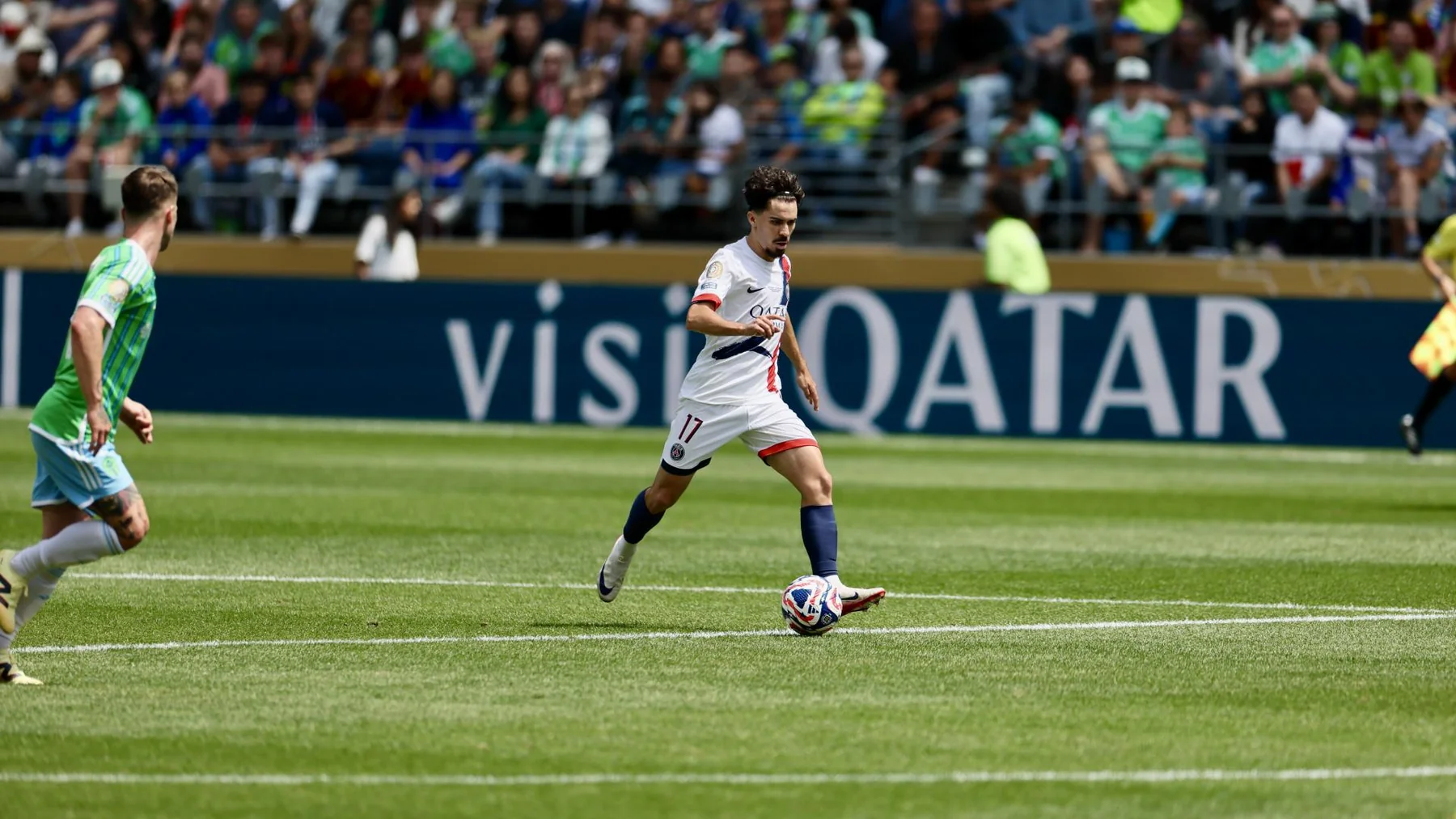
Vitinha is Vítor Machado Ferreira, the Portuguese PSG midfielder wearing number 17. His role connects possession at different depths: ahead of the defenders, alongside them when the team restructures, and further forward when a coordinated opening appears. This profile traces Porto and Wolves to Paris, uses a specific FIFA match analysis to explain those responsibilities, and separates league statistics from European and international achievements. Identity and current league figures are checked as of 14 October 2026.
Who Vitinha is, and how he reached PSG
Vitinha is the playing name of Vítor Machado Ferreira, the Portuguese midfielder at Paris Saint-Germain. The shorter name is familiar on team sheets, but using the full name helps when comparing profiles, historical records and players with similar nicknames. His story connects Porto's academy, a loan in English football and a return to Portugal before his move to France.
His full name, shirt number and football identity
PSG's official profile lists his birthday as 13 February 2000, birthplace as Santo Tirso, preferred foot as right and height as 172 centimetres. He is 26 on the fact-check date of 14 October 2026 and wears number 17 for PSG. Those details identify the player; they do not explain his midfield contribution on their own.
A shirt number should not be mistaken for a fixed tactical position. Vitinha's number remains a way to recognise him even when he receives the ball in different areas. Likewise, “midfielder” is a broad category: a player can contribute to the first phase of possession, help move the ball through pressure and later support an attack. The useful question is what the team asks him to do within each phase.
Height is another fact that becomes misleading when treated as a complete physical assessment. It can describe the player accurately without establishing his stamina, ability to find space or effectiveness under pressure. Those qualities need football evidence. In Vitinha's case, a detailed FIFA match analysis provides a stronger basis for understanding movement than an assumption drawn from his listed dimensions.
Porto, Wolves and the 2022 move to Paris
Vitinha joined Porto's system in 2011 and was part of its 2018/19 UEFA Youth League success. The Wolves loan announcement connects that academy work with his first-team breakthrough in Portugal. In September 2020, the English club signed him for a season on loan, with an option for a permanent move. That distinction matters: the Wolves period was a temporary stage in his Porto career, rather than the permanent transfer that later brought him to PSG.
A memorable moment in England came against Chorley in the FA Cup. Wolves' January 2021 account describes his first goal for the club as a long-range strike that secured progression. It belonged to the cup, not to his Premier League scoring record. The example is useful both as part of his development and as a reminder to label career statistics by competition.
Back at Porto, the 2021/22 season brought a domestic double and recognition as the league's young player of the year. PSG's biography then places his move to Paris in summer 2022. The sequence is important: the academy prospect gained experience away, returned to establish himself more strongly, and then joined a club operating at another European level.
That path should not be flattened into either an effortless rise or a verdict based on one loan season. Development can change when opportunities, teammates and responsibilities change. Vitinha's later role at PSG is best understood through how he uses the ball and creates options for others, rather than treating an earlier club's appearance total as the final measure of his potential.
Vitinha’s position is best understood through his responsibilities
“Central midfielder” is a useful label for Vitinha, but it is not a complete description of where he operates. A player responsible for connecting possession can change his receiving position as teammates move and opponents apply pressure. The distinction is between a position on a team sheet and the responsibilities performed during a passage of play.
A particularly useful example comes from the FIFA Training Centre's 2025 Club World Cup analysis. Drawing on technical-study work with Portugal coach Roberto Martínez, it identifies different ways Vitinha influenced PSG's possession against Seattle Sounders. This is a specific match example, rather than a claim that every PSG lineup or every current-season game uses the same arrangement.
Receiving in front of the defenders
In the first role, he offered a midfield receiving option ahead of the defensive unit. That places him between the initial possession and the players further forward. A useful pass is not always the longest or most ambitious one: it can be the delivery that finds a teammate able to receive with a better view of the next action.
For a fan, the revealing moments often come before the ball arrives. Where does he stand relative to the opponent's nearest midfielder? Can a defender find him without forcing a pass through an occupied lane? Does his receiving angle allow another option if pressure comes immediately? These are questions to use while following a match, rather than a substitute for examining the actual sequence.
The defensive-midfield description in this example therefore includes an important possession function. It should not be read as a claim that his only contribution is tackling or remaining stationary. A midfielder can help protect the team by keeping possession connected, while the quality of any particular decision still depends on pressure and the options available.
Dropping into the back line
FIFA also describes Vitinha moving alongside Willian Pacho and Marquinhos during possession. That changed the team's distribution of players and allowed Nuno Mendes and Fabián Ruiz to occupy different spaces. The key point is the relationship between movements: one player's deeper position can make another player's more advanced position workable.
This is why an average-position graphic can be surprising. A player registered as a midfielder may appear near the defenders when the team's possession is analysed. It does not mean that he has permanently become a centre-back or that the original team-sheet category was wrong. It describes where his particular work occurred within that sample.
The trade-off is structural. Dropping deeper can provide another passing route, but the team still needs connections further ahead. If everyone comes toward the ball, there may be too few options beyond the opposition's midfield. The football question is therefore not simply whether Vitinha is deep or advanced, but how the other players balance his position.
Moving forward when the team creates the opening
A third part of the Seattle example involves forward movement triggered within a coordinated team sequence. FIFA describes Ruiz playing toward Mendes in a wide area while Vitinha advanced into space further upfield. That is different from a midfielder independently abandoning his role whenever he wants to attack.
The timing matters because movement can make a player available at the moment a defender's attention shifts toward the ball. The same run made too early might leave him marked; made too late, it might miss the passing opportunity. This explains why individual mobility and team coordination belong in the same discussion. Neither alone guarantees that the next action succeeds.
When watching PSG, follow the relationship between the wide receiver, the central runner and the players staying behind the ball. That approach reveals more than a rigid argument about whether Vitinha is a number six, eight or ten. The 2025 example shows a midfielder contributing at several depths within one possession strategy. Future matches need their own context, but the framework gives fans a clearer way to recognise his work.
Which Vitinha statistics explain his influence
Vitinha's statistics are most useful when the number is matched to the question. A league appearance total answers how often he played in that competition. A passing measure can help describe how possession moved through him. Goals and assists identify certain decisive actions, but they do not capture every contribution made before the final pass.
Passing numbers need match and competition context
In FIFA's Seattle match analysis, he had nine involvements in sequences that ended in attempts at goal, joint-most with Achraf Hakimi. He also covered 12.3 kilometres, the highest distance for a PSG player in that game. The combination is informative: involvement in attacking moves was accompanied by the physical movement needed to keep offering options. Neither number should be presented as his average for the 2026/27 Ligue 1 season.
Passing totals still need context. A completion percentage can be high because a player repeatedly chooses secure options, or because he executes demanding passes accurately. Without considering the receiving location, the available alternatives and the pressure around the action, the percentage does not tell those stories apart. The midfield role described against Seattle gives a reason to examine where the passes connect, rather than rewarding volume automatically.
The season label is just as important. On 14 October 2026, ESPN's 2026/27 Ligue 1 profile listed five starts and one substitute appearance, with one goal and one assist. FotMob's league snapshot also listed six appearances and recorded 460 minutes. These are dated league figures, not a career total or a summary of his Champions League and international football.
Minutes explain why starts alone can be an incomplete comparison. Two players with the same appearance count may have spent very different amounts of time on the pitch. Likewise, a small early-season sample cannot settle a player's whole-year influence. Keeping the date and competition beside the numbers makes a future update straightforward and prevents older figures from appearing current by accident.
Goals and assists tell only part of a midfielder’s story
Vitinha can also make the scoring contribution impossible to overlook. In PSG's 5–3 Champions League win over Tottenham on 26 November 2025, he scored a hat-trick. The official match report records two equalisers and a later penalty. The first two goals restored parity after Tottenham had taken the lead; the penalty restored a two-goal advantage. Their value is clearer when the score state is included.
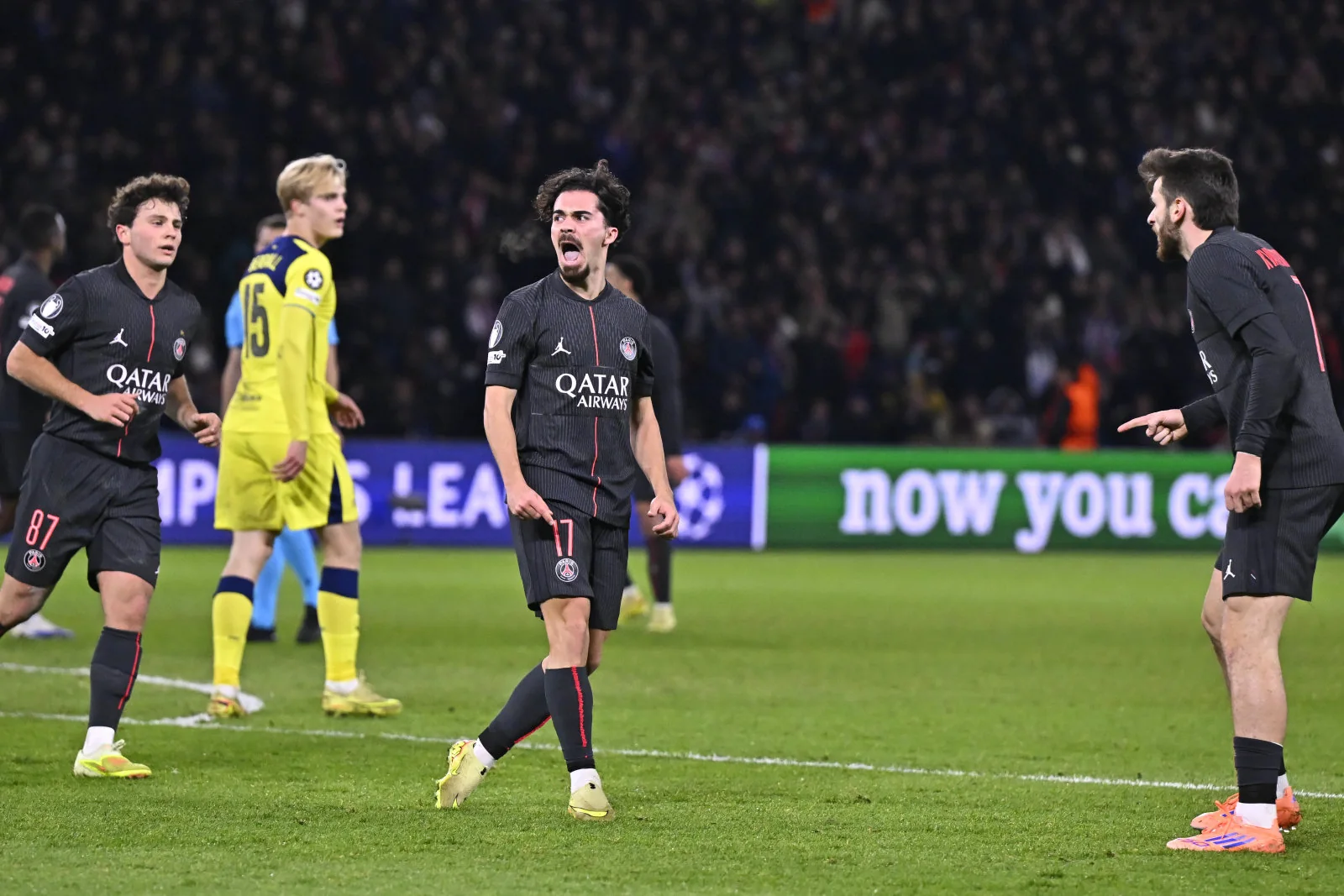
That match belongs to 2025/26 European competition. It should not be combined with the later Ligue 1 snapshot as if both were one season's league statistics. It is a specific example of scoring impact within a career more commonly discussed through midfield control.
An assist total also leaves some work uncredited. A pass that starts an attack or frees the player who later assists may be valuable without receiving the same statistical label. For Vitinha, combining clear decisive moments with possession responsibilities gives a more complete assessment. It recognises a hat-trick when it happens without requiring every useful midfield performance to produce one.
Portugal adds another chapter to the same midfield career
Vitinha's international identity is Portuguese. PSG's biography places his senior debut in March 2022, followed by his first World Cup later that year in Qatar. The national-team career should be read alongside the club career, but the two records are separate: an international appearance is not another Ligue 1 game, and a Portugal role is not automatically a copy of his PSG responsibilities.
The 2025 Nations League final gives a particularly clear example. Vitinha started as Portugal drew 2–2 with Spain after extra time and won the shoot-out 5–3 on 8 June in Munich. The official UEFA match report records the team and result. Portugal's goals came from Nuno Mendes and Cristiano Ronaldo; those decisive scoring actions should not be credited to Vitinha simply because he was part of the winning midfield.
There were familiar PSG connections, but different relationships. Mendes was a Portugal teammate, while Fabián Ruiz played for Spain. João Neves began in a less familiar right-back role before the half-time changes. The example shows why a collection of club teammates on a national-team sheet does not mean the same structure is being repeated. Their coach, opposition and surrounding players create another set of responsibilities.
UEFA's technical analysis of the final explains how Portugal adjusted after falling behind. Nélson Semedo and Rúben Neves came on at half-time, and observer Steve Cooper identified improved balance alongside Vitinha in a more orthodox midfield arrangement. This is documented analysis of that final, not a general claim about every Portugal selection.
The distinction between João Neves and Rúben Neves matters too. They are different players, and in this match their participation occurred within different roles. A shortened reference to “Neves” can obscure the very personnel change that explains the example. Naming the player precisely helps a supporter understand what changed, rather than assuming one midfielder simply moved around the same eleven.
For Vitinha, the significance is adaptability within an established technical identity. A player who can help connect possession still needs to work with the particular protection, receiving options and attacking movements of his team. The Seattle club example and the Portugal final illuminate different settings. They do not establish a universal solution that can be applied to every opponent without adjustment.
International honours also need the correct scope. Portugal's 2025 success was the nation's second Nations League title, but that team total is not a claim that Vitinha personally played in both winning finals. His individual record and the national side's historical record answer different questions. The same care applies to caps, goals and tournament appearances when comparing him with other midfielders.
To follow his next club match, use the PSG Ligue 1 fixture page and check the actual lineup when it is announced. The most useful viewing question is then how number 17 connects the players around him: where he becomes available, when he protects possession and when a coordinated movement takes him forward. His career provides the background; the specific match supplies the final explanation.
Loading comments…