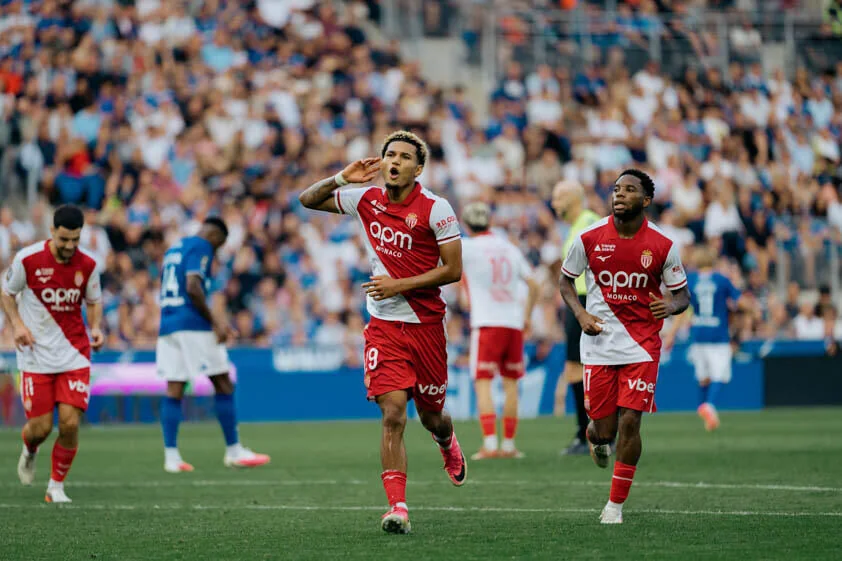
Paris Brunner's equalizer for Monaco at Strasbourg on 12 September 2026 was followed by a celebration that many viewers interpreted as a throat-slash gesture. Brunner said it was an emotional reaction to comments about his family and later apologized for the movement. The French football ethics body referred the incident to the LFP disciplinary commission, which has scheduled a hearing for 23 September. As of 18 September, no verified ban has been imposed. The question is what happened after a notable Ligue 1 goal, what the player has actually said, and what the league has—and has not—decided.
The match moment that sparked the controversy
The controversy began with a goal that changed the result, not with a disciplinary announcement. On Saturday, 12 September 2026, AS Monaco drew 1–1 away to RC Strasbourg at the Stade de la Meinau. Paris Brunner struck from distance in the second half to cancel out a Strasbourg lead and preserve Monaco's unbeaten start to the Ligue 1 season. Immediately afterward, his celebration in front of the home support included a thumb moving across his throat. Reports and the subsequent ethics referral treated it as a throat-slash gesture; Brunner later disputed that threatening interpretation. Keeping those facts separate is essential to understanding the argument.
Brunner's equalizer in a 1–1 game
Monaco arrived at Strasbourg after winning its first three league games. Its official match report describes an open first half and a setback just after the restart when defender Sadibou Sané inadvertently headed into his own goal. Strasbourg, playing at home in a sold-out Meinau, led 1–0. Monaco had to find an equalizer rather than simply protect an early advantage. Brunner had already threatened with a header that the goalkeeper turned onto the post, then supplied the moment that brought the visitors level.
The finish was a long-range effort into the top corner, and it mattered beyond aesthetics. It secured a point away from home, extended Monaco's unbeaten league start and prevented their first defeat of the campaign. The club reported that it was Brunner's third Ligue 1 goal of the season. Monaco pressed for a winner afterward, including a late effort ruled offside, but the match ended 1–1. L'Équipe's match account likewise notes that the draw ended Monaco's perfect start while leaving them near the top. The score is worth emphasizing because some early search phrases and recycled summaries make this sound like a Monaco victory; it was an equalizer in a draw.
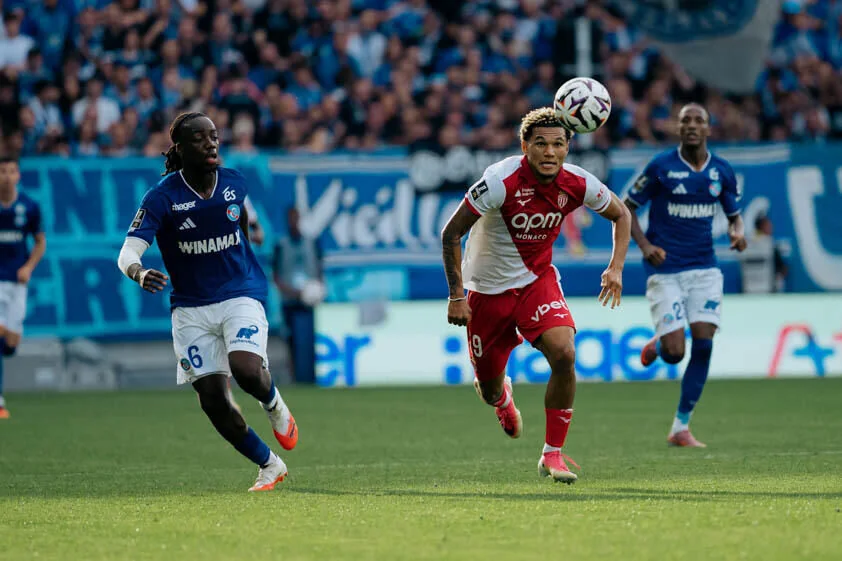
There is a small source discrepancy about the precise goal minute: Monaco's prose places the strike a little later than its own match sheet. That does not change the play or the result, so the useful account is “in the second half,” rather than forcing a false precision into an article about a different question. The important sequence is Strasbourg lead, Brunner's equalizer, and then a celebration that drew a separate response. Readers interested in what the point meant for the table should look at the current Ligue 1 match information; this article is about the incident that followed the goal.
The celebration and immediate crowd reaction
After scoring, Brunner turned toward the Strasbourg end. 20 Minutes describes him putting a finger to his ears and then drawing a thumb across the throat area. The visual sequence, especially in front of rival supporters, explains why many viewers read it as a threatening or provocative signal. The home crowd's reaction did not end with the initial celebration, according to the report. The gesture became a story separate from the footballing quality of the strike.
It is possible to state what an action looked like without deciding, from a video clip alone, what a player privately meant. A finger to the ear often invites or answers noise from a crowd; a thumb across the throat carries a more alarming public meaning in this context. That is why the ethics body later considered it serious enough to refer for review. But the apparent meaning is not the same as a proven intent to threaten anyone, and Brunner provided a different explanation soon after the game. Describing both is more useful than either sanitizing the movement as an ordinary goal celebration or declaring a complete account of his thoughts from a few seconds of footage.
There was no reported on-field dismissal for the movement in Monaco's match sheet. The issue moved into postmatch statements and a separate disciplinary process. That sequence matters for fans asking whether a referee had already punished him: the public controversy grew after the whistle, and the possible sanction was for a later committee to assess. A player can score a decisive equalizer, finish the match and still face postmatch scrutiny of how he celebrated it. The match result and the disciplinary question are connected by one moment but governed by different records.
What Brunner said after the match
Brunner's own explanation is an essential part of the record, even though it cannot by itself decide how the gesture should be judged. The forward spoke after the 1–1 draw and then addressed the controversy again on social media. Those were two different moments: a near-immediate account of why he reacted, followed by an apology for the way the movement could be received. Treating one as if it erased the other produces a misleading story.
His account of the Strasbourg supporters' comments
In postmatch mixed-zone reporting summarized by 20 Minutes and Get French Football News, Brunner said some spectators had spoken about his mother and father. He described strong emotion after scoring and said he had not intended to disrespect the crowd. His account was that the movement signaled a decisive goal, not a threat. That is his account of what he heard and meant. No independent audio transcript of the alleged crowd words was established by the sources checked here, so the allegation should not be repeated as a verified description of what the entire Strasbourg end said.
The setting explains the intensity without settling the ethics question. Brunner was facing the home end in a hostile away environment, his side had fallen behind, and his strike had just changed the score. A player can feel targeted by a small number of voices and react in the instant without a prepared message. It remains possible for the visible gesture to carry a meaning far beyond the one he says he intended. A supporter reading the incident should keep both views in mind: the footballer reports provocation and emotional release; viewers saw a motion widely associated with violence. Neither perspective requires pretending the other did not occur.
Monaco's own edited mixed-zone article concentrates on the football. Brunner describes seeing space and shooting, and says the team moved the ball more quickly after equalizing. He also explains that he had sought the ball to feet more often in the second half rather than fighting directly with a close defender. Those details help explain the goal on its own terms. The club article does not reproduce the celebration discussion, but that editorial omission should not be mistaken for evidence that no separate explanation was given; several outlets reported it from the mixed zone.
The later apology and why wording matters
The tone changed later. Goal reported that Brunner used an Instagram story to apologize to anyone hurt, describing the gesture as clumsy and saying he should not have done it. The Associated Press account also records his apology. This later message is materially different from merely saying “you misunderstood me.” It accepts that the movement itself was a poor choice, while still maintaining that he had not set out to convey a threat.
Some coverage quotes him in the immediate interview as not claiming regret at that moment, and some short summaries simply say he apologized. Both can be accurate if the timeline is preserved. An emotional first response may focus on intention; a later response can recognize public impact. Readers should resist turning that sequence into a manufactured contradiction or a guaranteed defense. An apology can matter to a disciplinary assessment without obliging the committee to clear a player, just as an initially defensive explanation does not prove malicious intent.
The football context should not be lost in a discussion of wording. Brunner's goal earned Monaco a point and showed a forward finding space against a compact opponent, as his club transcript and coach's later analysis indicate. That is a sporting achievement separate from what happened next. Criticizing the celebration does not require diminishing the strike, and appreciating the strike does not require denying that the movement in front of home supporters warranted scrutiny. That separation allows the eventual LFP decision to be considered on its own evidence rather than as a vote on whether Brunner is a promising player.
The ethics referral and possible LFP decision
The central status point is simple: as of 18 September 2026, Paris Brunner had been referred for disciplinary review, but no verified suspension had been announced. A referral means an authorized body has asked the league's disciplinary process to examine an incident. It does not mean the league has already decided how to classify the conduct, much less how many matches a player must miss. For a supporter trying to work out whether Brunner can play, that distinction is more useful than an alarming headline built around a possible punishment.
What the ethics body referred for review
The LFP's own notice of 15 September says the French Football Federation's National Ethics Council, usually shortened to CNE, decided on Monday 14 September to refer Brunner's celebration after his goal at Strasbourg. The receiving body is the LFP disciplinary commission. The ethics council has therefore triggered scrutiny; the commission is the body expected to consider the case and issue a decision. That sequence matters because a reader might otherwise confuse an ethics referral with an LFP finding of guilt.
The LFP says Brunner was summoned for the commission's Wednesday 23 September session. It expects a decision at the end of that process, with any eventual sanction taking effect from Tuesday 29 September. The word “eventual” is doing real work. It leaves open whether the commission will impose a sanction at all and, if it does, what form and duration that sanction might take. The official statement does not publish a fixed ban for the September match against Lens. On the contrary, it specifically says Brunner can take part in Monaco's Friday 18 September league fixture against Lens.
The referral concerns the celebration, not the legality of Brunner's equalizing goal or the final result of the Strasbourg match. Associated Press reporting connects the ethics intervention to the throat-cutting motion reported after the strike. Brunner's assertion that he meant no threat and his subsequent apology are relevant facts for a fair account, but they are not substitutes for the commission's assessment. Likewise, the fact that viewers interpreted the gesture as menacing does not tell us what the commission will decide. The process can consider the visible act, context, Brunner's explanation and the applicable rules; the result remains open at this date.
It is also worth tracking the calendar precisely. The match and celebration occurred on Saturday 12 September, the referral came on Monday 14 September, the LFP notice was published on Tuesday 15 September, and the scheduled hearing is still in the future on 18 September. Any article stating that Brunner was already suspended between the referral and hearing would be jumping over the decision stage. If a later reader reaches this page after 23 September, the appropriate next source is the LFP's published disciplinary decisions, rather than an assumption that the hearing necessarily produced the ban predicted in earlier reports.
Why a reported suspension range is not a sanction
Several reports have discussed a possible range of one to four matches, depending on whether the gesture is regarded as merely excessive or as intimidating. 20 Minutes explains the competing characterizations, and Get French Football News likewise describes a potential suspension. These are conditional interpretations of a disciplinary scale. They are not a quotation from an LFP ruling in Brunner's case. A number in a headline should therefore be read as a scenario, not as his current match ban.
The FFF's 2026–27 regulations index lists its disciplinary annex and scale, confirming that categories of conduct matter. But a reader cannot determine the commission's eventual classification merely by matching a video clip to a label. How the act is described, whom it was directed toward, whether any other evidence is considered and how the applicable rules are interpreted are questions for the decision-maker. The league's short scheduling notice does not announce its view on any of them.
There is a second practical trap: “available” and “selected” are different. The LFP's notice makes Brunner eligible for Monaco–Lens despite the pending case. It cannot promise that the coach will start him, bring him on, or even include him in the match squad. Later absence from a team sheet would also need an independent explanation before it could be called disciplinary. Conversely, if a suspension is eventually imposed after the 23 September hearing, the LFP has said it would not take effect before 29 September. The precise matches affected would depend on the actual wording and timing of a published decision, not on a forecast made beforehand.
For now the answer to “is Paris Brunner banned?” is no verified LFP ban as of 18 September. The case is pending. Fans should check the commission's post-hearing bulletin for the outcome and effective date, then compare that with Monaco's official match information. That keeps the immediate football question separate from the broader debate about whether a goal celebration crossed a line.
Why the episode matters beyond a single gesture
The incident has drawn attention partly because it involves a player whose football has been impossible for Monaco followers to ignore. Brunner's long-range equalizer at Strasbourg was his third Ligue 1 goal of the new season, according to Monaco's match report. It brought the visitors back from 1–0 down and protected an unbeaten start. Those are concrete reasons why questions about his availability matter to fans; they do not make his celebration immune to review.
The sporting picture is broader than a goal tally. After the draw, coach Filipe Luís spoke about the work his forwards had to do against a Strasbourg goalkeeper who played high and made pressing difficult. He named Brunner and Aleksandr Golovin as players who had to run extensively. He also praised his side's energy and refusal to stop pushing after conceding. That football analysis helps explain why a potential future loss of Brunner would be a selection question, not simply a missing entry on a scoring chart. The coach's remarks, however, were about the match and should not be repackaged as his judgment on the gesture.
There is a supporter dimension as well. Monaco's report describes a full Stade de la Meinau and roughly 400 traveling Monaco fans. An away equalizer in that environment naturally invites emotion from both ends. Yet a gesture resembling a throat slash in front of the home crowd is also liable to be read as threatening, whatever the player later says he meant. The standards for a professional's public response cannot be set solely by how heated the match felt. Equally, Brunner's account that he heard comments about his family should be represented as his own account, not converted into a claim about every Strasbourg supporter present. Treating individuals and groups precisely is part of taking the episode seriously.
For Monaco, the immediate planning question has an unusually clear answer. The LFP confirms he is available for the Lens match on 18 September. Monaco's match report lists the visit of Lens for 20:45 local French time that Friday. Availability does not tell us the team sheet, the score or how the coach will use him, so none of those should be guessed in an article written before kickoff. The later hearing could change future availability, but the league's published schedule places any eventual sanction no earlier than 29 September. Clubs and supporters can plan around what is established now while watching for the formal decision.
For the league, the test is whether a widely shared clip can be judged through its normal process without turning an allegation, apology or newspaper estimate into a verdict. Supporters may reasonably disagree about whether the gesture warrants a match ban, especially after hearing Brunner's explanation. The value of a formal review is that it should produce a stated outcome that can be checked against the rules. Until then, the sensible account contains three separate facts: a strong goal changed Strasbourg–Monaco to 1–1, the celebration triggered an ethics referral, and the LFP has scheduled a disciplinary hearing. Nothing in those facts requires announcing a punishment in advance.
As of 18 September 2026, the practical next update is the LFP commission's decision following its 23 September session. That decision may clarify the classification of the act, whether any sanction is imposed and its effective date. Until such a notice exists, Brunner's goal and apology can be described, his explanation can be attributed, and his Lens eligibility can be stated. His future match ban cannot.
As this article stands on 18 September 2026, Strasbourg–Monaco finished 1–1, Brunner's gesture remains under review, and the LFP says he is available against Lens before the scheduled hearing. Any later ruling should be read from the LFP's published decision with its stated effective date. The official Ligue 1 match pages can then show how Monaco's next fixtures unfold without confusing a possible sanction with a confirmed one.
Loading comments…