Paris gives French football supporters a particularly busy sporting Sunday on 25 October 2026. The NFL arrives at Stade de France while Ligue 1 continues across the country, including a scheduled evening match at Parc des Princes. Enjoying that overlap starts with a few practical distinctions: the two Paris-area stadiums are separate destinations, American football has its own match rhythm, and the clocks change that morning.
This guide is for supporters who already know their way around a football fixture list but want to add an NFL game without muddling the venues, entry rules or television schedule. Event details below were checked on 23 October 2026; use the linked official event and club pages for changes before leaving home.
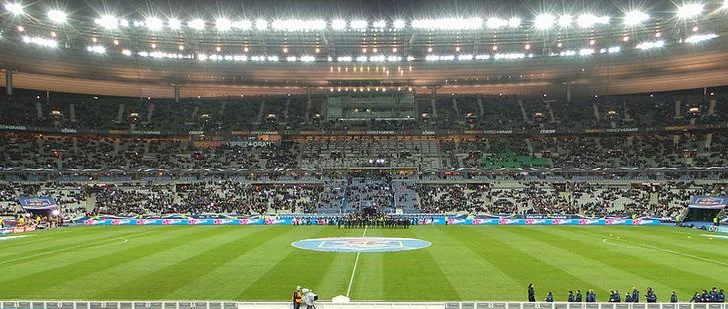
Cover: Stade de France in its football configuration, photographed by Poudou99 / Kootshisme, via Football-Stadiums.co.uk, CC BY-SA 3.0. Converted to WebP. This is a venue reference photograph, not an image of the 2026 NFL game.
Find the right stadium before planning the day
The first decision is geographical. The official event listing places Pittsburgh Steelers against New Orleans Saints at Stade de France on Sunday, 25 October 2026, with a 14:30 start. The stadium's access page gives its location as Saint-Denis. Treat the stadium name as essential information whenever you save the fixture or send it to a friend.
PSG supporters should keep that destination separate from the club's familiar home. Paris Saint-Germain's Parc des Princes guide identifies the stadium in the 16th arrondissement of Paris. These are different grounds with different journeys. The word Paris in an event title tells you the wider destination, but it does not tell you which route to take from your accommodation. Check the actual address before choosing the station, meeting point or hotel journey.
The sporting identity is different as well. The Paris game is an NFL regular-season fixture between two American teams. It is not a PSG match with another kind of entertainment attached, and a local football club does not become one of the participants because the event is marketed through the city. A French league supporter can approach it as a chance to understand another competition while keeping the familiar pleasure of a major matchday.
That distinction is useful when comparing tickets. A stadium tour, a club match and an international NFL game may all appear in a search for a Paris sports weekend, but they offer different experiences and admission. Read the opponent, date, year and venue on the actual product. If you want to see Ligue 1 as well, establish that second fixture independently; the NFL event announcement cannot tell you that your preferred French club will be at home.
For someone visiting from elsewhere in France or abroad, save a precise itinerary entry rather than a broad reminder called Paris football. Include Steelers-Saints, Stade de France, Saint-Denis and the local kickoff. Add the entrance information when your ticket provides it. Those details are more useful than a folder of stadium photographs when you are making the final journey, and they prevent the most basic confusion before you begin learning the sport itself.
Check the clock on the autumn changeover weekend
The 2026 Paris game falls on a date when a habitual time conversion can let you down. France changes its clocks that weekend, while the United States changes a week later. For this fixture, use the stadium's confirmed 14:30 Paris local time. Do not assume that every European NFL afternoon begins at the same local hour merely because the American listing looks familiar.
Paris and Eastern Time
France's public-service notice places the return to winter time in the night of 24-25 October 2026, with clocks moving back an hour. NIST's 2026 dates put the American change on 1 November. On the Paris game day, the difference between Paris and U.S. Eastern Time is therefore five hours. A 09:30 Eastern listing corresponds to 14:30 in Paris.
That is a dated calculation, not a year-round conversion rule. If you follow later NFL games from France, check their dates individually rather than adding the same number of hours every week. The clock difference is especially easy to miss when someone shares a fixture image without the time-zone label. Ask the simple question the image cannot answer on its own: whose local clock is being displayed?
A calendar that travels with you
For comparing international fixtures, NFL-Schedule.com's international games schedule provides a useful starting point. It is a related tool from the same publishing project as Ligue1Schedule.com, and brings the overseas matchups and venues together with time-zone selection. Set the zone deliberately, check the Paris row and compare it with the organiser's event listing. The tool is for planning; ticket and event instructions still come from the official provider.
When travelling, check how your phone and calendar respond to a new location. An event saved for a particular zone may display differently after arrival, while a manually typed reminder can remain a bare time with no useful context. Put the venue and the intended local kickoff in the event notes. If travelling with friends from different countries, share a sentence such as Paris local kickoff, 14:30 on 25 October, rather than sending an unexplained number.
Finally, keep kickoff separate from arrival. A correct calendar entry still does not include the journey, the walk to your gate or the admission checks. Make a second decision about when your group should leave and when it wants to be inside. The time-zone check prevents an hour's error; the arrival plan ensures that the correct hour is actually useful.
Follow the contest through territory and scoring
A Ligue 1 supporter already understands that the ball's location can change the meaning of a possession. Carry that interest into the NFL, while learning its scoring system. The league's basic glossary explains that a touchdown scores six points and a field goal scores three. After a touchdown, a team can attempt to add one point with a kick or two through a successful two-point try. The scoreboard therefore needs a different reading from a football scoreline.
Consider a simple hypothetical: a team trails by four points late in the game. A field goal alone will not put it ahead. That makes the distance to the end zone and the time available particularly important. You do not have to predict the coach's choice to see why the attacking side may need to take a risk. Read the score as a problem the team must solve, rather than treating every successful kick as an equivalent response.
The other useful idea is the set of downs. The offence normally has four attempts to advance ten yards and earn another set. A modest gain can matter because it improves the next situation, while an incomplete pass can leave the team with less room for error. The official rulebook contains the exceptions and detail; for a first visit, begin by reading the down and the required distance before each play.
Watch the space around the ball as well as the player holding it. A receiver can pull a defender away from another area, blockers can create a route for a runner, and the defence can close that route before the play develops. These are useful things to notice without declaring that an NFL formation is the same as a French club's pressing shape. The comparison is a viewing habit: look for how players create or deny useful space.
Between plays, use the pause to connect what happened with the next choice. Check whether the offence earned a first down, whether a flag changed the result and whether the clock is now important to the situation. If you miss a detail, the replay can clarify it without requiring you to watch the whole game through a screen. Following a few complete possessions is often more rewarding than trying to learn every specialist term at once, especially when the stadium atmosphere is part of the reason you came.
Use the event's transport and entry instructions
The venue's NFL event notice says parking is unavailable for this event and recommends public transport. Treat that specific instruction as the starting point, even if a general stadium guide describes car parks used on other dates. A location can have parking facilities without offering them for the ticketed event you are attending. Plan the journey you can actually use rather than a route copied from a previous visit.
The stadium's access guide lists La Plaine Stade de France on RER B, Stade de France-Saint-Denis on RER D and Saint-Denis-Porte de Paris on Metro line 13 among its options. Choose a route from your real starting point and check current service information before leaving. A station's name is only part of the plan: you also need to allow for the walk to the appropriate side of the ground and the entrance printed on your ticket.
Keep the booking and bag checks separate from transport. Follow the permitted-bag and prohibited-item link on the NFL event page rather than assuming that a bag accepted at another football match will be admitted. Read the current mobile-ticket instructions from your seller, confirm you can access the account and decide how each person in the group will enter. Solve missing-ticket or account-access problems before the journey begins.
As checked on 23 October, the NFL had announced heightened security for the Paris game. Follow the latest organiser messages and allow room in your arrival plan for the checks described there. That is a dated event update, not a prediction about every future visit. If you have also booked a separate fan gathering, read its own latest notice because a game ticket does not establish the status or admission arrangements of another event.
Prepare the return route before entering. The final play does not place you immediately on a platform: leaving the stand, walking through the crowd and reaching the transport stop are separate steps. Save an alternative route and agree where to meet if the group separates. If an onward train or other fixed departure is essential, leave a margin that reflects the whole journey rather than a guessed game length. The aim is to enjoy the closing stages without having to make a hurried decision because the itinerary ignored the exit.

Keep Ligue 1 and the Paris game in one realistic weekend
The football calendar gives the 2026 visit a concrete planning question. As checked on 23 October, PSG's scheduling announcement listed Lyon at the Parc des Princes for 20:45 on Sunday, 25 October. That is a separate fixture from the 14:30 NFL game at Stade de France. Two start times on one date can look attractive, but they do not by themselves establish that attending both will be comfortable or practical.
The gap between those kickoffs is six hours and fifteen minutes, not six hours and fifteen minutes of spare travel time. It includes the American football game, the stadium exit, the journey to the other venue and admission there. Before trying to combine them, confirm both fixtures are still proceeding as listed, hold separate valid tickets and calculate the complete route. If one event is your priority, protect that experience rather than treating the other as an obligation.
For the rest of the league, the Ligue 1 schedule lets you check your club's actual opponent, venue and date. This matters whether you support PSG, Lyon or a team playing elsewhere in France. An away fixture may make a remote viewing plan more sensible than another stadium journey. Do not confuse the matchday number with a fixed afternoon slot, and do not assume that a Paris visit means every French league match is conveniently nearby.
The 2026/27 Ligue 1 calendar can keep the football side organised. Choose the club you follow or the whole league, and distinguish a subscription from a one-time download. A downloaded copy retains the version you saved; a subscribed calendar can receive later changes when your app refreshes. Check the current fixture before a journey even when it already appears in your diary, especially if a change would affect a second event.
If watching the football after the NFL is the better plan, use the broadcaster for your location. The league's PSG-Lyon viewing notice identifies the French coverage, while our Ligue 1 viewing guide for France explains the service context. Confirm access before relying on a hotel or phone connection. For later seasons, repeat the same process with the new fixtures: choose your priority, confirm the local clock, and make the second sport fit a day you can enjoy.
Loading comments…