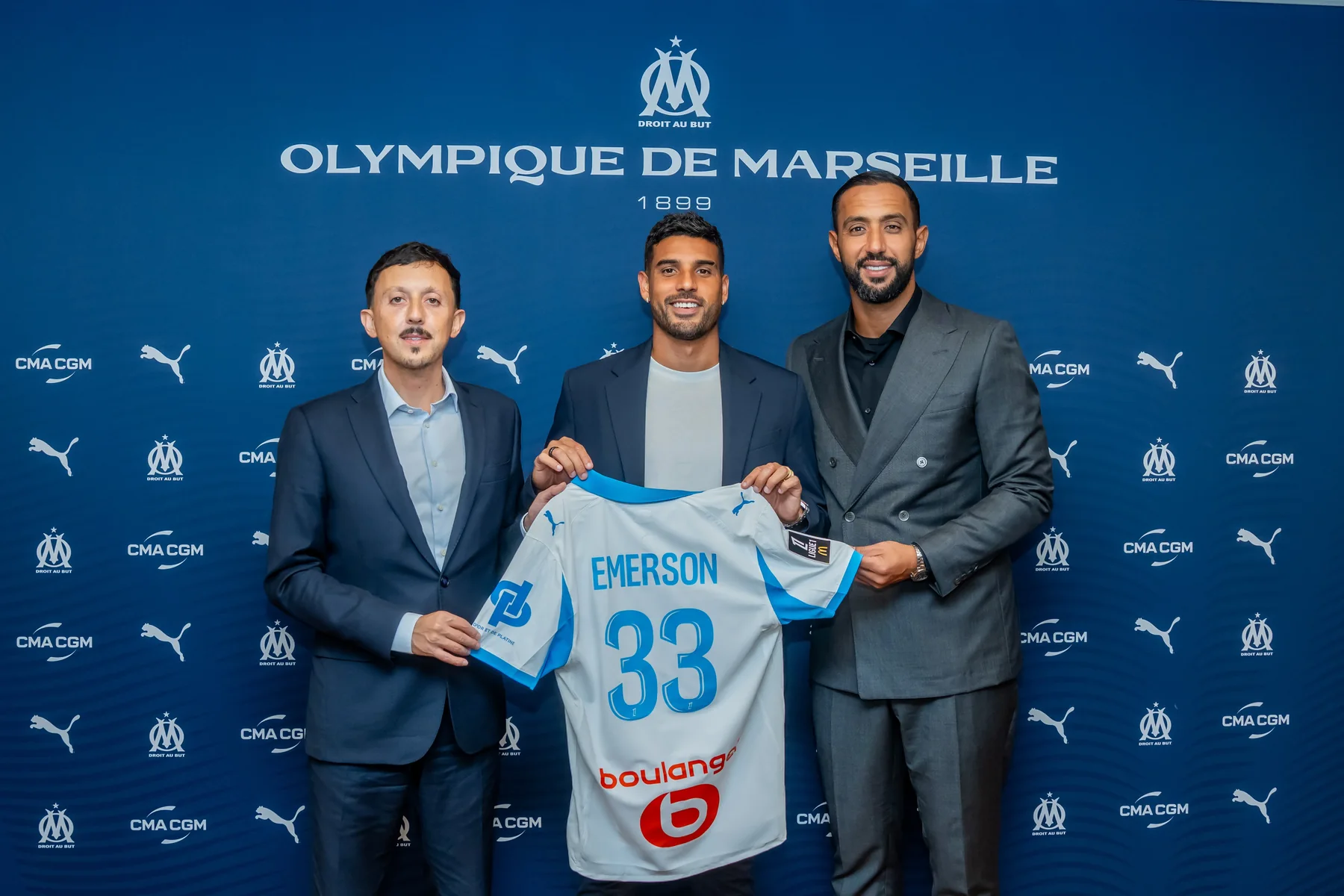
Marseille’s 2026/27 squad combines experienced internationals, younger alternatives and players whose roles extend beyond a single position label. This guide follows OM’s published men’s first-team directory as checked on 20 October 2026, explaining the players available to Bruno Genesio and the relationships that turn a squad list into a team.
The Marseille squad in October 2026
Marseille’s 2026/27 men’s squad is led by Bruno Génésio and combines experienced midfielders, several established defensive options and a forward group headed by Amine Gouiri and Igor Paixão. The names below follow the club’s official first-team page as checked on 20 October 2026. They describe the published senior group, rather than a promise about who starts the next match.
| Club category | Players |
|---|---|
| Goalkeepers | Jeffrey de Lange, Jelle Van Neck, Théo Vermot |
| Defenders | CJ Egan-Riley, Derek Cornelius, Bamo Meïté, Timothy Weah, Ulisses Garcia, Emerson Palmieri, Nayef Aguerd |
| Midfielders | Tochukwu Nnadi, Angel Gomes, Himad Abdelli, Geoffrey Kondogbia, Pierre-Emile Højbjerg, Amine Harit |
| Forwards | Amine Gouiri, Neal Maupay, Igor Paixão, Faris Moumbagna, Tadjidine Mmadi, Keyliane Abdallah |
The category names are a starting point for watching the team. Weah appears among the defenders on OM’s page, yet his involvement in a match can extend much farther forward. A midfielder can receive near the centre-backs in one phase and support the penalty area in another. The useful question is how those movements fit together: who provides a passing option, who occupies the width and who protects the spaces left behind.
Génésio addressed that relationship at his summer presentation. He described an active approach to regaining possession and freedom with the ball, while stressing that positions still need to be occupied. That is a useful framework for this squad. Freedom for a creative player only helps the attack if a teammate maintains the team’s balance behind or beside him.
The timing of the list matters after a summer of change. A preseason projection can contain players who later departed, and a season statistics page can retain a player who made an earlier appearance. Neither should automatically override the current club list. Equally, a younger player can enter an actual matchday group without appearing prominently on the senior directory. The role explanations below use club profiles and identifiable matches to make those differences clearer.
For the immediate fixture, the today page provides the date’s matches, while the current table shows the wider league situation. This guide explains the people and the football choices behind those fixtures.
Goalkeepers: de Lange and the options behind him
Jeffrey de Lange is the central name in Marseille’s goalkeeping group, with Jelle Van Neck and Théo Vermot the other goalkeepers listed by the club. De Lange’s role has changed from a supporting option to the first choice discussed in his September press conference. Football Club de Marseille’s report of that appearance explains both the increased responsibility and his continuing involvement in building attacks.
The same report describes a positional adjustment under Génésio: de Lange remains more central while still giving teammates a passing option. That is a useful detail for a supporter watching Marseille’s first passes. A goalkeeper who offers a return ball can help a defender escape pressure, but the location of that option changes the angles available. The task is not simply to make ambitious passes; it is to help the team reach a player who can continue the move.
His defensive workload also needs a team context. A 26 September analysis, citing FotMob, recorded 31 shots on target conceded across Marseille’s first five league matches. That is a dated early-season snapshot, rather than a current total or a complete judgment of the goalkeeper. It identifies why protection in front of him matters: repeated shots reaching the target keep asking the keeper to rescue situations after earlier defensive lines have been bypassed.
For Van Neck and Vermot, the published squad establishes the available names without settling every future selection. Their presence supplies alternatives in the position, while the next team sheet determines who actually plays. A change of goalkeeper can also alter familiarity with the defenders’ passing and positioning habits. Those relationships are part of goalkeeping depth even when a reserve has not accumulated the same visible match record as the regular starter.
Watch de Lange’s decisions together with the centre-backs and midfielders nearest him. A rushed clearance may begin with the absence of an easy receiver; a clean escape from pressure may depend on a teammate moving at the right moment. That makes his position a useful entry point into the squad’s collective organisation.
Defence: central partnerships and width from the sides
The defensive group is easiest to understand through its relationships. Central defenders must protect the penalty area and start moves; the players on the sides need to provide width without making the centre impossible to defend when possession changes. Marseille have several names for those tasks, but the balance depends on who plays together and how high the team chooses to defend.
Aguerd, Egan-Riley and the centre-back group
Nayef Aguerd and CJ Egan-Riley formed the central pair identified in PSG’s official pre-match account of the September Classique. That is a concrete example of their use this season, rather than a guarantee that the same partnership starts every fixture. Derek Cornelius and Bamo Meïté are also in the club’s published defensive group, giving the coach additional central options.
Aguerd’s involvement in distribution has a clear earlier illustration. The league recorded 118 attempted passes in Marseille’s 4–0 win against Lorient in September 2025. The match report also makes the context important: Lorient were reduced to ten men early. The figure demonstrates how frequently a centre-back can become involved when OM have the ball; it cannot be used as a normal expectation against every opponent or as a current-season average.
Egan-Riley brings a useful perspective on the other half of the job. In a Burnley interview after facing Leeds in January 2025, he emphasised the work of the forwards and midfield in preventing goals, alongside the defenders. That history does not prove Marseille will reproduce Burnley’s record. It does explain why judging him only by the final defensive action misses the pressure, second balls and passing lanes that determine what reaches the centre-backs.
Weah, Emerson and Garcia on the flanks
Timothy Weah illustrates the limits of a single position label. The league’s transfer coverage noted that OM announced him as a right winger, while the current club directory places him among the defenders. His speed and experience in several roles give the right side flexibility. When he advances, the nearest midfielder and centre-back must still account for the space behind him; attacking range and defensive responsibility are connected.
Emerson Palmieri and Ulisses Garcia provide the left-sided options. Emerson arrived from West Ham in September 2025, with the league’s deadline-day account documenting the move. Garcia offers another player for that side of the defensive group. The important comparison is the partnership with the player ahead of them: if a winger comes inside, an overlapping full-back can maintain width; if the winger stays wide, a more restrained supporting position can protect the next transition. The team’s shape comes from those complementary decisions, rather than the number of defenders written on a formation graphic.
Midfield: connecting control with chance creation
The midfield contains several different ways to move the ball forward. A deeper midfielder can offer the centre-backs a safe pass, change the direction of an attack and cover a full-back who has advanced. A player receiving farther forward has a different problem: turning a promising position into a pass or carry that threatens the penalty area. Marseille’s options overlap, but their responsibilities should still be distinguished.
The deeper options: Højbjerg, Kondogbia and Nnadi
Pierre-Emile Højbjerg provides an established reference for circulation. The league’s October 2024 profile highlighted his frequent involvement in possession and passing through opposition lines. Those figures belong to an earlier season, but they identify a relevant part of his game: making himself available repeatedly so that an attack can be restarted or redirected. A midfielder who performs that task helps the team avoid forcing every move through the same crowded channel.
Geoffrey Kondogbia gives the group another experienced option for the space in front of the defence. His positional history also includes covering in a back three, as the league discussed in April 2025 coverage of Marseille’s defensive options. That is background about versatility, rather than an October injury update. Moving a midfielder deeper can help a side adapt during a game, although it also changes who is available to receive the next pass in midfield.
Tochukwu Nnadi has already supplied a useful illustration of how running and distribution can work together. The league reported that his first OM start came in the 1–1 draw with Nice in April 2026, when he supplied the ball for Højbjerg’s goal. The account of that performance described his ground coverage as well as his passing. It gives his place in the squad more substance than calling him simply a defensive midfielder. It does not establish an automatic starting position in the new season.
Gomes, Abdelli and Harit between the lines
Angel Gomes adds a player with experience connecting possession in tight spaces. When the league covered his 2025 arrival, it emphasised his passing and versatility after his years at Lille, including work under Genesio. He can contribute from deeper positions as well as nearer the forwards. The useful question is where he can receive with an angle to play forward, and which teammate protects the space if he moves ahead of the ball.
Himad Abdelli arrived from Angers in February 2026 with substantial first-team experience. The league’s transfer summary recorded 119 Angers appearances, 19 goals and six assists, alongside his captaincy in 2024/25. Those are Angers figures, not his Marseille totals. They explain why his profile includes responsibility in possession and a contribution near goal, rather than only recovering the ball. His use beside Højbjerg in September’s Classique also shows that an attacking background does not confine him to the highest midfield position.
Amine Harit is listed as a midfielder but was used on the right in that same Classique example. Receiving from a wide starting point can still involve moving into the space between the opposing midfield and defence. The distinction matters for the team around him: a wide creator coming inside needs width from another player and a route back if the move breaks down. Gomes, Abdelli and Harit therefore expand the coach’s combinations; selecting several creators together still requires a coherent plan for both the ball and the space they leave.
Attack: Gouiri, Paixão and the forward alternatives
Amine Gouiri and Igor Paixão give Marseille two prominent reference points in attack, but the most useful way to watch them is through their interaction with teammates. A forward can create the space for somebody else to score without receiving the final pass. Equally, a winger’s starting position does not tell the whole story of where he will appear when the move reaches the penalty area.
Gouiri’s central role and Paixão’s movement
Gouiri is the number nine in the current club list, yet his earlier Marseille performances show more than penalty-area finishing. In February 2025, against Angers, he supplied the cross for Adrien Rabiot’s opener and the assist for Neal Maupay’s second goal. The league’s account of that match described a forward also being used behind the striker and moving towards the left. That history helps explain why his central role can include coming towards the ball, combining and then arriving again near goal.
The opening match of 2026/27 provides a more recent picture of the attacking connections. In Marseille’s 4–0 win over Strasbourg, a Paixão run opened the move, Gomes supplied the pass and Gouiri finished the first goal. Gouiri later scored a penalty after a foul on Paixão. The official league report also records Strasbourg’s red card, an important part of the context for the final margin. The sequence before the opener nevertheless shows why the forwards cannot be assessed independently of the midfielder joining them.
Paixão arrived from Feyenoord as a left-sided winger, but movement across the attack can make that label flexible. His run in the Strasbourg example developed from the right in the league’s account. By contrast, standing wide on the left can stretch a back line and create an inside passing lane for a teammate. These are complementary ways to threaten a defence, and the useful question is whether Marseille still occupy the other attacking spaces when he moves.
The league’s August 2026 profile of Paixão framed his second season around greater responsibility after the departures of Mason Greenwood and Pierre-Emerick Aubameyang. It recorded six league goals and four Champions League goals in his first OM season. Those are separate competition totals from 2025/26. The practical challenge now is sustaining an influence over complete matches: offering an outlet when OM are under pressure, combining when opponents defend deep, and recovering a useful position after an attack ends.
Maupay, Moumbagna and the younger forwards
Maupay’s presence gives Genesio another way to arrange the central attack. His goal from Gouiri’s assist against Angers is a concrete earlier example of the two combining. In September 2026, PSG’s pre-match account described Maupay coming into the side for Gomes to support Gouiri. That change alters the relationship behind the lead forward without requiring every other player to change his position. It is evidence of an available combination, rather than a claim that Maupay starts every match.
Faris Moumbagna, Tadjidine Mmadi and Keyliane Abdallah complete the published forward group. Abdallah already has a specific first-team landmark this season: the Strasbourg report records his first Ligue 1 goal after coming off the bench, on his fourth OM appearance. A substitute adding a goal can change how a coach views the final part of a game, especially when the first attacking group has already stretched the opposing defence.
For Moumbagna and Mmadi, the current directory establishes their inclusion without establishing a fixed share of the minutes. Their relevance is the additional choice they give the staff across a long calendar. A coach may need a fresh central presence, another runner or a different partnership when the opening plan is no longer working. The match selection and actual substitution show which responsibility a forward is being asked to perform on that day.
How the squad becomes a matchday eleven
Genesio’s selections turn these individual profiles into a set of connected tasks. At his July presentation, he described wanting proactive ball recovery and freedom in possession while keeping positions occupied. That combination helps explain why movement alone is not the objective. If a forward comes short, somebody else needs to threaten beyond him; if a full-back moves high, the rest of the team must be positioned to deal with a lost pass.
The September choice of Maupay in place of Gomes offers one example of changing the connection around Gouiri. Keeping a second forward close can provide another target near the penalty area. Using a midfielder in that space instead can add a receiver during the approach. Neither choice removes the need for width, protection in midfield or support for the centre-backs. The effect of one selection depends on the other ten players and what the opposition are allowing Marseille to do.
Watch the first pass after OM regain possession. Højbjerg showing centrally, a defender carrying forward and Paixão offering a wider outlet create different routes out of pressure. Then watch who moves when that pass is made. The attacker running away from the ball may be opening a lane for Harit or Abdelli, while the midfielder who stays behind the move may be preventing a counterattack. These details make the published position labels useful starting points for understanding the team rather than complete explanations of a performance.
The same principle applies to substitutions. Abdallah’s first league goal already illustrates a younger forward making a contribution from the bench. A fresh attacker can attack spaces created by the earlier work of the starters; a defensive change can help protect a lead or release another player to advance. The important evidence is the actual responsibility after the change, alongside the score and the time remaining.
For the next fixture, use the today’s matches page and the 2026/27 calendar, then read the confirmed team sheet when it is available. The season results give the competitive context. This squad guide explains the available names and their relationships as checked on 20 October; the final selection shows how Genesio chooses to combine them for a particular opponent.
Loading comments…