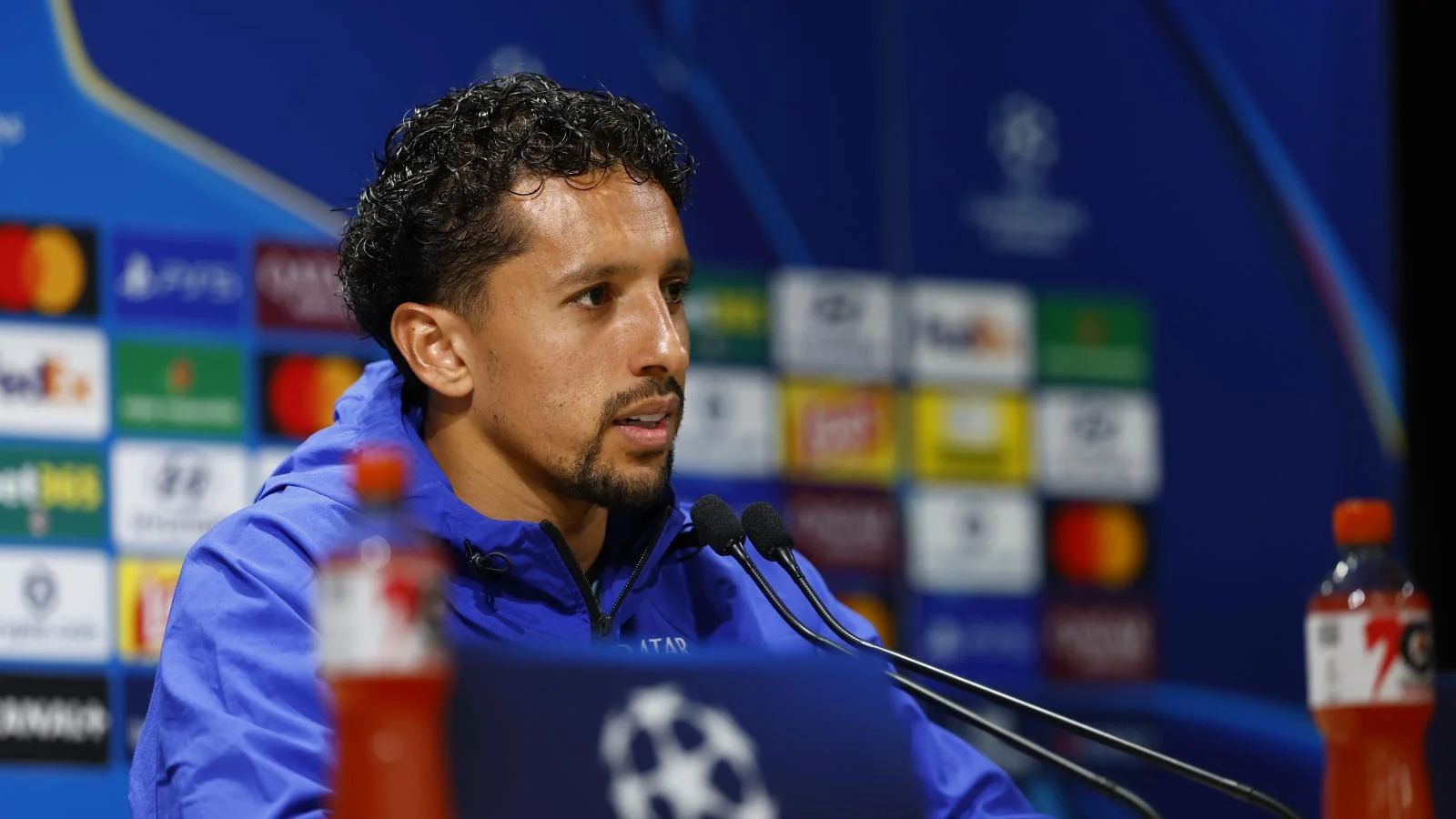
Marquinhos is PSG’s Brazilian captain and central defender, whose long Paris career connects domestic titles, appearance records and the club’s Champions League breakthrough. His full name is Marcos Aoás Corrêa. This guide explains his identity, route from Corinthians and Roma, defensive responsibilities and major honours, with facts checked on 20 October 2026 and historical milestones kept separate from changing match totals.
Which Marquinhos plays for PSG?
The PSG captain known as Marquinhos is Marcos Aoás Corrêa, the Brazilian defender born in São Paulo on 14 May 1994. He wears number 5 for Paris Saint-Germain. Those identifiers matter because “Marquinhos” is used by more than one footballer, and a bare name in a search result can lead to the wrong career, club or set of statistics. PSG’s official player profile confirms the full name and shirt number.
His Paris identity is built around centre-back and captaincy. The first describes the principal playing responsibility; the second adds a leadership role within the team. Neither should be reduced to a reputation which decides the quality of every performance in advance. An experienced captain can make an error, and a quiet defensive match can contain important work that never becomes a highlight. The useful starting point is knowing which player is being assessed and what the team asks him to do.
Full name, age, nationality and shirt number
Marquinhos is 32 on 20 October 2026. His birth date is the lasting reference; the age belongs to this guide’s fact-check date. PSG lists him at 183 centimetres and identifies him as right-footed. He represents Brazil internationally while playing his club football in France, another distinction worth preserving when reading a trophy record that includes both club and country.
The number 5 helps a new supporter locate him in PSG’s defensive line, but his importance is easier to understand by watching the space around him. Look at his distance from the other centre-back, his position when a full-back advances and the passing options he offers when PSG begin an attack. Those details explain how the role connects to the rest of the side.
Getting the identity right also makes historical comparisons more meaningful. A list of appearances for this PSG captain is not a record belonging to another Brazilian with the same familiar name. A club milestone belongs to Paris, while an international medal belongs to the Brazil team that earned it. His story becomes clearer when the name, the team and the competition stay connected.
From Corinthians and Roma to Paris
The early move into European football
Marquinhos developed at Corinthians before joining Roma in 2012. His Italian spell was brief enough that the next transfer still concerned a teenage defender: PSG signed him on 19 July 2013, when he was 19. UEFA’s contemporary signing report records 26 Serie A appearances for Roma in the preceding season. That is a league figure, rather than the complete appearance total across Italian competitions.
Moving between those environments at such a young age is a significant part of the career. A centre-back has to learn opponents’ movements, coordinate with a defensive partner and judge when to step forward. Experience can improve those decisions, but it cannot be borrowed simply by joining a successful team. The teenager arriving in Paris and the later captain should therefore be understood as different stages of development, connected by years of competitive responsibility.
The longevity which followed was not inevitable in July 2013. A signing announcement establishes a date and an intention. Only the subsequent seasons can demonstrate whether a player remains useful through changes of teammates, coaches and match demands. His early European experience supplied the starting point for that process, rather than a finished explanation of everything he would become.
Growing into a long PSG career
The 2020 Champions League run offers two clear examples of an expanding contribution. Against Atalanta in the quarter-final, Marquinhos equalised in the 90th minute before Eric Maxim Choupo-Moting completed the late 2-1 turnaround. UEFA’s match report records a goal which changed Paris’ immediate prospects from elimination to renewed opportunity.
Six days later, his early header put PSG ahead against Leipzig in a 3-0 semi-final win, confirmed in UEFA’s semi-final report. The two goals occurred in different game states: one rescued a match late, while the other helped establish an early advantage. Both made him part of the route to the club’s first Champions League final.
Goals are not a complete measure of a defensive player, but these moments belong in the career story because they show how his influence reached beyond a basic positional label. The later captain inherited the responsibility of helping PSG perform in matches whose consequences he had already experienced directly. That history explains the emotional weight of subsequent European success without making every earlier season merely a footnote to it.
What his captaincy means on the pitch
Following Thiago Silva
Marquinhos succeeded Thiago Silva as PSG’s club captain after his fellow Brazilian left in summer 2020. PSG’s official biography sets out that succession. It connects two parts of his Paris career: first learning and playing alongside a senior defensive figure, then becoming the player wearing the armband as a new group developed around him. The responsibility grew within the club rather than arriving with the teenager who signed in 2013.
Captaincy should still be understood within the coach’s organisation. The captain can help communicate, maintain concentration and coordinate teammates, but an armband does not mean he independently determines every tactical decision. It is also different from being the only leader. A goalkeeper sees the pitch from behind the defence, midfielders organise their own spaces and other experienced players can influence the response to a difficult moment.
For a supporter, the most useful evidence is often practical. Does the defensive line move together when the ball is played backwards? Is the nearest teammate aware of an unmarked runner? After an interruption, does the team recover its positions before play resumes? Those are observable parts of a captain’s playing environment. They offer a firmer basis for assessment than inventing a speech or assigning a private emotion to a television close-up.
Organising the space behind PSG’s attack
PSG’s attacking ambition creates demanding situations for the defenders behind it. UEFA’s 2025 analysis of the victory at Liverpool highlighted Marquinhos and Willian Pacho taking turns to delay Mohamed Salah after a counterattack. Giving teammates time to recover was the achievement. The useful action was not necessarily the most aggressive attempt to win the ball immediately.
Delay is valuable because the numbers around a counterattack can change within seconds. If a defender commits too early and is beaten, the covering teammate faces a harder situation. If he can restrict the attacker’s direction without giving away a clean shooting route, recovering players may restore the team’s balance. The best decision depends on the attacker’s support and distance from goal; caution and initiative are both tools rather than permanent opposites.
A later Anfield visit supplied another specific example. In its April 2026 technical review, UEFA identified Marquinhos’s first-half block to deny Virgil van Dijk as crucial. The same report explained PSG’s adjustment towards a more direct approach against Liverpool’s pressure. It shows the wider setting: defending a difficult period and choosing how to escape pressure can be connected parts of managing the game.
These examples do not establish that he, or PSG, defend perfectly in every match. They show the particular decisions which help explain his role. A captain at centre-back can contribute through positioning, communication, a controlled delay or an emergency intervention. Assessing those actions in sequence gives substance to the word leadership.
The appearance record and the value of continuity
Marquinhos became PSG’s all-time appearance leader when he reached 436 matches in April 2024, passing Jean-Marc Pilorget. The club records that milestone in its official biography. It later marked 500 appearances with a dedicated career gallery. These are fixed landmarks in a continuing career, rather than a claim that the later number remains his current total.
The competition boundary matters. A club appearance record across all competitions includes more than Ligue 1. European matches and domestic cups help build the total, and a season with progress in several tournaments offers more opportunities than one ending early in those competitions. Comparing that number directly with another player’s league-only record would give a misleading impression, even if both figures were correctly copied.
An appearance is also different from a complete match. A substitute can add one to the record while playing only a short spell. A player who starts and is withdrawn contributes another appearance with a different number of minutes. Neither type should be discarded, but the total alone cannot establish workload, responsibility or consistency. To understand a particular season, examine minutes and the occasions on which the player was trusted to begin important matches.
What the long record clearly establishes is sustained participation. For a defender, that can provide an important form of continuity as teammates change. A familiar reference point can help a new partner understand spacing, the rhythm of moving the line and the choices available in possession. Those relationships still have to be built on the training pitch and tested in games; knowing the club well does not remove the need to adapt.
Continuity also gives supporters a way to connect different versions of PSG. Marquinhos arrived long before the first Champions League final, played a part in reaching it and remained for the eventual European title. His record spans those stages. It therefore carries historical meaning beyond the individual matches, showing how one career can overlap with changes in a club’s ambitions and identity.
The fairest interpretation keeps achievement and present form distinct. A record holder deserves recognition for the years required to build the record. His next performance still involves fresh decisions against a specific opponent. Appreciating the long career while assessing the current game on its evidence allows both parts of the story to remain meaningful.
How to read Marquinhos’s trophy record
Marquinhos’s honours connect the domestic dominance of PSG with major achievements for Brazil. A useful account separates competitions and teams before adding anything together. A French league medal records a different campaign from a knockout cup, while a national-team title belongs to another group of players and another qualification process. Understanding those distinctions makes the achievements more concrete than a single large total.
Domestic titles and the European breakthrough
The league’s own April 2025 tribute marked his tenth personal Ligue 1 title. That wording matters: it describes the player’s collection, rather than saying PSG had won ten championships in its entire history. It also fixes the statement to the 2024/25 championship, so it should not be presented as a permanently current total.
The first Champions League victory carries a different historical weight. PSG beat Inter 5–0 on 31 May 2025, with Marquinhos captaining the team that delivered the club’s first European title in that competition. UEFA’s final report supplies the result and the match context. The official PSG biography subsequently records a second Champions League success in 2026.
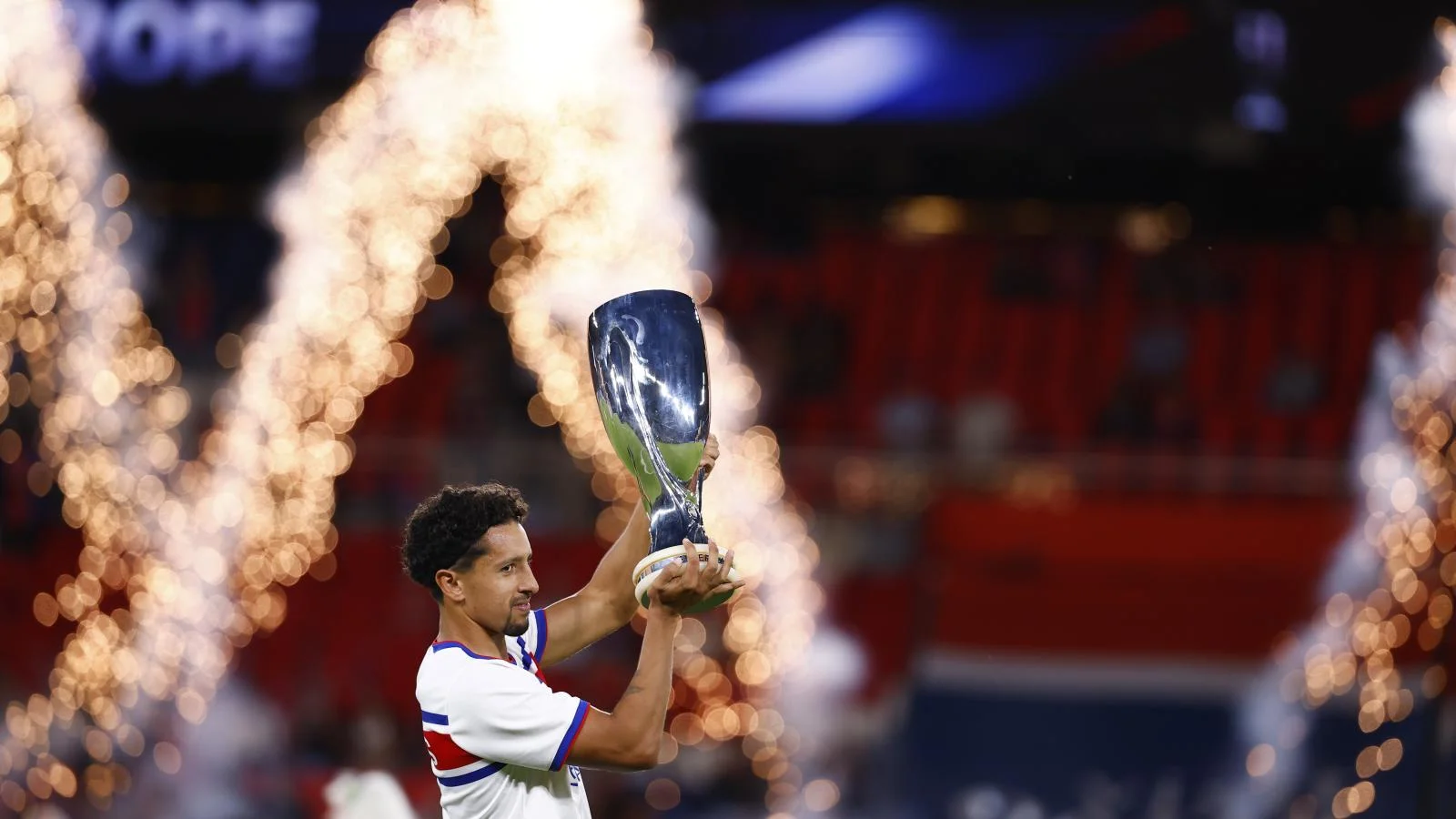
A cup lifted by a captain is a powerful image, but it represents contributions distributed across a squad and a season. Some players provide decisive goals, others make recovery runs or preserve possession under pressure, and substitutes can change a match. Marquinhos’s leadership belongs inside that collective story. His individual continuity explains why the moment resonated; it does not turn a team achievement into the work of one defender.
Brazil honours belong to a separate story
The official club biography also records Olympic gold with Brazil in 2016 and the Copa América title in 2019. These achievements should be named individually. Olympic football has its own eligibility structure and tournament history; an Olympic gold medal is not a senior World Cup title. Copa América is the continental senior international championship.
Playing for Brazil also changes the surroundings in which a defender works. The teammates available, the preparation time and the pattern of tournament matches differ from a long club season. It would therefore be misleading to assume that a successful PSG partnership automatically describes his national-team role. International medals add a distinct chapter to his career rather than simply extending the list of Paris trophies.
Following his next Ligue 1 appearance
For the next match, start with the Ligue 1 matches today page, then confirm the official team sheet. Captaincy, reputation and historical appearance totals cannot guarantee a start. The opponent, the manager’s selection and the player’s availability determine the actual assignment. A preview should describe that uncertainty until the lineup is published.
During the game, watch how he positions himself before a pass reaches the opposition striker. Does he step forward with support behind him, or delay the attack so teammates can recover? When PSG have the ball, notice whether his pass helps a teammate receive facing forward. These observations give more information about a central defender’s contribution than waiting only for a goal or a spectacular clearance.
Afterward, the 2026/27 table supplies the team consequence of the result. The match performance and the career record answer different questions. One explains how Marquinhos handled the immediate task; the other explains why his place in PSG’s history was established over many years.
Loading comments…