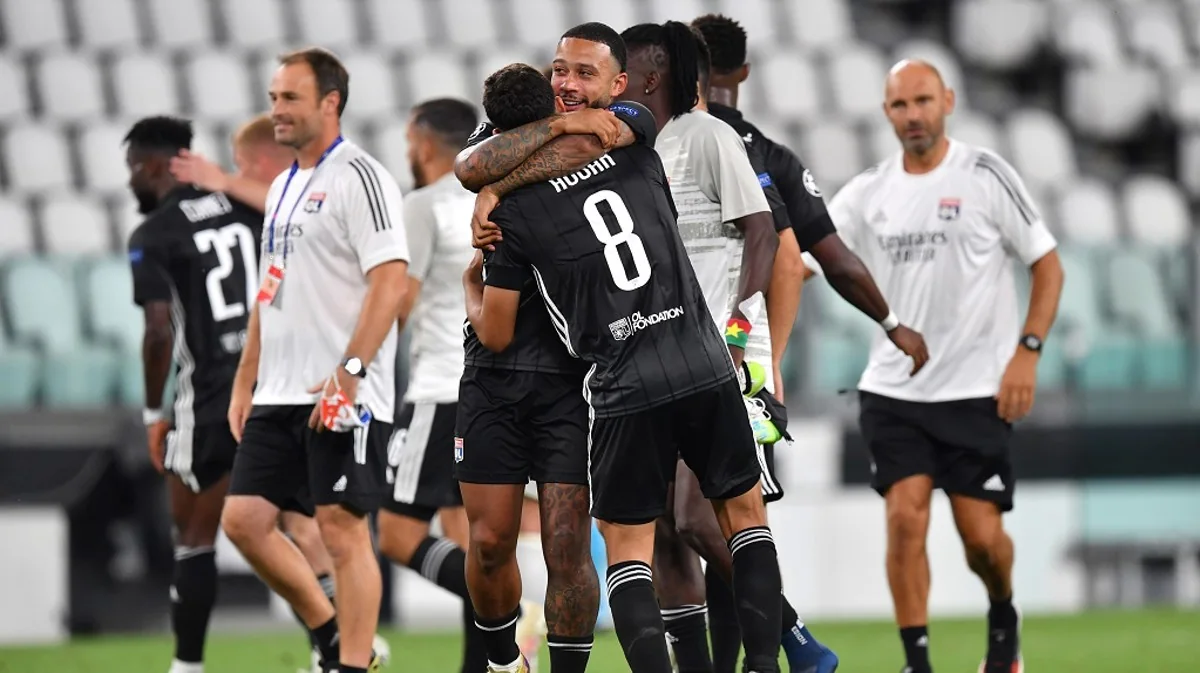
Lyon’s men have reached two Champions League semi-finals, in 2010 and 2020, but have never won the competition. Their 2026/27 attempt ended in August qualifying against Fenerbahçe. This guide connects that latest outcome with the campaigns, opponents and players that built OL’s European reputation. Facts checked on 20 October 2026.
Are Lyon in the 2026/27 Champions League?
Lyon’s men played in Champions League qualifying in August 2026, but did not reach the league phase. Their campaign ended in the play-offs against Fenerbahçe, who won 3–2 on aggregate. As of 20 October 2026, Lyon’s European season belongs to the Europa League. That distinction matters when searching for “Lyon Champions League 2026” or “Olympique Lyonnais Champions League 26/27”: a UEFA club profile can remain visible after elimination because it records matches already played.
The four-match qualifying route
The official qualifying results show two very different two-legged ties. Lyon first lost 2–1 away to Sparta Praha on 4 August, then won 3–0 at home on 11 August to advance 4–2 overall. A first-leg deficit was recoverable because the return remained a full match in Lyon, and OL supplied the response required to turn the tie. Winning that round earned another hurdle rather than a place among the final 36.
The play-off began with a 1–1 draw in Istanbul on 18 August. UEFA’s return-leg preview records Loïs Openda putting Lyon ahead before Mason Greenwood equalised just after half-time. That left the teams level for the return, rather than giving Lyon a decisive cushion. The home leg on 26 August then went against them: Fenerbahçe won 2–1, turning the two-match balance in the visitors’ favour.
The Turkish federation’s match report supplies the turning points: Vedat Muriqi scored in the 24th minute and Archie Brown in the 28th, before Malick Fofana replied after 61 minutes. Two goals in four first-half minutes meant Lyon were chasing a substantial deficit at their own ground. Fofana’s goal reduced it, but did not change who advanced. The score sequence explains the pressure without requiring a claim that Lyon controlled, or failed to control, every phase of play.
Why Lyon moved into the Europa League
UEFA’s qualifying explanation states that defeated Champions League play-off teams move directly into the Europa League league phase. Lyon therefore lost access to one competition while retaining European football in another. “Eliminated from the Champions League” and “eliminated from Europe” describe different outcomes here.
For supporters following the next route back, the Ligue 1 table gives the domestic race its changing context. The August results are completed history; the league position remains an ongoing contest. Keeping those timelines separate prevents an old qualifying preview or a prominent UEFA page from being mistaken for an upcoming Champions League match.
How Lyon became a regular Champions League club
Lyon’s reputation was built through repeated knockout appearances before either semi-final. The sequence in UEFA’s historical archive runs from quarter-finals in 2003/04, 2004/05 and 2005/06 to three successive round-of-16 finishes between 2006/07 and 2008/09. For a supporter encountering OL through the dramatic 2020 run, that earlier continuity is essential context. Lyon had already spent years treating the last eight as a realistic ambition.
The three quarter-final campaigns did not arrive by an identical route. In March 2004, Juninho scored the only goal of the home return against Real Sociedad, completing a 2–0 aggregate win. The UEFA report from Stade Gerland describes a tight game, with the decisive finish following Péguy Luyindula’s work down the left. It was a reminder that a close first-leg advantage still demanded patience and concentration at home. Juninho supplied the final touch, but the move was open-play combination football rather than one of his famous direct free-kicks.
A year later, OL’s return against Werder Bremen was emphatic: 7–2 on the night, 10–2 on aggregate. Sylvain Wiltord scored a hat-trick and Michael Essien twice, as the official match report records. Bremen needed to attack after losing the first leg 3–0; Lyon punished the spaces that followed. Comparing that match with the Sociedad return shows why a club’s European identity cannot be reduced to one scoreline or one player. The same broader period included narrow protection of a lead and ruthless exploitation of an opponent chasing a tie.
The 2006 quarter-final against Milan exposed the finer margin at the next level. After a scoreless first leg, Mahamadou Diarra’s equaliser in Italy left Lyon on course to progress under the away-goals rule then in force. Late goals from Filippo Inzaghi and Andriy Shevchenko instead produced a 3–1 defeat. UEFA’s account of that finish explains how close the first semi-final had appeared. Reaching the same round three times showed sustained quality; repeatedly stopping there did not mean the matches had been interchangeable.
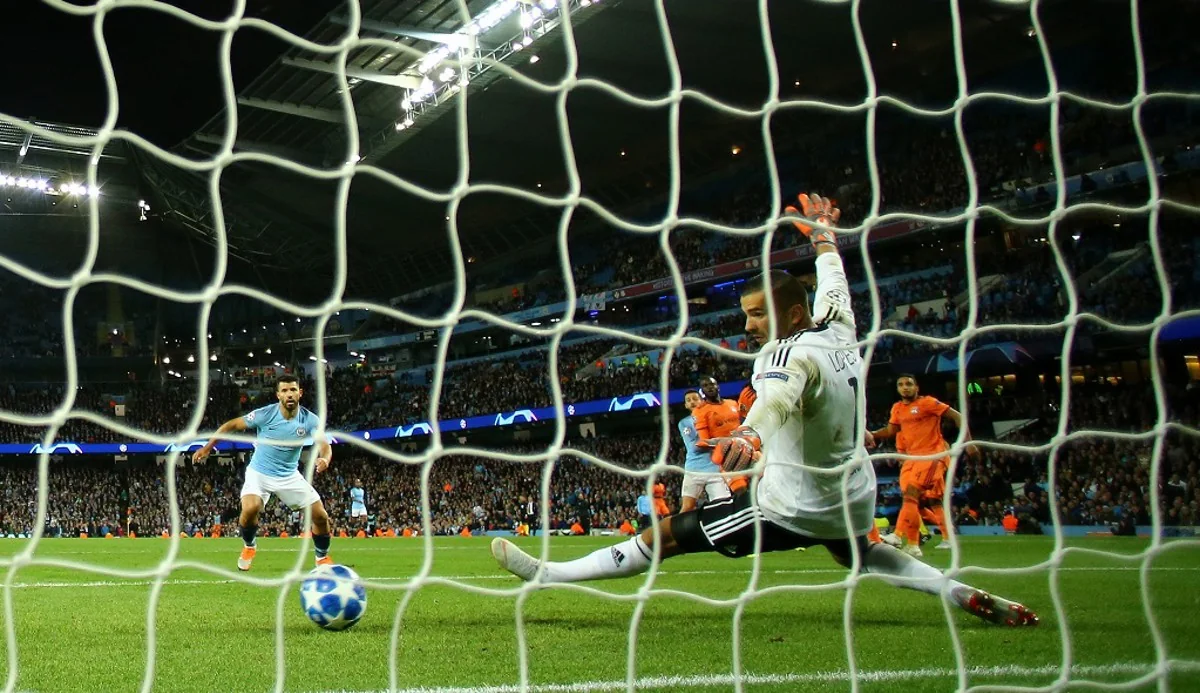
Later meetings with Manchester City renewed that capacity to trouble leading opposition. OL won 2–1 in Manchester and drew 2–2 at home in the 2018/19 group stage, according to City’s own historical preview. That is the context of the photograph below. It belongs to Lyon’s European past, rather than the August 2026 qualifying campaign.
2010: the first semi-final breakthrough
The 2009/10 campaign finally moved Lyon beyond the quarter-final ceiling. Its importance lies in the whole knockout sequence: an established European giant, a domestic rival, and then Bayern München. Each tie asked a different question of Claude Puel’s side. The first required a result in Madrid, the second demanded protection of a lead in Bordeaux, and the last exposed how difficult it remained to take the final step.
Real Madrid and Bordeaux before Bayern
Lyon beat Real Madrid 1–0 at home on 16 February 2010 and drew 1–1 at the Bernabéu on 10 March. The UEFA match archive remembers the return through Miralem Pjanić’s decisive contribution. The aggregate score was 2–1 to OL. A home win alone would have remained an unfinished achievement; following it with a draw in Spain made the advantage survive both venues. That distinction is central to why this tie still stands out in the club’s European memory.
The quarter-final was entirely French. Lyon established a 3–1 home advantage against Bordeaux on 30 March, then lost the return 1–0 on 7 April while advancing 3–2 overall. UEFA’s season results publication records both legs. Calling the return a defeat is accurate; treating it as failure misses the purpose of a two-match tie. Lyon had earned a margin at home and preserved enough of it away to reach the last four.
An all-French draw guaranteed one French semi-finalist, but did not guarantee Lyon’s place. Familiar domestic opposition can make a tie feel less exotic while leaving the stakes just as severe. For OL, the useful comparison is with the earlier quarter-final exits: the club now had a completed example of surviving that round, rather than another near miss to explain. It also shows why aggregate results belong alongside individual scorelines in any account of the run.
Bayern ended it decisively. Arjen Robben’s goal settled the first leg 1–0 in Munich; the return at Gerland finished 3–0 to the German side. In the official return-leg report, Ivica Olić’s hat-trick and Cris’s dismissal are the defining events. Once Bayern had scored in Lyon and OL had lost their captain to a red card, the recovery task had become far harder than overturning a single-goal first-leg deficit.
The final 4–0 aggregate margin should be preserved alongside the achievement of getting there. Lyon had not reached a final, and there is no need to soften the semifinal outcome. Equally, the Bayern result does not erase victories across two earlier knockout rounds. For a club repeatedly halted in the last eight during the preceding decade, 2010 established a higher historical benchmark: a Champions League semi-final that a later generation would have to match.
2020: Juventus, Manchester City and a second semi-final
Ten years after the first breakthrough, Rudi Garcia’s Lyon matched it under exceptional circumstances. The 2019/20 Champions League finished in August, and OL’s route combined an ordinary two-legged round of 16 with single-match knockout games in Lisbon. It is therefore misleading to compare the raw number of matches in the two semi-final campaigns as though the tournament had followed the same calendar and format. The achievement was the same finishing round; the path to it was different.
Two legs against Juventus, one match against City
Lyon took their first advantage against Juventus in February. Lucas Tousart’s goal, made by Houssem Aouar, delivered a 1–0 home win on 26 February. The UEFA first-leg report identifies both the scorer and the creative contribution. Aouar’s importance was broader than a final pass: UEFA’s observer recognised his technique under pressure and his defensive work. Against a strong opponent, progressing the ball and helping the midfield compete were connected tasks.
The return finally took place in Turin on 7 August. Memphis Depay’s early penalty meant Juventus needed three goals to overturn the tie. Cristiano Ronaldo supplied two, but a 2–1 home win left the aggregate score at 2–2. Lyon advanced because they had scored away while Juventus had failed to score in France. Both UEFA’s return-leg report and Juventus’ own report explain the away-goals outcome. That was the rule applied to this historical tie; it should not be assumed to describe a current qualifying scenario.
The quarter-final against Manchester City on 15 August offered no return leg in which to repair a bad evening. Maxwel Cornet put Lyon ahead, Kevin De Bruyne equalised, and substitute Moussa Dembélé scored twice to secure a 3–1 win. This was Moussa, the former Celtic forward, rather than Ousmane Dembélé. The distinction is particularly useful for fans arriving at the result through today’s player searches.
UEFA’s match report shows how separate contributions fitted together. Cornet finished after a ball into the space behind City’s defence, Aouar released Dembélé for Lyon’s second, and Dembélé reacted to a parry for the third. OL’s back three and wide players provided the structure, while the substitute provided decisive finishing late in the match. Their win was more specific than a vague story of determination: they found routes forward, survived the equaliser and still had an attacking option capable of changing the score.
The earlier 2018/19 meetings gave this result an additional layer. City had already failed to beat Lyon over two group games, and Cornet had been a prominent threat. Repeated success against one opponent does not guarantee the next result, but it does make the quarter-final less isolated in hindsight. OL had evidence that their players could hurt City, rather than only an underdog’s hope of one fortunate moment.
The Bayern defeat in Lisbon
Bayern again stood between Lyon and a final. The 19 August semi-final finished 3–0, with Serge Gnabry scoring twice before Robert Lewandowski’s late header. The official report also records early Lyon chances: Depay hit the side-netting and Karl Toko Ekambi struck the post. Their threat behind Bayern’s high defensive line was real, but it did not produce the opening goal.
That sequence is a useful lesson in separating opportunity from outcome. Lyon could identify and attack space, yet Bayern converted their own chances and established the lead. Neither the chances alone nor the final score alone describes every stage of the contest. The complete picture is a promising Lyon start followed by a more clinical opponent taking control of the result. A second semi-final matched the club’s best finish, while another Bayern defeat preserved the limit of that achievement: OL’s men had still not reached a Champions League final.
The players and lessons behind Lyon’s European reputation
Juninho is the leading scorer displayed on UEFA’s Lyon Champions League history page, with 18 goals. Sidney Govou leads its appearance list on 71, just ahead of Anthony Réveillère on 70. Grégory Coupet and Juninho also feature prominently. These UEFA archive records give the long period of regular participation a human shape. Repeated knockout appearances required more than a single exceptional evening, and the same influential players returned to difficult European assignments over several seasons.
Goals and appearances tell different parts of that story. A leading scorer identifies decisive attacking contributions, while an appearance list preserves the importance of defenders, a goalkeeper and players trusted across changing opponents. Govou’s involvement in the 2005 Bremen goals and Coupet’s place in those earlier teams make that distinction concrete. A history built only around the player who applied the last touch would miss much of the structure that brought Lyon to the knockout rounds repeatedly.
The two semi-finals also belong to different generations. The 2010 team crossed a barrier that earlier quarter-finalists had approached; the 2020 side combined midfield creativity, defensive work and decisive contributions from a substitute. There is no need to turn that into one timeless tactical identity. The common thread is the club’s capacity, in those campaigns, to solve specific knockout problems against strong opponents. Lyon could win a home match, protect an aggregate advantage away, or make a one-off quarter-final turn on its late attacking choices.
One final distinction prevents a common misunderstanding. Lyon’s women have a separate, hugely successful Champions League history. They beat Wolfsburg 3–1 in the 2020 final, as the official women’s final report records. Those trophies should be celebrated in their own competition. They do not change the men’s best Champions League finish from semi-finals to winners. A search that simply says “Lyon European titles” needs the team and competition specified before the answer makes sense.
For the men in 2026/27, the immediate benchmark remains the August play-off exit and the domestic effort to earn another opportunity. Follow the latest league results alongside the current table to understand that effort. History provides useful expectations, but does not award a future European place. Lyon’s most memorable campaigns were earned one opponent at a time, and the same discipline is the fairest way to judge the next chapter.
Loading comments…