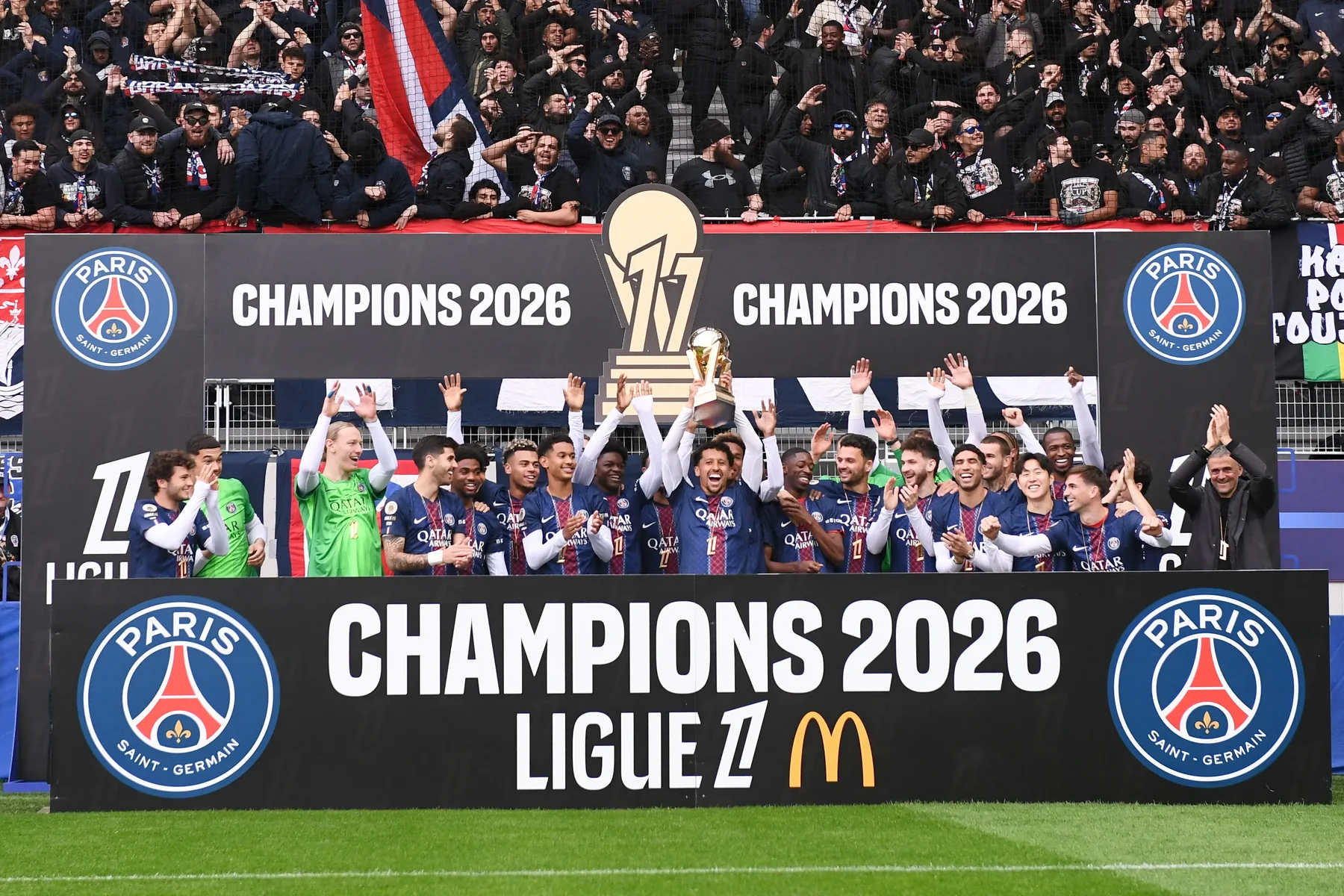
Paris Saint-Germain are the current record holders in French top-flight football with 14 titles through the completed 2025/26 season. They won that latest championship in May 2026, ahead of a 2026/27 campaign whose winner remains unknown. The names behind PSG—Saint-Étienne, Marseille, Monaco, Nantes and Lyon—tell different stories of how the French league has changed.
Who won Ligue 1 in 2025/26?
Paris Saint-Germain won the 2025/26 Ligue 1 title. That is the direct answer to “Who won Ligue 1 in 2026?” as of September 2026. The club clinched the championship with a 2–0 victory away to Lens, and the league confirmed it as PSG’s 14th French top-flight title and fifth in a row. The 2026/27 season is now under way, but its champion has not yet been decided. Keeping those two season labels separate prevents a completed achievement from being confused with an ongoing race.
PSG's latest title in context
The league’s title review identifies the decisive away victory at RC Lens and the milestones it created. It matters that the confirmation came through a direct meeting with a close pursuer rather than through someone else’s result alone. Lens had kept the race alive, so PSG’s win settled the question on the field against the club most able to prolong it. The season was therefore not simply an uninterrupted procession, even though the final answer is another PSG title.
Fourteen total titles also changes how the club is discussed historically. A fan who remembers Saint-Étienne as the long-time benchmark can now see how far PSG have moved ahead in the all-time league count. Yet “most titles” is not the only kind of dominance. Five successive championships measure a different achievement: maintaining enough performance through changes of opponents, players and schedules. That run is the reason PSG enter 2026/27 as a reference point, though the next title must still be earned on the current league table.
The distinction between title count and current form is useful beyond Paris. A historic giant can have a difficult present season, while a less decorated club can be the immediate challenger. Lens’ 2025/26 pursuit is a reminder of that. When assessing a present match, first check the relevant season’s results and the league position; use the honours list to add depth to the story, not to decide the next fixture in advance.
The champions of the last ten completed seasons
The last ten completed championship seasons, from 2016/17 through 2025/26, are a concise way to see the modern balance of power. The league’s season-by-season list gives PSG eight of those ten titles. AS Monaco won in 2016/17, and LOSC Lille won in 2020/21. Every season since Lille’s win has ended with PSG as champion. The pattern is striking because the exceptions are not spread randomly through time: Monaco and Lille each interrupted a strong Parisian period, and PSG then built its current five-season streak.
| Season | Champion |
|---|---|
| 2025/26 | Paris Saint-Germain |
| 2024/25 | Paris Saint-Germain |
| 2023/24 | Paris Saint-Germain |
| 2022/23 | Paris Saint-Germain |
| 2021/22 | Paris Saint-Germain |
| 2020/21 | LOSC Lille |
| 2019/20 | Paris Saint-Germain |
| 2018/19 | Paris Saint-Germain |
| 2017/18 | Paris Saint-Germain |
| 2016/17 | AS Monaco |
The table is a result record, not a claim that all ten seasons unfolded in the same way. In particular, 2019/20 was curtailed, so a reader comparing points or match totals across years should check each season’s competition context. The winner list still records PSG as champion. The helpful takeaway is that, even in an era of concentrated titles, an exceptional Monaco side and a well-built Lille side could finish above Paris. That keeps historical evidence from turning into a fatalistic forecast: a long run can be challenged, but a challenger must prove itself over a season rather than in one famous night.
Which French clubs have won the most league titles?
As of the completed 2025/26 season, Paris Saint-Germain lead the official French top-flight honours list with 14 championships. AS Saint-Étienne follow with ten and Olympique de Marseille with nine. Those numbers answer one narrow but important question: which clubs have finished first in the national league most often? They do not answer who plays the best football this week, who has the loudest stadium or which club has the broadest record across all competitions.
PSG, Saint-Étienne and Marseille
The league’s champions archive puts PSG on 14, Saint-Étienne on ten and Marseille on nine. It then has Monaco and Nantes level on eight, Lyon on seven, and Reims and Bordeaux on six. This ranking can surprise supporters whose first memories of French football come from a different era. PSG’s climb is relatively recent in the long history of a championship that began in 1932; Saint-Étienne’s greatest run belongs chiefly to the 1960s and 1970s; Lyon built its seven titles in one extraordinary consecutive sequence in the 2000s.
Saint-Étienne’s ten remain a substantial mark even though its last league championship was in 1980/81. The official archive describes eight of those ten titles arriving across the years from 1964 to 1976, with the other two in 1956/57 and 1980/81. That distribution reveals a long peak with repeated rebuilding rather than one brief hot season. It also explains why the club’s place in the all-time ranking can remain high while the modern Ligue 1 table tells a different story. A historical title is permanent; a division place and a current squad are not.
Marseille’s nine put it third under the same official count. Its significance to the league extends beyond the arithmetic: decades of rivalry with PSG and its run of championships around the turn of the 1990s make it central to many fans’ view of French football. Still, a “best French club” argument needs its criteria stated. If the criterion is league titles through May 2026, PSG lead. If the criterion is a particular historical decade, the order may change. If the criterion is current form, look at this season’s standings rather than the honours roll.
How to compare league titles fairly
First, count the same competition. The league championship is not the Coupe de France, a season-opening super cup or a European title. Those honours can enrich a club’s story, but adding them to a Ligue 1 total produces an answer to a different question. Second, name the period covered. The official archive starts with the national championship in 1932/33, when Olympique Lillois won the first listed season. It recognizes 19 different champion clubs across that history. A list limited to the modern “Ligue 1” brand years would produce a different picture from the complete top-flight championship history.
Third, take care with exceptional seasons and record conventions. The official season list does not assign a winner to 1992/93; it moves from 1991/92 to 1993/94. If another website presents a different Marseille total, check which seasons it counted before declaring either list a simple arithmetic error. This article follows the current league archive for consistency. The same caution applies to 2019/20: PSG appear as champions in the official list, but that campaign was curtailed, so comparisons of matches played or raw point totals across years need context.
Finally, distinguish champions from consistent challengers. The league’s podium history gives Monaco 31 top-three finishes through 2025/26, Marseille 29 and PSG 26. Monaco leads that particular measure despite having fewer championships than the other two. That does not overturn the title ranking. It shows why a richer conversation can ask two questions: how often did a club reach the top, and how often did it remain close? For a fan watching the present season, both are background. This year’s results must supply the current answer.
How the title race changed across eras
A winners list is most illuminating when read as a sequence of eras. Saint-Étienne’s peak, Lyon’s seven straight titles and PSG’s modern run did not happen under identical league conditions or with the same competitive field. Their common feature is the ability to turn a strong team into repeated first-place finishes. The interruptions matter just as much: they show what a challenger had to build to break a dominant side’s rhythm.
Lyon's seven-season run
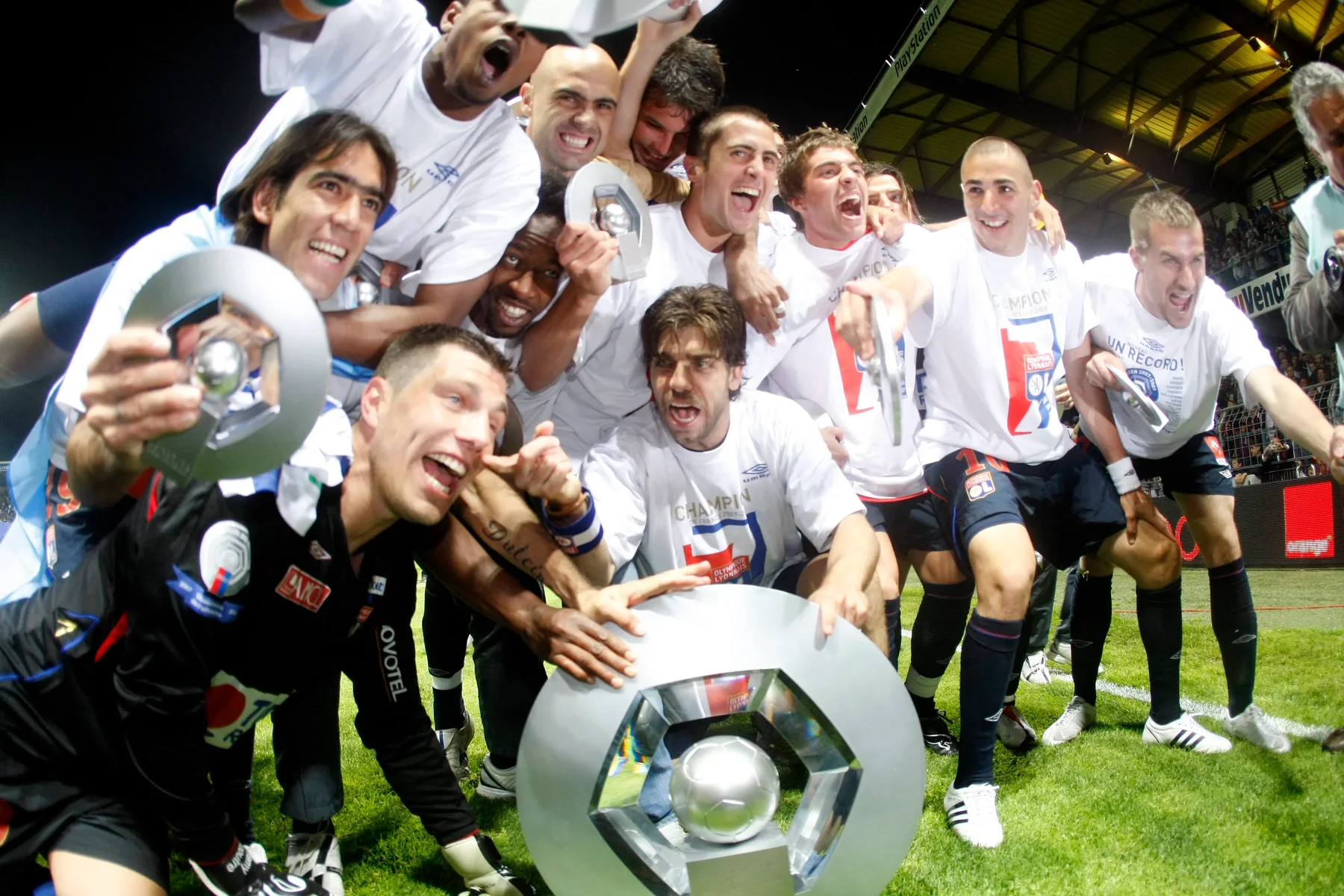
Olympique Lyonnais won seven consecutive French championships from 2001/02 through 2007/08. The league’s history of the dynasty emphasizes that the streak continued while coaches and players changed. Jacques Santini began it, later managers consolidated it, and Alain Perrin completed the seventh in his only season in charge. That is a different kind of dominance from one brilliant squad winning once. The club kept enough structure and competitive standards to renew the team without surrendering first place.
For a fan comparing title streaks, the Lyon years also reveal why continuity does not mean keeping everything static. Key figures such as Juninho, Sidney Govou and goalkeeper Grégory Coupet were part of the club’s identity, but a season-by-season winner list hides how often a side must adapt around them. The league’s PSG–Lyon comparison confirms that all seven of Lyon’s league titles came in that single consecutive run. Lyon did not win them across scattered decades. Its historical rank rests on a concentrated period of remarkable repeatability.
That makes Lyon a useful benchmark for PSG’s current five-title streak. Five is extraordinary, but it is not seven. Counting consecutive wins asks how long one club can survive the league’s annual changes in opponents, tactics and personnel. Total titles answer a different question: how many times, across all eras, did a club finish first? PSG lead that cumulative measure. Lyon still hold the longer consecutive run in this comparison. Both facts can be true without one cancelling the other.
The exceptions and challengers of the PSG era
The last two decades also contain stories of clubs interrupting a seemingly settled order. Montpellier won in 2011/12, finishing three points above PSG, according to the league’s club retrospective. That championship came before Paris’ longer modern run became the defining pattern. It remains a reminder that the richest or most talked-about club does not receive the title by expectation: the table rewards what happens over the season.
AS Monaco then won in 2016/17, one of the clearest breaks in the recent PSG sequence. Four years later, LOSC Lille took the 2020/21 title. The league’s Lille retrospective describes a side built with several former PSG academy players, including Mike Maignan and Boubakary Soumaré, and highlights how it turned a cohesive squad into a full-season championship. The official winners list confirms that Lille were the first club to finish above PSG since Monaco’s 2016/17 triumph.
None of these exceptions happened because a favorite lost one match. The champion had to assemble enough points across an entire campaign. That is why current claims such as “this weekend ends PSG’s era” should be treated carefully. A head-to-head victory may be a turning point, but the other 32 matches still matter. Lille’s 2020/21 achievement is compelling precisely because it survived that test, and Monaco’s 2016/17 crown stands as a season result rather than a single upset.
For the 2026/27 reader, the eras frame a balanced view. PSG’s recent record makes them the standard. Lyon shows how long a dynasty can last. Montpellier, Monaco and Lille show that the standard can be exceeded when a challenger is complete enough over time. The present table will determine whether this season joins the dominant sequence or becomes another exception. Historical names make that race richer; they do not pre-write its result.
What winners lists can and cannot tell a fan
A champions list is a record of final outcomes. It tells you who finished first in a completed season, not which team led in November, which club played the most attractive football, or who will win next May. This sounds obvious until a search for “Ligue 1 winner 2026” appears beside a search for “Ligue 1 2026/27 winner.” The first has an answer: PSG won the season ending in 2026. The second does not yet have an answer because the 2026/27 season is still being played.
The date range matters. The league’s official archive starts with 1932/33 and currently runs through 2025/26. It spans several names and versions of the top competition. Treating that long record as though every year had the same number of clubs, matches and point rules would make comparisons misleading. An all-time count of championships remains meaningful because it counts first-place finishes; a comparison of raw point totals requires more information about each season’s format. The current 2026/27 calendar, for example, runs to a 34th matchday on 29 May 2027.
The same care applies to a club’s identity. A supporter may ask for the “best football club in France” and mean the most league titles, the strongest team today, the richest recent European history or the team with the deepest local tradition. Those are different measures. Under the first definition, PSG lead with 14 official league titles through 2025/26. For repeated closeness to the summit, the league’s podium count gives another view. For the present season, the live table is the relevant evidence. A historic trophy cannot score a goal in the current campaign.
Neither should a single past champion be turned into a simple recipe. Lyon’s seven-year run depended on organizational strength and sustained performance, but a club today cannot reproduce it merely by hiring a similar coach or signing one star. Lille’s 2020/21 exception showed that a challenger could finish above PSG, yet that outcome also involved a whole season of results. A historical article can identify patterns and plausible questions; it cannot provide a shortcut around this year’s fixtures, injuries, tactical changes and direct meetings.
The most useful way to read the records is to move between timescales. Start with the all-time list to understand why PSG, Saint-Étienne, Marseille, Monaco, Nantes and Lyon carry particular weight in French football history. Then choose the completed season you actually want to compare. Finally, follow the 2026/27 results and the upcoming matches to see whether the current league is repeating an old pattern or creating a new one.
When a title is decided in 2027, it will be added to the archive and the counts will change if an existing champion wins again. Until then, the all-time table is complete only through 2025/26. That is not a weakness of the record; it is the essential line between documented history and the open competition that makes a new season worth watching.
The champions archive gives every finished season a name. It does not decide an unfinished one. Follow the 2026/27 fixtures and table to see whether PSG add another crown or a new challenger earns its place in the list.
Loading comments…