
PSG topped the 2023/24 Ligue 1 table with 76 points and the 2022/23 table with 85; Lille won 2020/21 with 83. The numbers describe three different seasons, including a change from 20 to 18 clubs. These complete final tables show the ranking in each year and explain why raw points, relegation lines and title margins need context.
The 2023/24 final table: the first 18-club season
Paris Saint-Germain won the 2023/24 Ligue 1 title with 76 points from 34 matches, nine ahead of Monaco. Brest finished third on 61, a notable podium result for a club that had never previously ended a top-flight season in the top three. The final table below fixes the order at the end of the regular season; later promotion/relegation play-off matches are explained separately. This was the first season of the 18-club format, so every club played 34 league games rather than the 38 played in the 20-club season immediately before it.
| Pos. | Club | Pld | Pts |
|---|---|---|---|
| 1 | Paris Saint-Germain | 34 | 76 |
| 2 | Monaco | 34 | 67 |
| 3 | Brest | 34 | 61 |
| 4 | Lille | 34 | 59 |
| 5 | Nice | 34 | 55 |
| 6 | Lyon | 34 | 53 |
| 7 | Lens | 34 | 51 |
| 8 | Marseille | 34 | 50 |
| 9 | Reims | 34 | 47 |
| 10 | Rennes | 34 | 46 |
| 11 | Toulouse | 34 | 43 |
| 12 | Montpellier | 34 | 41 |
| 13 | Strasbourg | 34 | 39 |
| 14 | Nantes | 34 | 33 |
| 15 | Le Havre | 34 | 32 |
| 16 | Metz | 34 | 29 |
| 17 | Lorient | 34 | 29 |
| 18 | Clermont | 34 | 25 |
The nine-point title margin is best understood alongside the actual route to the trophy. The league's contemporary account identifies a 5–2 home win over Monaco in November and a 3–1 home win over Lille in February among defining results. Monaco was the final runner-up, and Lille the final fourth-place side. Winning against direct upper-table opponents gives a champion more than three points: it blocks a rival from adding three on the same matchday. These particular results help explain why PSG could build a decisive gap over a strong Monaco campaign.
Brest's third place deserves attention for a different reason. The LFP's historical podium review describes 2023/24 as Brest's first podium season. Brest finished six points behind Monaco but two ahead of Lille. That modest cushion over fourth had a large competitive meaning because the top three went straight into the Champions League league phase under the following season's access rules, while fourth entered qualifying. For Brest supporters, the table therefore records both an unprecedented league finish and a different European route from the club immediately below.
Mid-table positions have their own useful distinctions. Lens finished seventh on 51, only one ahead of Marseille, while Rennes was tenth on 46. A five-point spread across four places is a reminder that a final position is an outcome of a full season, not a permanent measure of club stature. Marseille's eighth place in 2023/24, for instance, does not erase other stronger campaigns; it tells you how that specific 34-game run compared with rivals at the same time. Search results for “Ligue 1 table last season” can point to entirely different years, so print the season next to the rank when citing it.
The lower end of this table also needs more than a red line. Le Havre finished 15th with 32 points and stayed up directly. Metz and Lorient both finished with 29, but Metz took 16th under the relevant ranking criteria, while Lorient was 17th and directly relegated. Clermont, last on 25, also went down directly. A reader who looks only at points might wonder why two 29-point clubs had different initial outcomes. The answer is that the standings require tie-break criteria when points are level; the ranking shown above is the published final order.
Metz's 16th place did not ultimately save the club. It earned a two-legged tie against a Ligue 2 contender, and Saint-Étienne won that play-off to reach Ligue 1 for 2024/25. For an archive, keep both facts: Metz was 16th in the regular table and was relegated after the play-off. Combining them into a single rank without the tie would hide how the outcome was decided. The same discipline helps when reading any season with a survival play-off.
The 2023/24 table is a good baseline for modern comparisons because it has the same 18-team, 34-match length as 2025/26. PSG had 76 points in both seasons, but those equal totals do not mean the races were identical: the 2023/24 runner-up had 67 and the 2025/26 runner-up 70. A champion's raw points can stay constant while the difficulty and closeness of its closest challenger change. That is the sort of insight a historical table offers when it is read beside, rather than instead of, the match story.
The 2022/23 final table: the 20-club transition
Paris Saint-Germain finished first in 2022/23 with 85 points, but only one point separated the champion from Lens on 84. This was the last 20-club Ligue 1 season before the division contracted to 18 teams. Each club played 38 matches, four more than in 2023/24. The bottom four went down directly as part of the planned transition. That makes the table a particularly important archive: it records both a close title race and a relegation rule that should not be copied into later seasons.
| Pos. | Club | Pld | Pts |
|---|---|---|---|
| 1 | Paris Saint-Germain | 38 | 85 |
| 2 | Lens | 38 | 84 |
| 3 | Marseille | 38 | 73 |
| 4 | Rennes | 38 | 68 |
| 5 | Lille | 38 | 67 |
| 6 | Monaco | 38 | 65 |
| 7 | Lyon | 38 | 62 |
| 8 | Clermont | 38 | 59 |
| 9 | Nice | 38 | 58 |
| 10 | Lorient | 38 | 55 |
| 11 | Reims | 38 | 51 |
| 12 | Montpellier | 38 | 50 |
| 13 | Toulouse | 38 | 48 |
| 14 | Brest | 38 | 44 |
| 15 | Strasbourg | 38 | 40 |
| 16 | Nantes | 38 | 36 |
| 17 | Auxerre | 38 | 35 |
| 18 | Ajaccio | 38 | 26 |
| 19 | Troyes | 38 | 24 |
| 20 | Angers | 38 | 18 |
The title and European positions
A one-point final gap demands precision. PSG was champion, but Lens took 84 points and won 25 of its 38 games. The league's later statistical comparison puts Lens at 2.21 points per match and a 65.8% win rate in 2022/23. Those are not the numbers of a distant runner-up. They show that the title was decided against a highly consistent challenger. A single additional draw or an avoided defeat in the right circumstances could have changed the final arithmetic, though the actual season ended with PSG ahead.
PSG's 85 points were nine more than its 2023/24 total of 76, but that does not mean the 2022/23 side was automatically better. It had four more fixtures in which to gain points. Points per game gives a fairer first comparison: 85 divided by 38 is about 2.24, while 76 divided by 34 is about 2.24. That near equality is a useful warning against ranking seasons by raw total alone. The 2022/23 title race was far closer because Lens, at 84, nearly matched that pace; Monaco in 2023/24 finished farther behind PSG.
Marseille was third on 73, eleven points behind Lens but five ahead of fourth-place Rennes. That makes the table's top three look like two clusters: a very close first and second, then a distinct third. Rennes, Lille and Monaco finished on 68, 67 and 65, respectively, another compact contest. Those gaps matter when reconstructing European qualification: a one-point move could change a club's route, while a club outside the upper ranks could still reach Europe by another competition. Toulouse, for example, finished 13th in the league but earned a European place through the Coupe de France. The final league table must therefore be read alongside cup results, not treated as the only access list.
There are useful surprises farther down. Clermont was eighth with 59 points, ahead of Nice and Lorient. That rank is a reminder that historical tables can challenge assumptions based on club budgets or later seasons. A reader looking only at a modern club list might overlook a strong Clermont year because the club did not remain near that level indefinitely. A table is a season-specific record. It does not promise that a team will repeat the position or that another season's opponents and format were identical.
Why four clubs went down
The bottom four were Auxerre, Ajaccio, Troyes and Angers. Auxerre's 35 points left it one behind 16th-place Nantes, while Ajaccio, Troyes and Angers were further adrift. In many later Ligue 1 seasons, a 16th-place club has a play-off route and 17th and 18th go down directly. In 2022/23, the league was reducing from 20 clubs to 18, so 17th through 20th all went down directly. The LFP's reform decision explicitly specified four relegations from Ligue 1 and two promotions from Ligue 2 at the end of this season.
The arithmetic of that transition is simple and useful. Start with 20 top-flight clubs. Remove four relegated sides and add two promoted sides. The next season begins with 18. A normal three-way exchange would have left the size unchanged, so the one-off four-down rule was integral to the contraction. The league's play-off history also records that the Ligue 1/Ligue 2 play-off was not held in 2022/23 because of the change to 18 clubs. Searching for a 2023 promotion play-off final under the usual modern format will therefore lead nowhere.
Nantes's 16th-place survival was narrow but automatic under that season's rules. Auxerre had 35 points, Nantes 36. One point can separate an established top-flight fixture list from a summer preparing for Ligue 2, and here there was no later tie for Auxerre to repair the position. That consequence is different from a recent 16th-place team's chance to survive through two more matches. When using old tables to talk about “the relegation zone,” always ask which season's rule defined that zone.
Raw points also require a season-length adjustment at the bottom. Angers's 18 points came over 38 rounds; Clermont's 25 in the following 34-round season came over fewer opportunities. Both totals indicate difficult campaigns, but comparing the numbers alone loses the change in exposure. Points per match offers one normalization, while the number of relegation slots tells you the actual stakes of the rank. In 2022/23, the exceptional transition made 17th a direct drop. In 2023/24, 17th still meant direct relegation, but 16th regained a play-off route. The table and the rule belong together.
The 2020/21 final table: Lille's title race
Lille won the 2020/21 Ligue 1 championship with 83 points, one ahead of Paris Saint-Germain. Monaco finished third on 78 and Lyon fourth on 76. This was a 20-club, 38-match season, so its raw totals should be compared carefully with the 34-match tables above. The competition was then branded Ligue 1 Uber Eats, although present-day league websites may place a newer sponsor logo around an old article. The season year and final ranking are more reliable identifiers than the current page header.
| Pos. | Club | Pld | Pts |
|---|---|---|---|
| 1 | Lille | 38 | 83 |
| 2 | Paris Saint-Germain | 38 | 82 |
| 3 | Monaco | 38 | 78 |
| 4 | Lyon | 38 | 76 |
| 5 | Marseille | 38 | 60 |
| 6 | Rennes | 38 | 58 |
| 7 | Lens | 38 | 57 |
| 8 | Montpellier | 38 | 54 |
| 9 | Nice | 38 | 52 |
| 10 | Metz | 38 | 47 |
| 11 | Saint-Étienne | 38 | 46 |
| 12 | Bordeaux | 38 | 45 |
| 13 | Angers | 38 | 44 |
| 14 | Reims | 38 | 42 |
| 15 | Strasbourg | 38 | 42 |
| 16 | Lorient | 38 | 42 |
| 17 | Brest | 38 | 41 |
| 18 | Nantes | 38 | 40 |
| 19 | Nîmes | 38 | 35 |
| 20 | Dijon | 38 | 21 |
The title margin tells only part of why Lille's campaign is remembered. The league's retrospective describes the side built under Christophe Galtier and highlights a 1–0 away win at PSG in April 2021, with Jonathan David scoring. The official classic-match review also confirms that result. Beating the main rival away from home was particularly valuable in a race decided by one point: Lille took three points in Paris while PSG took none from that fixture. The match was not the entire championship, but it changed the arithmetic of the closest contest.
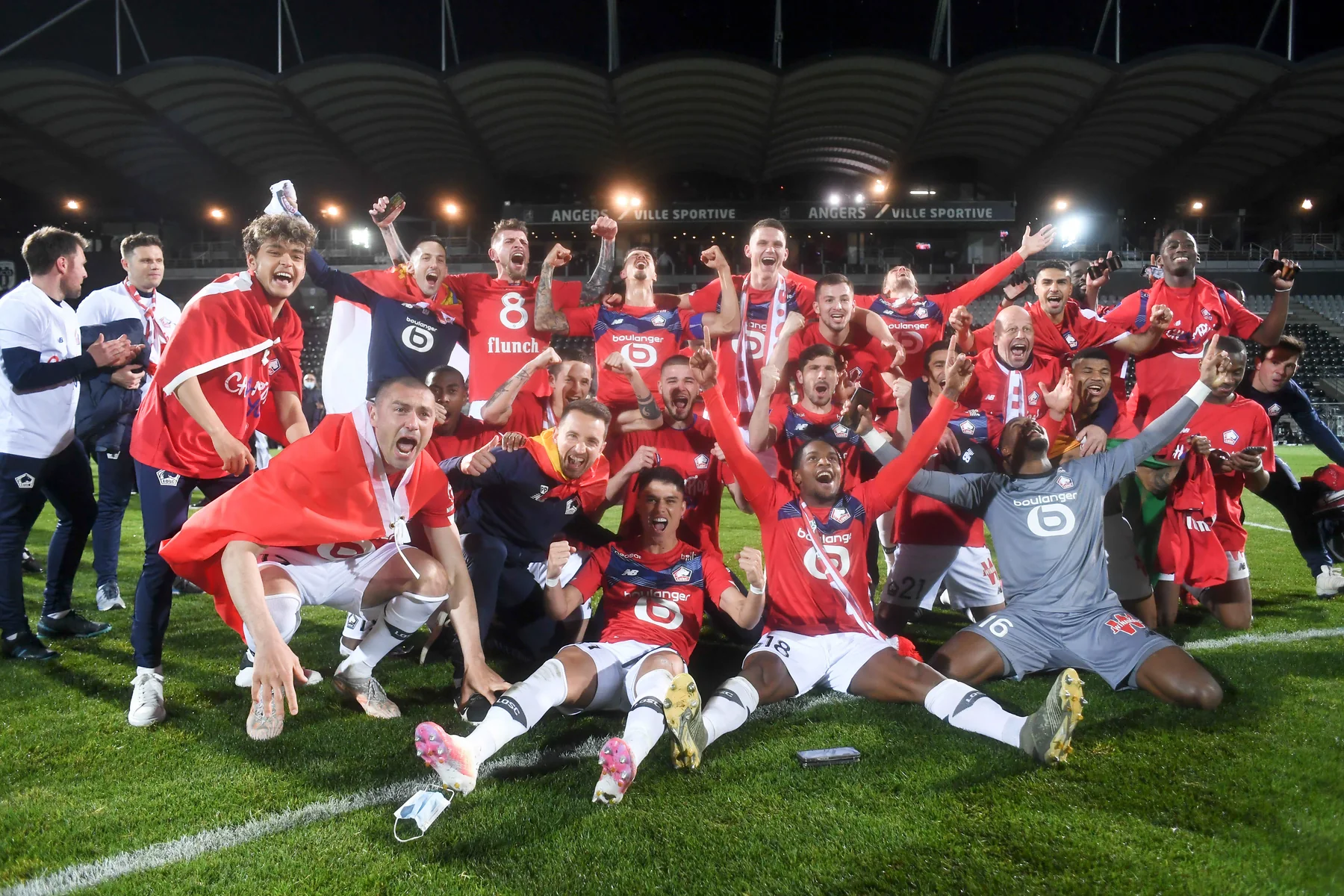
The final records show how different paths can produce adjacent point totals. Lille won 24 games and drew 11; PSG won 26 and drew four. Lille therefore had fewer victories, yet lost only three times, compared with PSG's eight defeats. Turning potential losses into draws kept Lille's points accumulation steady. The club also conceded 23 goals, five fewer than PSG. Those figures suggest a team that limited damage exceptionally well across the schedule. They do not prove a single tactical formation or a style in every match; the supported conclusion is the narrower one that Lille combined a strong win count with far fewer defeats.
Monaco's 78 and Lyon's 76 show that the title race did not take place above an empty field. Both clubs were close enough to make the top four genuinely competitive, though neither finished within three points of Lille. After Lyon, the table drops sharply to Marseille on 60. That 16-point break tells us more about the shape of the season than a generic list of “European contenders.” The top four formed one performance group; Marseille, Rennes and Lens formed a second group around 57–60 points. Reading gaps, not just ranks, makes a historical standings page more informative.
The lower table also had a play-off story. Nantes finished 18th with 40 points, above Nîmes and Dijon but below Brest by one. Eighteenth was the survival play-off position in this 20-club format. The league's play-off history lists a 2–1 Nantes away win at Toulouse and a 1–0 Toulouse win at Nantes. The aggregate was 2–2; Nantes survived on the away-goals rule then in effect. That rule is a historical fact of the 2021 tie, not a rule to assume in a current play-off. An archive must preserve the regulation that actually decided the contest.
There is a useful three-season comparison in the champion's points per match. Lille's 83 from 38 works out to about 2.18. PSG's 85 from 38 in 2022/23 works out to about 2.24. PSG's 76 from 34 in 2023/24 is also about 2.24. That rough normalization prevents a false conclusion that every 80-plus-point season is necessarily stronger than every sub-80 season. Even points per match does not settle every comparison: a different set of clubs, opponents' strength, injuries and cup schedules can alter the context. It is a first correction for different season lengths, not a final verdict on team quality.
For a reader seeking “Ligue 1 table last season,” these three archives answer different historical questions. The 2020/21 table explains Lille's one-point upset; 2022/23 explains PSG's one-point defense against Lens and the one-off four-club relegation; 2023/24 shows PSG's nine-point lead in the first 18-club season. For today's race, use the current 2026/27 table. Keep the season year beside any rank or points figure you quote. That simple habit makes the record accurate even when a club's position, the number of teams or the league's commercial title changes.
Use the season and the number of matches as the first labels on any comparison. The 2022/23 four-team drop was a one-off transition, while Lille's 2020/21 title and PSG's 2023/24 win unfolded in different-sized leagues. A historical table is most useful when read with the rule and race that produced it; the ongoing season belongs on the current table page.
Loading comments…