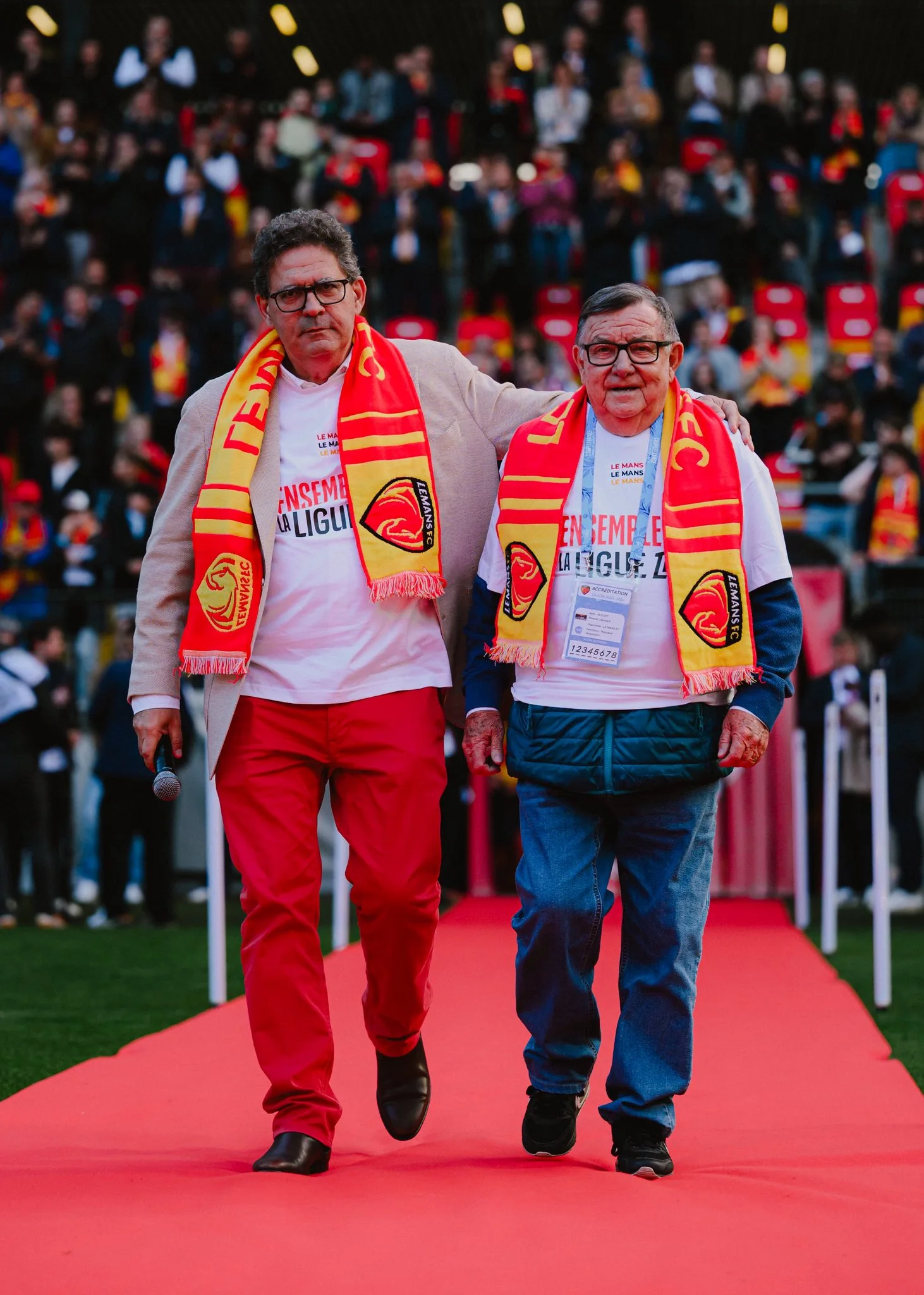
Le Mans FC returned to Ligue 1 for the 2026/27 season, sixteen years after its previous top-flight campaign. The comeback follows consecutive promotions and a much longer reconstruction after financial collapse. This guide explains the club behind the result, OutField’s investment, the leadership changes and the role of Stade Marie-Marvingt. Facts and practical information are checked as of 14 October 2026; match times and ticket availability can change.
What Le Mans FC is, and why the return matters
Le Mans FC is the professional football club of Le Mans, in the French department of Sarthe. The city's international sporting fame often arrives through motor racing, but its football story has a different rhythm: mergers, a period in the top division, financial collapse and years of rebuilding. Its return to Ligue 1 for 2026/27 is meaningful because it reconnects those chapters. A newly promoted badge on a league table tells only a small part of the story.
From MUC 72 to Le Mans FC
The club began on 12 June 1985 as Le Mans Union Club 72, a merger of Union Sportive du Mans and Stade Olympique du Maine. The number points to Sarthe, while the red and yellow colours connect the team with the city's heraldry. Those details explain why supporters still recognise the older MUC 72 identity alongside the modern name. The club's fortieth-anniversary announcement places the merger, colours and original Stade Léon-Bollée home within one continuous sporting memory.
Moving up the leagues was part of that identity well before the present revival. Christian Gourcuff led the club into Division 2 in 1988, and Le Mans later established itself in the professional second tier. Its strongest Ligue 1 finish was ninth under Rudi Garcia in 2007/08. That achievement matters when assessing the return: Le Mans has experienced credible top-flight competition, rather than entering an entirely unfamiliar football landscape. It also provides a more useful historical benchmark than the celebrity names associated with recent investment.
The change to Le Mans FC came in 2010, before the move into the new stadium in January 2011. A changed name therefore does not mean a newly invented sporting identity. For a visiting supporter, the older initials in conversation or memorabilia are another name for the same local football tradition. They should not be confused with a racing team or with the modern stadium's former commercial name.
The collapse that made promotion a reconstruction
Sporting relegation and financial collapse were separate stages. After leaving Ligue 1 in 2010, Le Mans continued in Ligue 2 before its financial position became unsustainable. The official club timeline records liquidation on 15 October 2013 and the federation's subsequent decision to place the club in the regional Division d'Honneur. Dropping to that level required much more than winning back a place immediately below the top flight.
A club in those circumstances must restore the practical foundations of professional football: an organisation that can operate, training facilities that can support progression, and a relationship with supporters that survives less visible seasons. The distinction also prevents a misleading explanation of the crisis. The new stadium belongs in the historical account, but its existence alone does not establish the full cause of the debt or legal collapse.
This is why the return carries weight beyond the promotion celebration. Supporters who followed regional and national-level fixtures did not simply wait for a wealthy investor to produce a Ligue 1 team. They helped sustain a football community through a long absence. The present club's ambitions are easier to understand when that period of rebuilding is treated as part of its identity, rather than an inconvenient gap between better-known seasons.
How Le Mans earned its 2026 Ligue 1 return
The decisive achievement was consecutive promotion: from National in spring 2025 to Ligue 2, then into Ligue 1 a year later. That timetable is important. Le Mans did not spend several comfortable seasons rebuilding in the second division before taking another step. The speed of the final climb brought a team developed outside the elite into a new competitive environment almost immediately.
Two promotions changed the scale of the project
The club's promotion announcement confirms the National starting point and successive accessions. It presents the result as the work of an established collective, strengthened by new investment, rather than a replacement project created from nothing. That distinction gives supporters a sensible way to assess the next stage: improvements should help the existing club function at a higher level without erasing the relationships that carried it there.
Two division changes also affect how players are judged. A footballer who contributed to National promotion earned that achievement against the opposition of that season; success does not automatically prove readiness for every Ligue 1 opponent. Equally, dismissing the promotion group because it previously played lower down ignores what its results actually accomplished. The relevant question is how experience, recruitment and coaching combine when the same club meets a different standard.
Support was another part of the story. The official communiqué identifies Le Mans as having Ligue 2's second-highest average attendance that season. In its account of the celebration, the club records more than 20,000 people and the appearance of the 28 players who contributed to the campaign. Those figures capture two different things: regular matchgoing support and a city's response to the completed achievement. The celebration turnout should not be mistaken for a league attendance average.
Why the Bastia result needed official confirmation
The final-day match at Bastia on 9 May 2026 ended with an interruption while Le Mans led 2–0. Promotion was subsequently confirmed when the LFP disciplinary commission validated the score on 13 May. The ruling retained the score achieved on the field. It was not a 3–0 forfeit, and an abandoned-match label by itself did not tell supporters the final standings consequences.
That distinction explains why different dates appear in accounts of the return. The football result belongs to 9 May; the official confirmation belongs to 13 May. A supporter remembering the emotions of the match and another remembering the announcement may both be describing genuine milestones. A careful account needs both, particularly when explaining how Le Mans joined Ligue 2 champion Troyes among the promoted clubs.
The unusual ending should not overwhelm the season's achievement. The ruling settled one outstanding match situation; the promotion still reflected a league campaign. For the current season, the same principle is useful: interpret one dramatic result within a broader sequence of matches. The 2026/27 results show that sequence without turning the historical promotion story into a constantly changing score report.
Who owns Le Mans FC, and who runs it
OutField is the central investor in the current Le Mans project. The Brazilian sports investment group entered the club's capital before becoming its majority shareholder in February 2026. Well-known athletes are associated with the investment, but understanding the club requires separating the investors' public profile from operational responsibility. A famous shareholder is not automatically the person choosing players, coaching the team or operating the stadium.
OutField investment and sporting names
The August 2025 partnership announcement introduced OutField, entrepreneur Georgios Frangulis and sporting figures including Novak Djokovic, Felipe Massa and Kevin Magnussen. For Le Mans, the motor-racing connection has particular commercial relevance: the city already has a recognisable international sporting name. Turning that recognition into a stronger football identity is different from assuming that motorsport fame guarantees football expertise.
A further official announcement on 19 February 2026 confirmed the majority-shareholder change. It also named Thibaut Courtois's NXTPLAY investment vehicle and NinetyTwo X among the new participants. These are documented connections to the project. They do not provide a basis for inventing individual ownership percentages, personal financial commitments or informal recruitment powers.
The same statement set out more concrete ambitions: acquiring the La Pincenardière and Clos Fleuri training sites, reopening the training academy, and strengthening sporting and administrative structures. These priorities offer fans a better measure of the investment than estimates of an investor's net worth. They concern the capacity to prepare players and sustain the organisation. An announced intention, however, should be read as a development plan unless a subsequent announcement confirms that the work has been completed.
Shareholding, club leadership and football decisions
Thierry Gomez was central to the reconstruction, but his role must be dated accurately. The club's 16 June 2026 communiqué announced that he was leaving his president and chief executive responsibilities after ten years. It identified Pedro Oliveira as president-owner and stressed continuity under OutField. Older biographies describing Gomez as the current president therefore explain an earlier stage of the project, rather than the leadership position entering this new chapter.
The June announcement also highlighted coach Patrick Videira's contract extension. That is a useful example of how a club can change its leadership structure while seeking stability in its football work. It does not mean that every detail of the playing approach has remained unchanged, nor does it prove that any individual signing was an investor's choice. Those conclusions would need their own evidence.
For supporters, the practical distinction is between resources and decisions. Capital can make recruitment, facilities and staffing more achievable; the usefulness of those resources depends on how they fit together. A promotion squad may need reinforcement, but recruitment has to address the demands of the new division and the balance of the team. Le Mans's public statements emphasise construction and continuity. The sporting test is whether that organisation helps the club establish itself after the excitement of promotion has faded.
Stade Marie-Marvingt is central to the new chapter
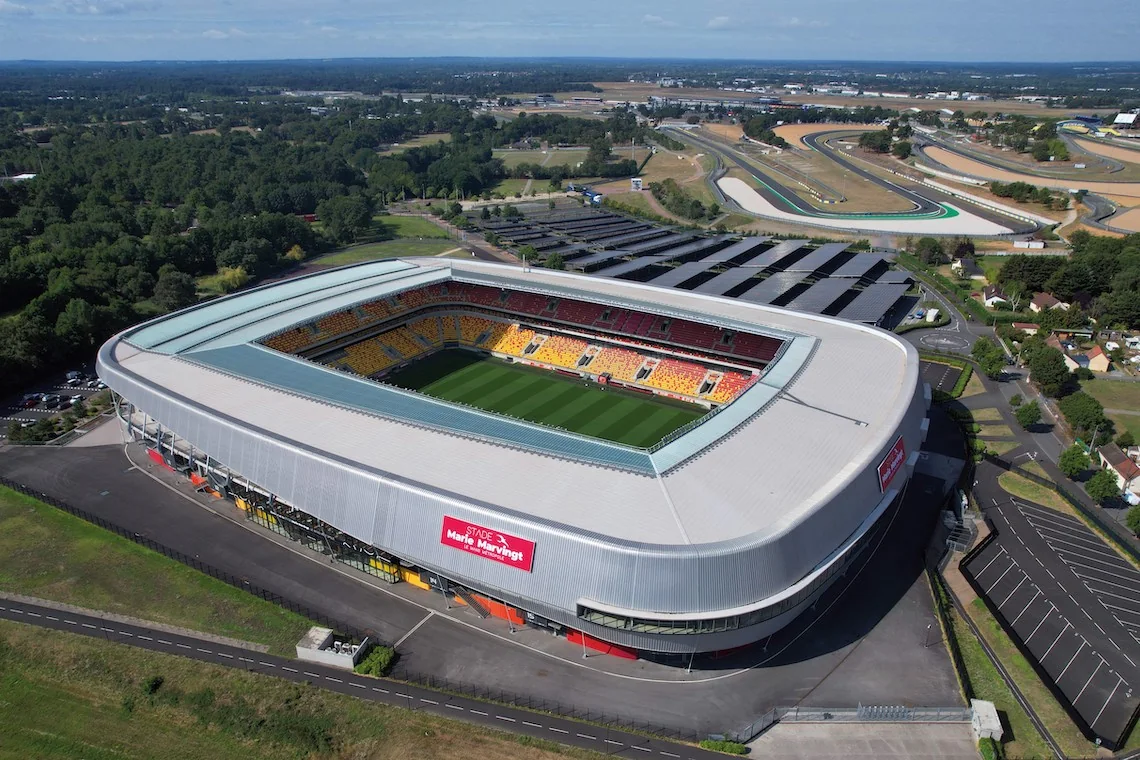
Le Mans's new Ligue 1 home is Stade Marie-Marvingt, formerly known as the MMArena. It is a different setting from Stade Léon-Bollée, which hosted the club during its previous top-flight era. Understanding the stadium's history makes the return more distinctive: the venue has existed for years, but the club's renewed elite status gives it a new football chapter.
A stadium opened after the old Ligue 1 spell
The stadium opened on 29 January 2011, with Le Mans beating Ajaccio 3–0. By then the club had already left Ligue 1. The operator's historical timeline therefore helps explain why the 2026/27 return is also a first: this modern ground is finally hosting the club in the top division. Remembering Le Mans's former Ligue 1 team does not mean remembering Ligue 1 matches in this stadium.
The earlier MMArena name came from the MMA insurance partnership, an early French example of stadium naming. The operator dates the change to Stade Marie-Marvingt to July 2022; the club records a formal naming ceremony in May 2023. These refer to different stages of the transition. Marie Marvingt was a sportswoman and aviation pioneer, so the present name connects the venue with a broader sporting heritage rather than another corporate title.
Capacity, location and the matchday journey
The club describes a football configuration of approximately 25,000 seated places. Concert arrangements can accommodate a different number, and they should not be used as a football attendance capacity. Ticket inventory can be smaller still when particular areas are unavailable. For a supporter planning a visit, the seating plan for the actual fixture matters more than an impressive maximum quoted for another type of event.
The ground sits in the sporting district south of Le Mans, near the racing circuits and other major facilities. That location creates an unusual backdrop, but it also changes the journey from the city centre. The club's access guide names the tram stop Antarès–Stade Marie-Marvingt and explains which nearby car parks need reservations. Choosing public transport or checking the correct parking arrangement before departure is more useful than assuming every visible space belongs to the match.
Choosing tickets for a football match
Use the official Le Mans ticket portal to select the opponent, competition and date, then check the block and seat before paying. Parking can appear as a separate item, so a parking reservation is not a match ticket. A season ticket campaign and an individual fixture sale also have different availability; the closure of one does not establish whether the other is sold out.
If you need accessible seating, contact the club through its dedicated accessibility information before purchasing an unsuitable place. Visiting supporters should also check their own club's away-ticket arrangements and any match-specific access instructions. An ordinary home-area purchase does not necessarily carry the same conditions as an away allocation. Allow time for the journey back after the match, especially before committing to a final train connection.
Finally, verify the kickoff again before travel. A league calendar can identify the round without confirming the final broadcast slot. The current Ligue 1 schedule is the appropriate starting point for that changing information; this club guide provides the context for choosing and enjoying the visit.
How to follow Le Mans without mistaking promotion for a guarantee
The return is already an achievement; becoming established in Ligue 1 is a separate task. Keeping those ideas apart allows supporters to enjoy the scale of the reconstruction without treating every difficult match as proof that it has failed. Conversely, the emotional strength of the comeback should not make a single impressive result evidence that the club has solved the demands of its new division.
Start with the match context. A home fixture against a direct competitor and an away trip against an established European contender ask different questions of a newly promoted side. The score matters in both, but assessing progress requires considering the opponent and venue together. This is a way to read the season, rather than a claim about how Le Mans played in a match that has not been examined here.
Then look at the sequence. One match may turn on a dismissal, a set piece or a finishing opportunity; a longer run is more useful when asking whether the club is collecting enough points. The current league table puts results alongside the other clubs competing for the same places. Reading it together with completed fixtures is more informative than judging the whole project through an isolated highlight.
The organisation also deserves a longer view. Training infrastructure, an academy and reliable administrative work are not substitutes for points, but they can affect the club's ability to sustain its football. The development priorities announced in 2026 provide concrete subjects to follow: what facilities are secured, what training opportunities are available, and how the professional and wider club structures progress. A new investor's name alone answers none of those questions.
For a matchday, use today's Ligue 1 matches and then the club's own access and ticket information. For a historical discussion, keep the timeline clear: the name change preceded the new stadium, the collapse followed the earlier top-flight spell, and the last two promotions completed a much longer recovery. Mixing those stages makes the story less accurate and the new season harder to understand.
Le Mans now offers something distinctive within French football: a revived club in a famous sporting city, playing its first Ligue 1 season in a stadium built after its previous elite years. The most rewarding way to follow it is to appreciate that history while watching how the next chapter develops. Promotion has restored the opportunity. The league season will show how the club uses it.
Loading comments…