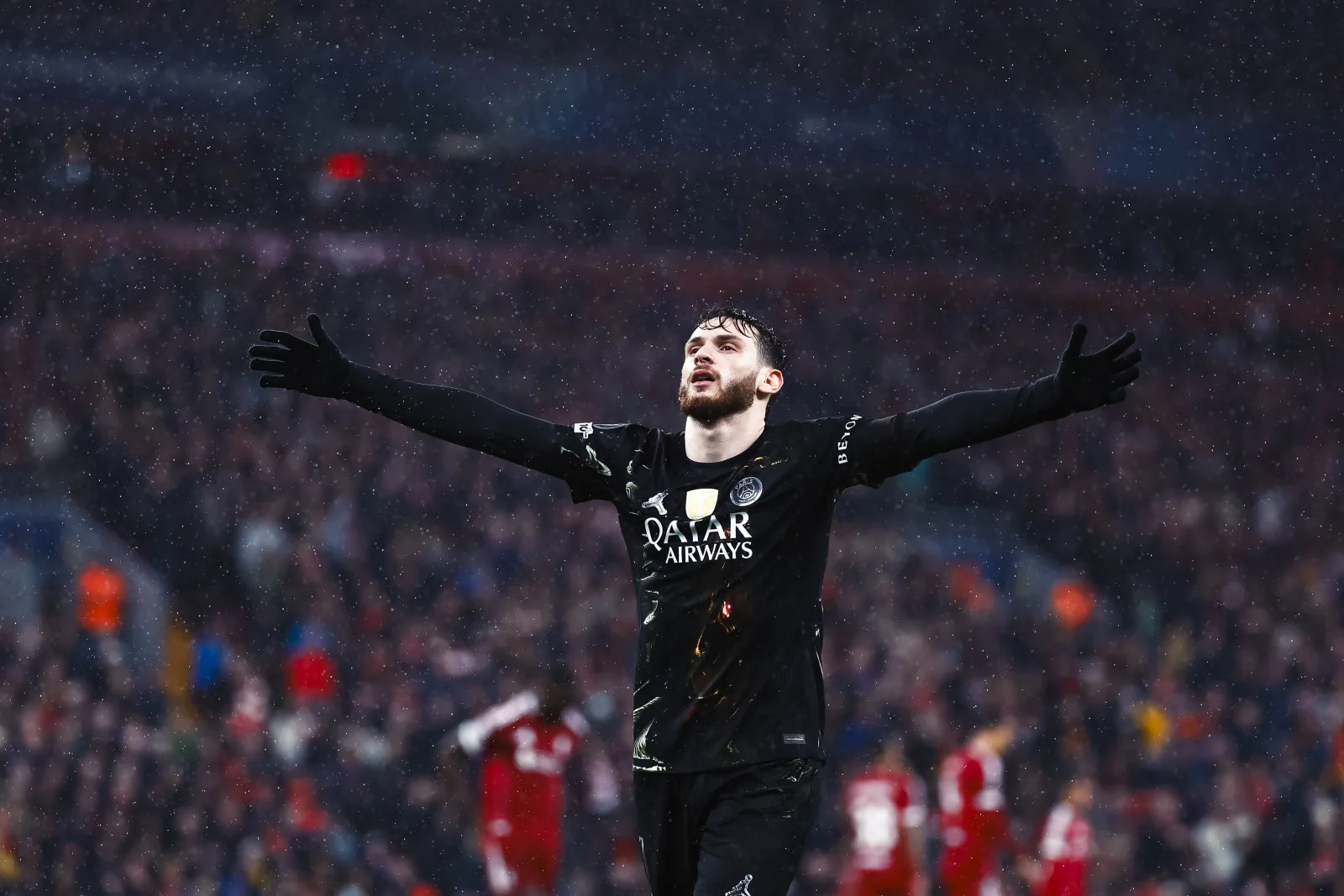
Khvicha Kvaratskhelia is PSG’s Georgian forward, who joined from Napoli in January 2025 on a contract announced until 2029. His story connects a Scudetto-winning breakthrough in Italy with major European success in Paris. This guide explains his name, career, transfer, playing style and the difference between the statistics from each stage, with facts checked on 20 October 2026.
Who is Khvicha Kvaratskhelia?
Khvicha Kvaratskhelia is the Georgian forward wearing number 7 for Paris Saint-Germain. Born in Tbilisi on 12 February 2001, he is 25 on 20 October 2026. PSG lists him at 183 centimetres and describes him as comfortable using both feet in its official player profile. He joined Paris after establishing himself at Napoli, bringing the reputation of a winger who could both unsettle a defender and help finish the attack.
The distinction between nationality and club location matters here. He represents Georgia, while his club plays in the French league. A search for his country should not turn him into a France international, just as his time in Naples did not make him an Italy player. His career connects those football settings without changing the national identity central to his story.
His name, pronunciation and Georgian identity
The length of the surname can make it look harder to say than it is to recognise on a team sheet. A practical reading aid is to separate the name into the chunks “Kh-vicha” and “Kvarats-khelia”, the form used in GOAL’s pronunciation guide. Treat that as an approximate guide to the written name, rather than a perfect English transcription of Georgian sounds. Listening to the recorded pronunciation gives a better model than forcing every consonant into a familiar English word.
“Kvara” is a useful shorthand once the full name is understood. It also helps fans connect references in commentary, player lists and transfer stories without imagining they describe different people. Nicknames can make a player familiar, but the football should still be assessed through his own decisions and achievements rather than through comparisons with someone else’s career.
For a first PSG viewing, identify where he begins the move and where he finishes it. The winger designation suggests a starting area; it does not describe every run. His Napoli background explains the attacking tools he brought, while his Paris role shows how those tools can fit into a team in which the forwards, midfielders and full-backs repeatedly exchange positions.
What his Napoli years explain about his football
The route from Georgia to the Scudetto
Kvaratskhelia’s reputation did not begin in Paris. After developing in Georgian football and spending an important period at Rubin Kazan, he moved to Napoli in summer 2022. His first Italian season ended with the Scudetto and the league’s overall player award. Napoli’s official departure summary places the title confirmation on 4 May 2023, a landmark which explains why his association with the club remains so strong.
The beginning had already given supporters reasons to notice him. That same club account recalls a goal on his league debut in a 5-2 victory at Hellas Verona and a brace against Monza in his first home appearance. The sequence mattered because a new arrival was contributing immediately, rather than merely carrying promise for an unspecified future. Napoli’s eventual title supplied the sustained team achievement around those early moments.
He left after 107 appearances and 30 goals in all competitions, figures confirmed by Napoli at the time of the transfer. They belong to his completed spell at that club. An appearance in Paris cannot be added to that Napoli record, and a later player page’s career total answers a different question. Keeping the club boundary clear is especially useful when a player becomes well known in two leagues within a few years.
The attacking qualities Paris inherited
The more revealing first-season balance is 12 Serie A goals and ten assists in 2022/23. Napoli’s review of that campaign also identifies his ability to create chances after dribbling. This was not simply an attacker taking opponents on for the sake of a successful dribble. The value came from what the action could unlock: a shot for himself, a pass for a teammate or a change in the defensive arrangement.
For a defender, that combination complicates the decision. Closing quickly can prevent the winger from accelerating but may allow a combination around the pressure. Holding back can preserve a barrier in front of goal while giving the attacker more time to choose a pass. The details change with the nearest support player and the position of the covering defender. There is no single defensive response which can be judged independently of those relationships.
Paris inherited those attacking options, but a new team creates a new distribution of responsibility. If another forward occupies the central lane and a full-back advances outside, the left-sided attacker may have room to move inside. If teammates are already close to the ball, staying wide may be the more useful contribution. Napoli’s record establishes the scoring and creative foundations. It does not mean that every PSG possession should reproduce a familiar Italian highlight, or that the same statistics must follow automatically from a change of club.
The January 2025 transfer and PSG contract
PSG announced Kvaratskhelia’s arrival from Napoli on 17 January 2025, with a contract running until 2029. UEFA’s contemporary Paris match facts confirms those details and identifies him as the first Georgian player in the club’s history. Napoli separately confirmed that the move was permanent. Those are the established transfer facts; an estimated market value is not the same thing as an announced fee, salary or contractual clause.
What the signing announcement confirmed
The timing is central to understanding the first Paris season. A January arrival enters a team whose competitive routines are already established. He has to learn the spacing of new teammates while matches continue to matter immediately. A preseason signing can also face pressure, but the calendar offers a different preparation period. The distinction is useful when comparing a half-season of opportunities with a complete campaign elsewhere.
Kvaratskhelia addressed that challenge directly in his April 2025 UEFA interview. He described the limited adaptation time after a winter transfer and credited the staff, coaches and players with helping him settle. He also praised Luis Enrique’s clear explanations. These comments offer a documented account of the environment he experienced, rather than an invented story about a dressing-room conversation.
From a football perspective, clarity has practical value. A winger needs to understand when the full-back will advance, when a central forward will come towards the ball and which teammate needs space to receive. These decisions happen quickly during a match. Familiarity can reduce hesitation, while a clear set of responsibilities gives a newcomer a way to contribute before every relationship is fully developed. That is an interpretation of the challenge he described, rather than a claim that adaptation follows one universal timetable.
The contract’s horizon and the immediate match assignment also answer different questions. An agreement until 2029 expresses a long-term commitment at the time it is announced. It cannot guarantee a starting place in every future fixture or establish the player’s fitness on a later date. To follow his progress, keep the transfer milestone fixed, then examine the football evidence as each season develops. His first months provide one chapter; a full campaign in the same team supplies a much broader sample.
How Kvaratskhelia fits PSG’s moving attack
Starting wide and attacking the inside space
A left-sided starting position gives Kvaratskhelia an opportunity to receive away from the most crowded central area. What happens next depends on the defensive response and the positions of his teammates. He can advance towards the full-back, combine inside or move beyond the line without receiving the first pass. A useful winger does not need to choose the same solution every time, and the absence of a dribble does not necessarily mean he has been taken out of the game.
UEFA’s analysis of the 2025 away semi-final against Arsenal supplies a concrete example. It describes Kvaratskhelia running behind on the inside and Nuno Mendes advancing to take over the width on the left. The value lies in the coordinated exchange: the attacker changes his route while another player keeps the outside option available. Both movements belong to the same attacking solution.
For a defender, following the inside run can open the flank, while holding the wide position can leave a teammate responsible for the runner. The passer’s decision then depends on which space becomes available first. This is why following only the ball can hide an important contribution. The player who creates the opening may not receive the next pass, but the movement can still change the opponent’s shape.
Why the work without the ball matters
Kvaratskhelia’s role also includes responding when PSG lose possession. UEFA counted ten final-third pressing actions by him in the 2025 Champions League final against Inter, second among Paris players in its technical review of the match. That figure describes one final. It illustrates a contribution to a collective defensive task, rather than establishing a permanent pressing rate for his entire career.
The direction of the pressure is important. An attacker can close an opponent while screening the easiest pass inside, helping guide play towards an area where a teammate can challenge. If several players react together, the team may recover the ball before it has to retreat. If the first runner goes alone, the opponent may escape into the space behind him. The running action and the supporting distances have to be judged as one situation.
That balance is especially relevant to a player known for taking opponents on. A successful dribble can destabilise the defence, but attempting one involves accepting the possibility of losing possession. The surrounding team has to be prepared for either outcome. When watching Kvaratskhelia, notice where his nearest teammates stand before the duel begins and how quickly they respond afterwards. It gives a fuller picture of his responsibility than a highlight reel containing only the successful take-ons.
The attraction of his Paris role is therefore the combination: an individual who can alter a contest, working inside a structure intended to connect the next action. His best contributions can involve carrying the ball, supplying another attacker or helping the team keep the opponent under pressure. Each serves the same practical objective of making PSG harder to contain.
European success, statistics and the next match
From the 2025 final to a full Paris season
Kvaratskhelia’s first European spring with PSG included a decisive change of score against Aston Villa. He put Paris ahead early in the second half of the 3-1 quarter-final first-leg win on 9 April 2025, as documented in UEFA’s match report. That goal arrived when the tie was still finely balanced, illustrating the importance of the situation as well as the finish.
He then scored PSG’s fourth goal in the 5-0 Champions League final victory against Inter on 31 May. The official final report records the low finish in the 73rd minute. It was a memorable contribution to a historic result, with a different competitive context from the goal that had moved Paris ahead against Villa. Both belong to the record, but they should not be discussed as if the score had been identical when each was scored.
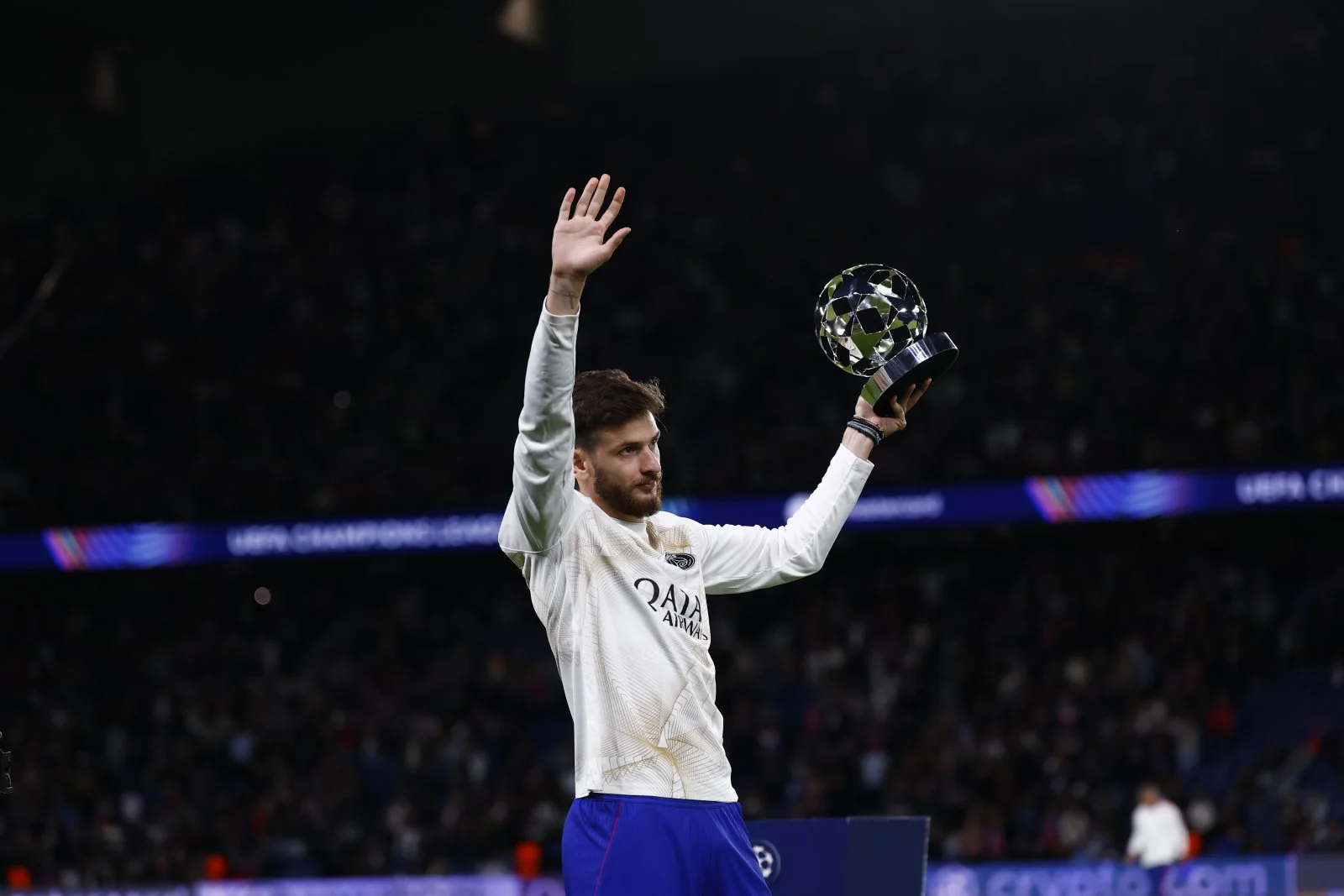
His first full Paris campaign brought another major distinction. UEFA named him the 2025/26 Champions League Player of the Season, recording ten goals and six assists. Those figures describe the completed European campaign, rather than his Ligue 1 total or a forecast for 2026/27. They establish a broader body of achievement beyond the first months after his transfer.
Reading a new performance in context
A useful statistical comparison keeps the competition and opportunity clear. Napoli’s first-season league figures, a partial PSG season after a January transfer and a full Champions League campaign are three different samples. Even before asking whether a player improved, establish how many matches and minutes were available and what job the team asked him to perform. A bigger total can reflect more opportunity as well as better execution.
The same care improves match viewing. If a defender receives close support every time Kvaratskhelia touches the ball, forcing the duel repeatedly may not be the best decision. A quick pass can move the attack towards a less crowded area. Conversely, when he is isolated against one opponent with support arriving, taking responsibility for the contest can be exactly what the team needs. The choice becomes more meaningful when the surrounding picture is included.
Find PSG’s next league fixture through the current match listings, and use the results page to revisit completed games. Confirm the team sheet before assuming he starts, then follow how his decisions contribute to the attacking pattern. His Napoli title, Paris transfer and European awards explain why he attracts attention. The next sequence of movement, touch and pass explains what he is doing with that ability now.
Loading comments…