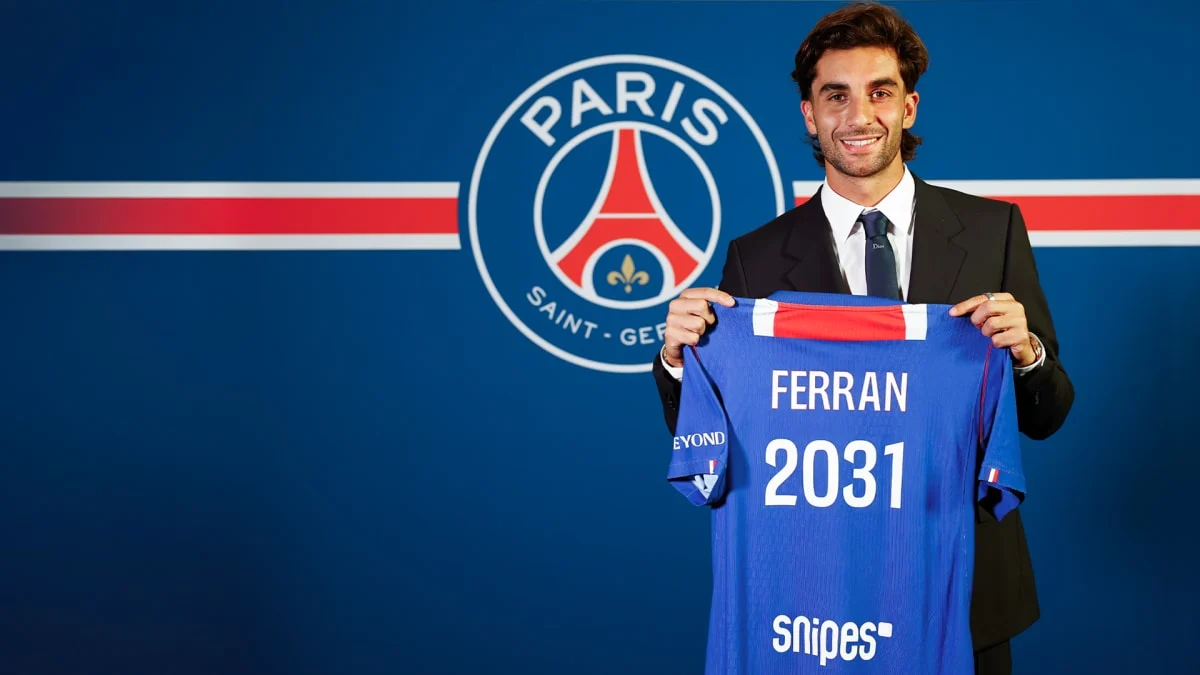
Ferran Torres is PSG’s number 9 for 2026/27. He joined on 15 August 2026 and signed through 2031. This guide follows his route from Valencia, Manchester City and Barcelona, explains his attacking options under Luis Enrique, and separates his early Paris league and European numbers. Facts were checked on 14 October 2026.
Ferran Torres is PSG’s number 9
Ferran Torres joined Paris Saint-Germain on 15 August 2026 and wears number 9. The club's current player profile gives his full name as Ferran Torres García, his birthplace as Foios and his date of birth as 29 February 2000. He is 26 at this guide's 14 October 2026 cutoff. PSG list him as a right-footed Spanish forward, with a height of 182 centimetres.
The official signing announcement confirms a contract through 2031. It establishes the move from Barcelona and the new shirt number. It does not turn every reported transfer figure or salary estimate into an official financial disclosure. For a supporter trying to identify his current team, the important confirmed points are straightforward: he is a PSG forward in the French league and a Spain international.
That distinction explains why searches can still return apparently contradictory information. A Barcelona profile or match report describes a real stage of his career. A Manchester City goal video belongs to another stage. Neither needs to be erased for the current Paris affiliation to be correct. Check the date and the competition before deciding whether a result answers who he plays for now or what he did previously.
The number 9 introduces an obvious football question, but it does not settle it. A striker can start centrally and move towards a flank to combine; a wide forward can attack the box when a teammate comes short. The shirt identifies Ferran in the current squad. His relationship with the other attackers, the opponent's defensive shape and Luis Enrique's selection determine the task in an individual match.
Likewise, the contract's end year describes a commitment between player and club, rather than a guarantee of minutes. PSG have other attacking options, and a team competing across different competitions needs ways to change its approach. The useful assessment is whether Ferran adds productive movement and finishing to those choices, not whether one number entitles him to start every game.
Begin with that current identity, then follow the career chronologically. Valencia explains where he reached senior football, Manchester City and Barcelona explain the roles he encountered before Paris, and PSG's early 2026/27 matches offer a first sample of how the new combination is working. Keeping those stages separate makes both the biography and the statistics considerably easier to read.
The route from Valencia to Paris
Valencia gave him a first-team starting point
Ferran's first senior chapter belongs to Valencia, the club whose academy developed him. Manchester City's August 2020 signing announcement records his Valencia first-team debut as a substitute against Real Zaragoza in a November 2017 Copa del Rey victory. That is a different milestone from a first La Liga appearance. Keeping the competition attached to a debut prevents two accurate dates from being treated as a contradiction.
The same announcement describes a predominantly wide player who could operate on either flank or through the middle. It records 44 Valencia appearances and six goals in the preceding season, before his move to England. That background is useful because it challenges the idea that PSG's number 9 has always been a narrowly defined penalty-box striker. His route involved attacking from wider spaces before the current central-shirt association.
A wide position presents a young attacker with several connected tests. He may receive facing a full-back, decide whether to go outside or inside, and then judge when to release the ball. Moving towards the middle changes the pressure: a centre-back can engage him directly while another defender covers. Developing in both situations can make an attacker more adaptable, but it also means his numbers should be interpreted alongside the position he was asked to occupy.
Valencia's 2019 Copa del Rey victory belongs to this period too. City recorded six appearances in that successful cup campaign. Cup football can give a player a different sequence of opportunities from the league: a substitute contribution or a run of starts across several rounds can be important even if it does not determine the usual league lineup. That distinction remains relevant when assessing his subsequent clubs.
Manchester City and Barcelona expanded the role
Ferran joined City in 2020 and left for Barcelona during the 2021/22 season. City's departure statement gives 16 goals in 43 appearances across all competitions and identifies his Premier League and League Cup winners' medals from 2020/21. Those are club-wide totals, not his Premier League goals alone.
The move also illustrates why a short spell should not be reduced to a single verdict about success or failure. Different competition opportunities and a historical injury affected his time in Manchester. The statement discusses the injury in its 2021 context; it says nothing about his availability for PSG five years later. A current fitness claim would require a current update.
At Barcelona, the 2025 Copa del Rey offers a specific example of his value as a scorer. The club's final-day report records six goals in five cup matches, including a quarter-final hat-trick at Valencia. Against Real Madrid in the final, his late equaliser took the game to extra time before Jules Koundé scored the winner. Ferran was also named player of the match.
That sequence connects scoring volume with match consequence. The quarter-final goals helped move the team into the next round; the final goal changed the state of a match Barcelona were losing. Neither example proves that every future chance will be converted. It does show why evaluating Ferran only by whether he starts every league game misses a form of attacking contribution that has already mattered in decisive fixtures.
What Ferran’s position means in PSG’s attack
Central runs and wide starting positions
The strongest explanation of Ferran's positional range comes from coaches who have worked with him. After his hat-trick in City's 4–3 win at Newcastle in May 2021, Guardiola described a winger who could also play as a striker, highlighting runs behind defenders and the instinct to arrive where a scoring opportunity developed. This is a specific description tied to a real match, rather than a position assigned from his shirt.
Those qualities can matter in two different spaces. From a flank, a forward can threaten the channel between full-back and centre-back. Starting centrally, he can move across a centre-back's sightline or attack a gap as another player receives the ball. The defender must decide whether to follow the run, pass responsibility to a teammate or step towards the ball carrier. Timing makes the movement useful; simply running quickly does not.
For PSG, that creates an obvious combination question with attackers who prefer receiving the ball to feet. If one player comes short, Ferran can potentially threaten the space beyond the line. If he stays high and occupies a defender, a teammate can potentially receive in the space underneath. These are ways his established range may be used, not a claim that every PSG attack follows a prearranged pattern or that he must always occupy one side.
The distinction also affects how a quiet match is interpreted. A run that draws a defender away can help somebody else without producing a Ferran touch, shot or assist. Conversely, movement that is not connected to the passer may leave him isolated. To judge the contribution, watch whether the run gives the ball carrier a realistic option and whether another teammate occupies the space it creates. That gives the position label practical meaning.
The connection with Luis Enrique
Luis Enrique already knew Ferran from the Spain national team. PSG's signing account records that the coach gave him his senior international opportunity against Germany in 2020. The Paris move therefore brought a player and manager together again, although national-team familiarity cannot substitute for adapting to a new set of club teammates and a different weekly competition.
In his August 2026 press conference before facing Lens, Enrique described Ferran as an international-level player capable of playing across the attack and praised his mentality. In the same appearance, he explained why his team needs attackers who contribute to defending as well as possession. Those remarks frame selection as a collective football decision.
For a forward, defending can involve steering the opponent's first pass, blocking a route into midfield or reacting immediately when an attack breaks down. If the nearest player presses without support, the opposition may escape through the gap behind him. If the players coordinate, the team can recover the ball closer to goal. Ferran's finishing is therefore one part of the task; the way he connects his movement with the others also matters.
A supporter can assess this fit without inventing a private instruction from the coach. Ask whether he occupies a useful space when PSG have the ball, whether teammates can find his runs and whether the front line stays connected when it does not. Those questions follow the publicly described role while leaving room for Enrique to choose different combinations from match to match.
His first PSG matches need separate statistical lenses
League goals and European goals are different totals
As checked on 14 October 2026, Opta Analyst's career record gives Ferran six Ligue 1 appearances, 341 minutes and four goals for PSG in 2026/27. Its separate Champions League row gives one appearance, 73 minutes and three goals. A search result describing three European goals and another describing four league goals can therefore both be correct.
Their distribution matters. Three goals in one European appearance show a particularly productive single game; four goals across six league appearances describe a different sample. Adding them can answer a carefully defined combined-total question, but it does not produce his Ligue 1 tally. Nor should a row repeated under a team label and a competition label be counted twice. The competition heading is part of the statistic.
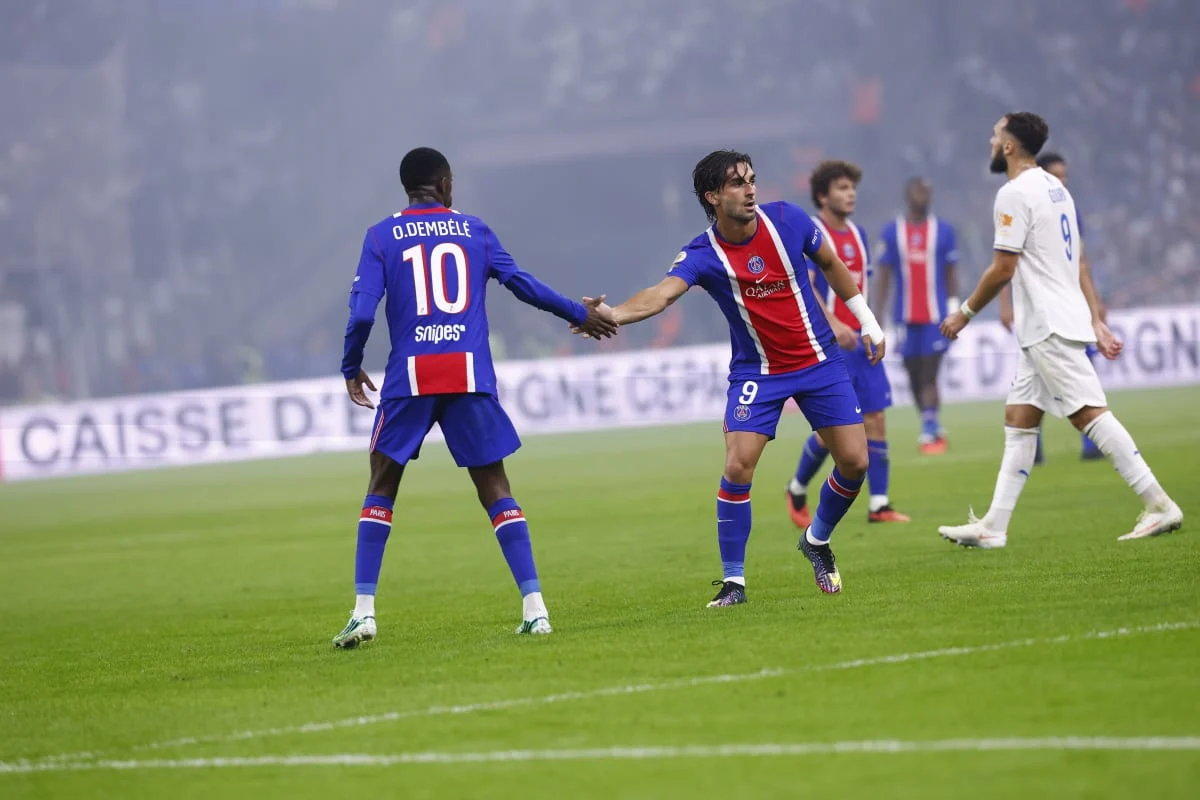
PSG's Marseille match account offers a useful dated milestone. It records his opening goal in a 2–1 away win and seven goals in his first six appearances across all competitions at that point. Marquinhos supplied PSG's second goal. The milestone belongs to the moment of that report; it should not be relabelled as six league appearances or an undated current total.
That away match also adds competitive context. An opener changes the questions for both teams, and an equaliser changes them again. The final winning goal came from a teammate. Ferran's contribution mattered within a collective result rather than turning the match into a personal scoring contest. Reading the score sequence alongside the player total gives a more complete picture of what the goal achieved.
Minutes matter when comparing starts and substitute appearances
Six appearances do not represent six complete matches. The Opta league record includes three substitute entries and only 341 minutes in total. Using that provider's numbers, four goals divided by 341 minutes and multiplied by 90 gives approximately 1.06 goals per 90. This is a description of a small, dated sample, not a projection of how often he will score over a full season.
A substitute can enter when opponents are tiring or when the match has become more open. He can also enter against a team protecting a lead with every player behind the ball. A starter faces a different period of the game, but that alone does not establish that his task was easier or harder. Minutes improve the comparison; the opponent and score make it more meaningful.
For Ferran, a useful next step is to compare the kind of chances reached rather than extending the early scoring rate mechanically. Was he receiving inside the box, attacking a cross or finishing after a transition? Did PSG create repeated opportunities or rely on a difficult finish? The statistics explainer helps distinguish actual goals from chance-quality measures. A productive opening sample is encouraging, but its size and conditions remain part of the assessment.
How to follow Ferran through the 2026/27 season
The next useful question is how his opportunities change as the season develops. A run of substitute appearances asks whether he can affect a game quickly; a run of starts asks whether he can repeat his movement and contribution across longer stretches. Neither situation should be reduced to an undated claim about being first choice. The opponent, the other selected attackers and the score remain part of his job.
Start with PSG's league fixtures. Identify the actual opponent before comparing performances. An away game in which the home team attacks can present running space that a compact visiting team at the Parc does not. A useful forward has to solve both kinds of problem, although the solutions can look different: an early run behind one week, a patient adjustment inside the box the next.
Then follow the match through the results and match-detail pages. Record whether he started or entered later, the minutes involved and how his movement connected with the other forwards. Look beyond whether a goal appeared beside his name. A finish is decisive evidence of one contribution, but the absence of a goal does not by itself explain the quality of the whole performance.
Keep a separate record for European matches. Opponents, game states and the competition schedule can differ from the league. A burst of goals in one Champions League game should be enjoyed for what it achieved rather than used to rewrite a domestic season total. Equally, a difficult league match does not erase a productive European appearance. Competition-separated records allow both to remain visible.
The strongest longer-term assessment will ask whether he repeatedly reaches valuable positions and helps PSG create a coherent attack. Does his run stretch the defence for a teammate? Does the next pass arrive early enough for him to use it? When the ball is lost, does the front line remain connected? Those questions preserve the football meaning behind the career examples and early numbers in this guide.
Ferran arrives in Paris with experience of major club competitions, different attacking positions and decisive cup goals. The current PSG chapter adds a new setting rather than cancelling the previous ones. His number, contract and confirmed move identify that chapter; its eventual quality will depend on sustained contribution across the matches still to come.
Loading comments…