
Estéban Lepaul is Rennes’ French number 9, a striker whose route from Lyon’s academy through the lower divisions led to the 2025/26 Ligue 1 scoring title. His 21 league goals that season include 20 for Rennes and one for Angers. This guide explains the career, movement and finishing behind those numbers, with current facts checked on 14 October 2026.
Who is Estéban Lepaul at Rennes?
Estéban Lepaul is a French forward wearing number 9 for Stade Rennais. The club's current profile gives his birthplace as Auxerre and his date of birth as 18 April 2000, making him 26 on 14 October 2026. Rennes list him as right-footed and 181 centimetres tall. He joined the club in August 2025 after establishing himself at Angers.
His Rennes contract runs through 2030. The club confirmed the extension on 25 June 2026, adding a year to the previous 2029 end date. That is a confirmed contractual fact; a valuation or salary number on another website describes a different question. Neither is needed to understand why his football has drawn attention.
The most useful description is a goalscoring forward whose path to the top division took several stages. Lyon's academy belongs to the beginning of the story, Épinal and Orléans to the work before his professional breakthrough, and Angers to the move through Ligue 2 into Ligue 1. Rennes is the current club chapter. Searching only one of those names can make an older affiliation look current unless the date is checked.
Lepaul's number 9 makes him easy to identify, but a striker's job contains more than waiting for a finish. He must give teammates a target, find space relative to the centre-backs and react when the ball changes direction. A forward can be useful while starting alone centrally or playing alongside another attacker. The combination changes where he can move and who occupies the defender he leaves behind.
His height and age are reference details rather than a scouting verdict. A striker's ability to reach a cross depends on timing and positioning as well as physical size. A run behind the back line depends on the passer's opportunity and the defender's attention as well as speed. The career and match examples below explain those relationships more clearly than an isolated measurement can.
His rise also requires precise seasonal language. A league scoring award can include goals for two clubs in the same season, while a club page naturally displays only the goals scored for that club. That distinction is central to reading his Rennes record accurately, and it becomes especially useful when comparing the finished 2025/26 campaign with the smaller 2026/27 sample.
A route through Lyon, Épinal and Orléans
Leaving an academy did not end his development
Rennes' 2025 arrival announcement traces Lepaul's early football through Baldenheim, Colmar and Nancy before Lyon's academy. It then records the more difficult transition into senior football: Lyon did not retain him, and he moved to Épinal in National 2. His first Épinal spell produced five goals in eight matches in 2020/21.
This stage is useful because an academy's decision and a player's eventual level are different judgments made at different times. A youth environment assesses potential alongside the club's immediate opportunities. Senior football tests whether the player can perform against opponents whose experience and physical approach can differ substantially from youth competition. A setback in the first environment does not settle the outcome in the second.
Nor does the early goal return mean he was already the finished Ligue 1 striker. Eight matches provide a limited sample. They establish productive involvement in that particular setting, rather than proving that the same rate will transfer unchanged to a stronger competition. The challenge is to keep getting into useful positions when opponents have more experience closing them and teammates face different levels of pressure.
Orléans followed from 2021 to 2023, before another move back to Épinal. That part of the route matters even without treating every reserve and first-team appearance as one interchangeable total. A player needs match opportunities to develop his decisions, and different teams can demand different contributions. Some games ask the forward to press and make repeated runs without many touches; others give him more chances to finish. A goals total does not explain that entire experience.
The return to Épinal created a new opening
When Lepaul returned to Épinal in 2023, the club had reached National, the third tier. Rennes' account distinguishes 12 league goals in 16 matches from 14 goals in 20 matches across competitions during that spell. The two totals describe different scopes, and the tier is important: this was the later National chapter, not a repetition of the earlier National 2 season.
The league return created a concrete reason for a club higher in the pyramid to pay attention. Scoring regularly over a sequence of matches is different from being noticed after one exceptional afternoon. It suggests the forward was repeatedly reaching chances in the team's attacking structure. Still, a recruitment decision also has to consider whether that structure and the space available will resemble the new environment.
A third-tier striker moving upwards can expect the time available to finish to change. Defenders may recover more quickly, a first touch may need to be cleaner and a run may have to begin before the passer has full control. Those are football challenges implied by the change of level, not a claim to know a private scouting report about Lepaul. His later Angers record is the evidence that the move created a workable next stage.
The lower-league period therefore belongs at the centre of his biography. It prevents the story becoming an unexplained jump from Lyon's academy to Rennes. Épinal and Orléans provided the senior chapters in between; the productive 2023/24 return to Épinal opened the route to Angers and the professional divisions. The important point is the sequence of opportunities and confirmed performances, rather than a simple label about being discovered late.
Angers provided the bridge to Ligue 1
Angers announced Lepaul's arrival from Épinal on 25 January 2024. It was a move into Ligue 2 during the season, rather than a summer with a long preparation period. The new club offered a path towards the top division, but he still had to contribute to a promotion campaign already under way.
Promotion and survival tested different parts of the job
The club's subsequent review records 17 Ligue 2 appearances, three goals and three assists during that first half-season. Angers won promotion, giving Lepaul the opportunity to test himself in Ligue 1. Those numbers are useful because they show involvement across a run of games, rather than presenting promotion as the consequence of one player alone.
He later told young supporters in an official club question-and-answer session that his first Angers goal was a header against Ajaccio. He also explained that heading had improved through work. This supplies a practical example of development: an aspect he did not initially regard as his main finishing strength became another way to affect a match.
Promotion then changed the competitive question. In Ligue 2, his contributions belonged to a side trying to secure a place above it. In Ligue 1, the test included helping Angers stay there. The opponents, pressure on the ball and number of chances available could change. A forward may need to make the most of fewer deliveries while still providing an outlet when his team has been defending.
His first Ligue 1 goal came against PSG on Matchday 11 of 2024/25, in a 4–2 Angers defeat. The club account describes a strike from the edge of the area after a pass back from Himad Abdelli. The goal was an individual milestone in a match his team lost. That combination matters: scoring against a strong opponent demonstrates one successful action without turning the overall result into a victory.
His first top-flight season finished with nine league goals. Four more in three Coupe de France matches brought the all-competition total to 13. Angers' review highlights his cup brace at Strasbourg, scored within fifteen minutes. A league survival campaign and a cup tie therefore supplied different settings in which his finishing could matter. The 13-goal figure belongs to both competitions together.
This stage makes his later Rennes move easier to understand. He had progressed from scoring in National to contributing in a promotion campaign, then scoring against top-flight opponents. It does not mean every step was smooth, or that his next team's attack would automatically reproduce the same chances. It does establish a series of real football tests before Rennes recruited him.
The lesson for following his career is to keep the team task beside the personal record. A goal in a defeat, an assist during a promotion run and a brace that helps a cup progression each have a different consequence. Lepaul's Angers chapter contains those different forms of contribution, rather than one undifferentiated total used to explain everything that followed.
Rennes made movement and finishing central to his role
His goals came from finding useful spaces
Rennes confirmed Lepaul's transfer on 28 August 2025. His first season there gave a clearer picture of the attacking role that had developed through the earlier clubs. In a May 2026 club interview, he emphasised intelligent movement and well-timed runs rather than choosing repeated physical confrontations with defenders. He also described finishing as something he had practised from childhood.
This is a useful way to understand a striker who does not need to dominate every duel to be productive. If a centre-back is focused on the ball, a forward can move out of that defender's immediate view and arrive as the delivery comes. If the defender follows closely, a change of direction can create separation. These are examples of how the qualities Lepaul described can work, rather than an assertion that one particular goal used an unseen movement.
Playing with another forward adds a further relationship. One attacker can occupy a defender while the other attacks the gap; a player coming short can create a decision about who follows him. Playing alone centrally changes the support needed from midfield and the wide positions. The striker's task is still to find a productive position, but the route towards it depends on the teammates around him.
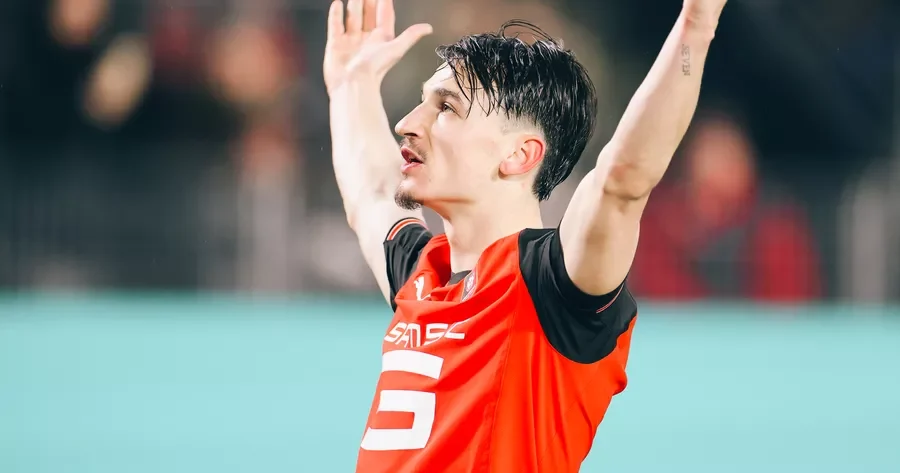
The 2025/26 Strasbourg match is a concrete performance anchor. His hat-trick helped Rennes win 4–1 at Roazhon Park on Matchday 11. A single match cannot define every part of his game, but three goals against a top-flight opponent show why the club's account placed it among the season's turning points. The finishing translated into a result for the team.
The same interview makes an important distinction about quieter spells: creating chances and failing to score is a different situation from not reaching chances at all. For a supporter, that means asking whether Lepaul is still getting into useful areas before declaring that a scoreless match represents a loss of ability. The finishing outcome matters, but the opportunity to finish is part of the diagnosis.
Twenty Rennes goals and twenty-one league goals are both correct
Lepaul finished 2025/26 as Ligue 1's leading scorer with 21 goals. Rennes' contract-extension announcement records the award and the season total. The club's player statistics give 20 Rennes league goals in 32 appearances. Those figures describe different scopes rather than a missing goal.
The remaining league goal belongs to Angers before his transfer. The former club's departure account records that he opened his 2025/26 scoring against Paris FC. The league award follows the player across the season, while Rennes' own tally follows only his games in red and black. A transfer during the season is enough to make both totals correct.
The distinction is valuable beyond this particular biography. When comparing a striker's seasons, check whether the page follows a player, a club or a competition. A player may appear under two teams in the same campaign. Cup goals may be listed beside league goals without belonging to the league scoring race. Reading those headings avoids either removing a valid contribution or counting it twice.
Lepaul's Rennes output is substantial on its own, and the league-wide total adds the earlier Angers contribution. There is no need to inflate either with another competition or to treat the two numbers as competing claims. The Ligue 1 statistics guide supplies the same principle for assists, minutes and other performance measures.
Reading Lepaul’s next stage in 2026/27
Keep club form, playing time and France selection separate
The finished scoring-title season and the next campaign answer different questions. On 14 October 2026, Rennes' official 2026/27 statistics show six Ligue 1 appearances, five starts, 453 minutes and four goals. A separate Europa League appearance adds 86 minutes without a goal. The combined current-season row is therefore seven appearances and 539 minutes, while the league-only figures remain six and 453.
The larger combined playing-time total does not belong in a league-only calculation. Nor should the four league goals be treated as if they were spread over seven league games. This is the same kind of scope distinction that separates his 20 Rennes goals from the previous campaign's league-wide 21, but it arises here from two competitions rather than two clubs.
The new campaign is still a much smaller sample than a complete season. A scoring title establishes what Lepaul achieved across 2025/26. It does not oblige every short period that follows to reproduce the same average. Different opponent sequences, playing time and attacking combinations can affect the chances a striker receives. The useful comparison examines those conditions alongside the goals.
There is another confirmed change in his football setting. Rennes published a first France call-up interview on 18 September 2026. The FFF player record identifies him as a Rennes forward. National-team selection is a further milestone in his rise, but it is separate from a club match total and from being selected for any earlier international tournament.
A new national-team environment can ask a forward to form relationships with different passers and attacking partners. A club combination built over repeated training sessions does not automatically transfer to a short international gathering. That is a football reason to assess the two settings separately, without assuming that a call-up establishes a permanent starting place or predicts how he will perform for Rennes on his return.
For the Rennes supporter, the relevant longer-term test is whether the same strengths continue to produce useful opportunities: intelligent movement, a clear finishing decision and a connection with the delivery. Compare his next performances with the specific milestones already achieved at Épinal, Angers and Roazhon Park. The current Ligue 1 results and table supply the team consequence. His career has reached a new level; the football questions now concern sustaining and adapting that contribution.
Loading comments…