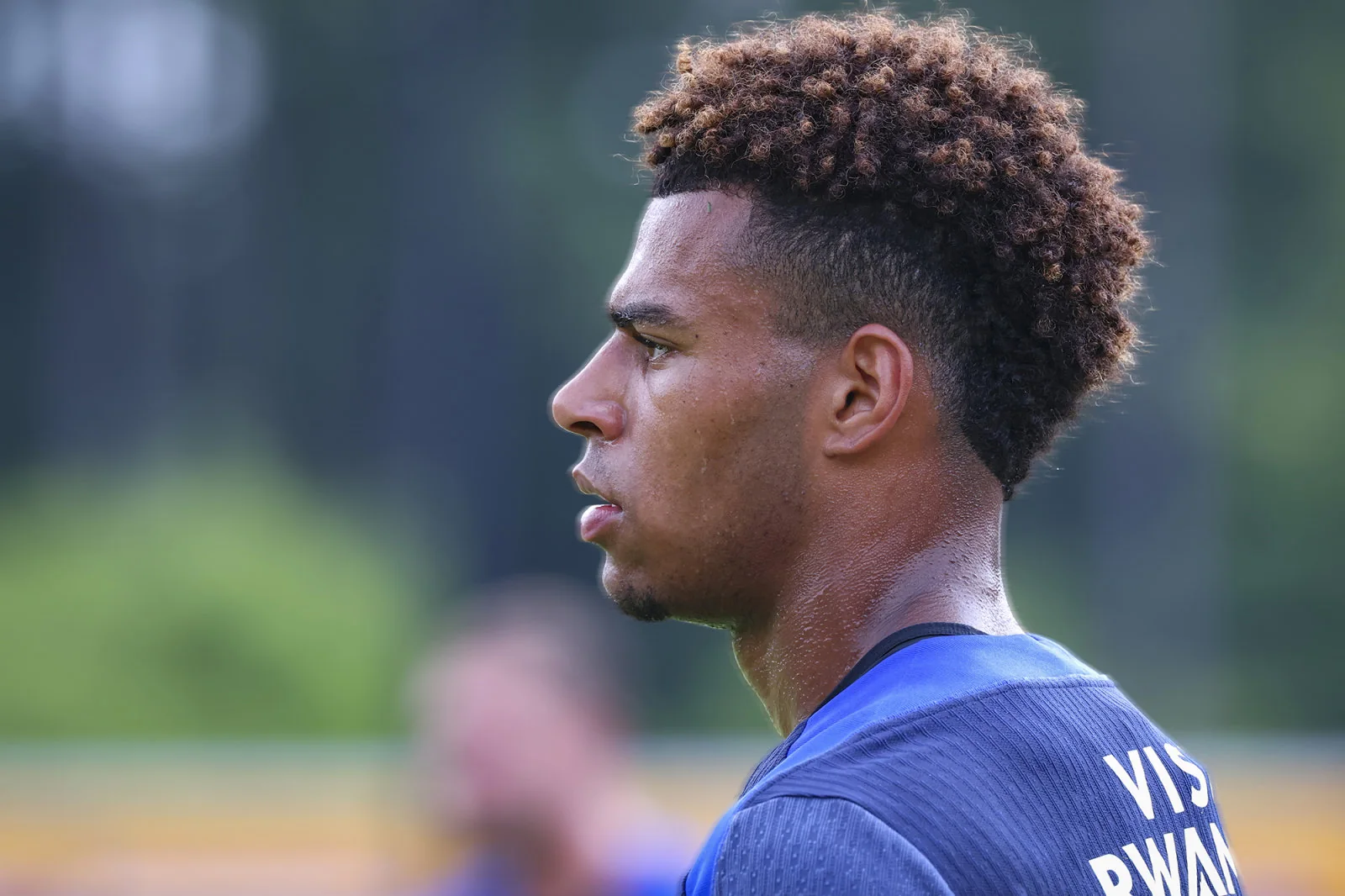
Désiré Doué is a French PSG attacker, a Rennes academy graduate and the younger brother of defender Guéla Doué. His position can involve work from either wing and movement into central attacking spaces. This guide explains his club development, the 2025 Champions League final that brought his biggest breakthrough, and the distinct youth, Olympic and senior stages of his France career. Current league statistics are checked as of 14 October 2026 and kept separate from his completed European campaigns.
Who Désiré Doué is at PSG
Désiré Doué is a French attacking player at Paris Saint-Germain, wearing number 14. His full name is Désiré Nonka-Maho Doué. PSG's official profile lists his birthday as 3 June 2005 and birthplace as Angers. He is 21 on 14 October 2026, the fact-check date for this guide.
The club lists him as a forward, while other football profiles use more specific labels such as winger or attacking midfielder. Those descriptions are not necessarily contradictory. One can identify his place in the attacking unit; another can classify the starting area or role used in a particular formation. The useful football explanation comes from what he does with the players around him, rather than selecting one label and excluding every other attacking responsibility.
PSG also records a height of 181 centimetres and a right-foot preference. These details help distinguish an accurate profile from older measurements or database entries, but they are not a substitute for understanding his game. Being right-footed does not mean every important action uses that foot, just as a height measurement does not establish the effectiveness of his movement or decision-making.
Doué joined PSG in August 2024 after developing at Rennes. The move placed a player with Ligue 1 experience into another club and competitive setting. His name may now be most strongly associated with the Champions League final, but the professional foundation came before that breakthrough. A complete profile needs both stages rather than beginning and ending with the most famous night.
When searching for his current lineup, keep that biography separate from a match announcement. Number 14 identifies him within the PSG squad; it does not guarantee a starting place for the next fixture. Selection, position and available teammates are match-specific. The following sections explain the career and a documented attacking example so that the eventual lineup has more meaning than a single word beside his name.
Rennes gave Doué his professional foundation
Doué's PSG breakthrough grew from a long academy education at Stade Rennais. The distinction matters because a teenager arriving at a major club is not necessarily beginning from the same point as a player entering senior football for the first time. By summer 2024, Doué had already encountered Ligue 1 opposition and European competition with Rennes.
Academy development and the first-team step
Rennes announced his first professional contract in April 2022, when he was 16. The announcement described years in the academy, reserve football and progressive involvement in first-team training. Those are related but different steps. Training with professionals and appearing in a matchday group do not themselves mean a player has already made a league debut.
The senior league step followed against Lorient in August 2022, when he was 17. Rennes' farewell account recalled decisive moments against domestic opponents and Dynamo Kyiv in Europe. It also described his work both from wide areas and in recovering the ball. That is evidence of a varied football education, rather than a career defined only by a later forward label.
The same account remembered a goal at Clermont supplied by his brother. It is a useful football detail because it shows a real connection on the pitch, not merely two players sharing a surname in an academy photograph. Yet the wider professional development remained individual: each brother had to establish a role and earn playing time.
Moving to PSG in August 2024 changed the demands around Désiré without removing that foundation. He brought senior experience but still had to adapt to another team and level of expectation. His eventual breakthrough should be read as a later stage of development, rather than proof that the academy years and initial professional matches were incidental.
Guéla Doué is his brother, with a different football career
Guéla Doué is Désiré's older brother and a defender, principally a right-back. Bayer Leverkusen's September 2026 signing profile follows his path from Rennes through Strasbourg to Germany. Older references describing him as a Strasbourg player belong to the preceding stage, rather than his club affiliation on this guide's fact-check date.
Bayer's account also recalls an unusual first-team debut: Guéla entered Rennes' February 2023 match against Strasbourg in place of Désiré, helping complete a 3–0 win. It is a concrete example of their shared club history. It does not make their positions interchangeable: the attacking brother and the defensive brother went on to follow different professional routes.
The national-team records differ too. Guéla represents Côte d'Ivoire, while Désiré plays for France. Those are documented football affiliations; they should not be replaced by assumptions based on surname, birthplace or family background. Keeping each player's identity precise is particularly helpful when reading a shortened headline about “Doué” scoring, signing or being selected.
The brother connection is therefore worth including as part of the public football story. It explains a shared academy and a striking substitution moment, while leaving each career its own achievements. It supplies useful context without turning the profile into speculation about private family matters.
His PSG position combines wide and central attacking work
Doué is a forward whose attacking work can begin on a wing and continue between the lines or inside the penalty area. PSG's broad forward designation and a database's more specific right-wing label can both be useful. The first describes his place in the squad; the second helps locate a common starting position. Neither tells you where every touch will occur. For a player operating in Luis Enrique's interconnected attack, the movement after the initial formation is especially important.
Starting wide does not mean staying on the touchline
Two matches from the 2024/25 Champions League illustrate the distinction. In its analysis of the first leg away to Arsenal, UEFA described Doué and Khvicha Kvaratskhelia holding width while Achraf Hakimi moved into central areas. That arrangement gave Paris different ways to occupy the pitch: attackers could stretch Arsenal horizontally while a full-back supplied another passing option inside. See UEFA's Arsenal performance analysis.
The value of a wide position is not limited to receiving a cross-field pass. A defender who must respect the winger's location has a decision to make before the ball arrives. Moving inward can expose the flank; staying outside can leave a passing lane toward the middle. This is a tactical interpretation of the spacing UEFA describes, rather than a claim that Doué beat the same marker in every possession. Width can create a teammate's opportunity even when the winger does not record the assist.
Against Inter in the final, the relationships looked different. Doué began on the right but moved through other attacking areas, and Hakimi finished centrally from his pass for the opener. UEFA's final analysis explains how the interchanges complicated Inter's marking. A full-back appearing as a central scorer is a particularly clear example of why the formation graphic cannot describe the entire attack. Doué's creative contribution came from recognising the next receiver, not simply remaining in a lane labelled right wing.
Versatility has to fit the players around him
Those examples support an interpretation of Doué as a flexible attacker; they do not mean he is given unlimited freedom without responsibilities. A player moving away from the touchline changes the space available to the full-back, the nearest midfielder and the centre-forward. Someone must still provide an outside option, someone must occupy the defenders, and the team needs a response if possession is lost. Effective movement is coordinated, with teammates able to recognise and use the space that opens.
UEFA's technical observers highlighted the collective mobility that made Inter's man-oriented defensive assignments difficult. For a supporter following Doué, that suggests three practical things to notice: where he receives relative to the nearest defender, which teammate changes position at the same time, and whether his next action advances the attack. These are more revealing questions than asking only whether he was officially a winger or an attacking midfielder. They also allow a fair assessment of a match in which he contributes to progression without scoring.
His ability to operate in several areas creates selection options, but the opposition and the available teammates still matter. A plan that needs an attacker to maintain width can demand different decisions from one that asks him to combine centrally. Likewise, a start and a substitute appearance offer different amounts of time to affect a game. Use the PSG fixture list to identify the next opponent, then read the confirmed lineup and match report in that context. The 2025 European examples explain his range; they are not a promise of the same position in every future match.
The 2025 Champions League final explains the breakthrough
The match most closely associated with Doué's breakthrough is PSG's 5–0 victory over Inter in Munich on 31 May 2025. He supplied the pass for Hakimi's opening goal and then scored Paris' second and third goals. The official UEFA match record places his goals in the 20th and 63rd minutes. With a birthday three days later, he was still 19 during the final.
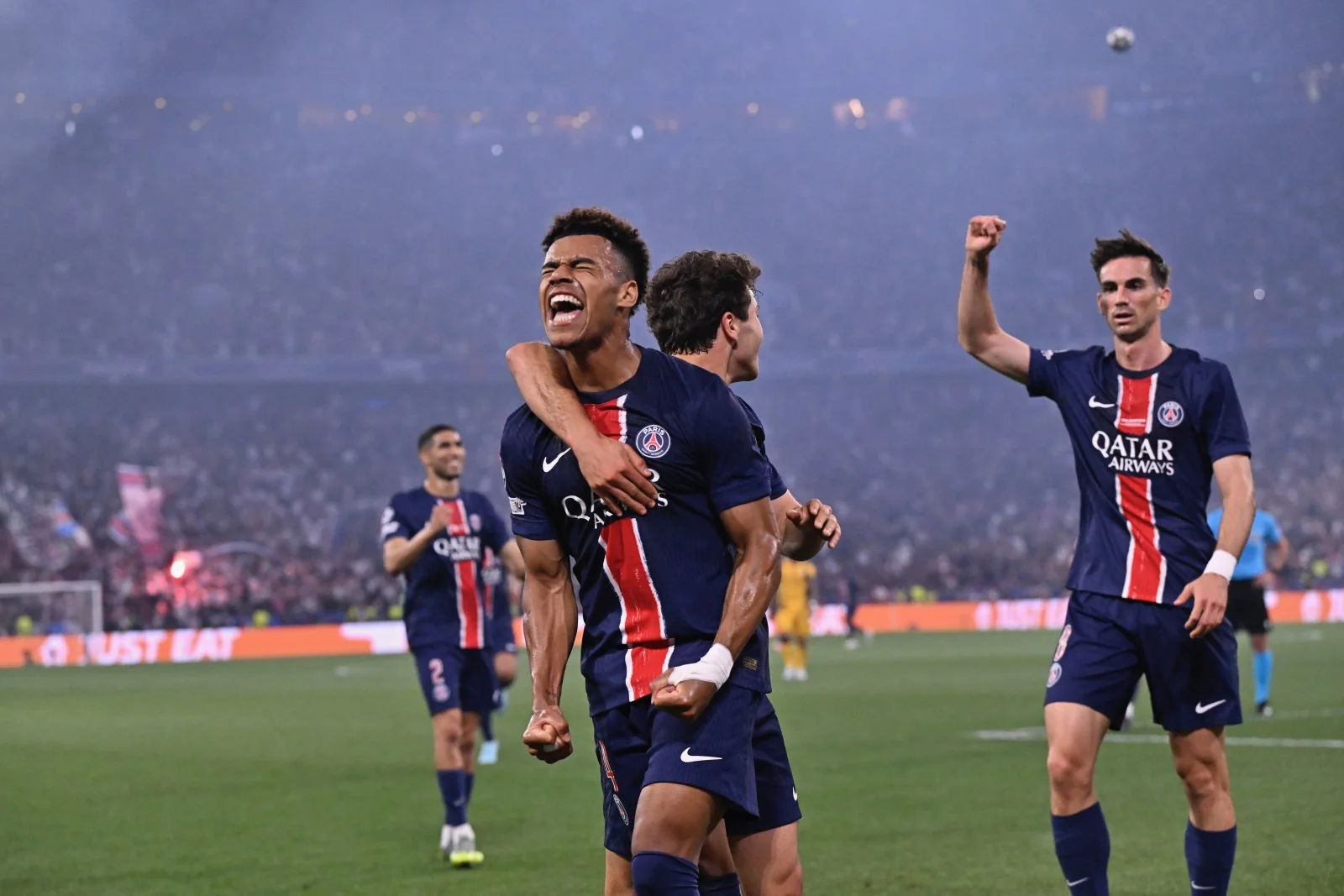
His contribution mattered at several stages of the scoreline. Creating the opener helped Paris establish control; scoring the second expanded the advantage before half-time; his next goal moved the result to 3–0. Those actions involved both supplying a teammate and finishing himself. The sequence helps explain why he became the face of that evening, while the team around him continued to provide the passing, defending and additional goals required to complete the victory.
UEFA named him the final's Player of the Match, identifying him as the first teenager to score twice in a Champions League final. That is a precise historical achievement. It is stronger and more informative than an undefined claim that he was the best young footballer in every competition. The award recognises a particular match; the separate Young Player of the Season award evaluates the wider European campaign.
Reading goals and assists with the correct season label
For the entire 2024/25 Champions League, UEFA's season award report lists 16 appearances, 742 minutes, five goals and five assists. It also identifies goals against Salzburg, Brest and Aston Villa before the final. That broader record places Munich within a developing campaign, rather than treating the two final goals as his only European contribution. The total appearances and minutes also remind us that an appearance is not automatically a full match.
A different question is how he is doing in the current French league season. In the 14 October 2026 snapshot, ESPN's 2026/27 Ligue 1 statistics show six appearances, consisting of four starts and two substitute appearances, with no goals and one assist. Those figures describe a much shorter, different competition sample. They do not erase the 2025 final, and the 2025 final cannot be added to them as if both belong to the same league season.
The useful comparison is therefore between questions, not just numbers. Historical European totals answer what he contributed during a completed competition. Current league totals answer what has happened so far in the new campaign. A match log can also include France appearances, so the team and competition labels matter when a supporter sees a recent goal on the same profile page. National-team output belongs to the national team, even when the scorer is employed by PSG.
To assess his next league performance, keep the starting role, time on the field and opponent beside the goal or assist count. Six appearances are a limited basis for judging an entire season, particularly when two came from the bench. The 2026/27 Ligue 1 results provide the match context for following that developing record. Munich remains a major career landmark; the current season is an ongoing football story with its own evidence.
France youth, Olympic and senior football are different stages
Doué represents France internationally, but his national-team career includes several distinct teams and competitions. A youth European title, an Olympic medal and a senior international appearance each describe a different stage. Keeping those stages separate makes the chronology easier to understand and prevents a youth achievement from being presented as a senior European Championship victory. His development with France also overlapped his club career rather than beginning only after he became established in Paris.
The youth title and the Paris Olympic silver
He was part of France's victorious team at the 2022 Under-17 European Championship. In the final at Netanya on 1 June, France beat the Netherlands 2–1 after falling behind. The FFF's final record lists Doué in the starting team and records his substitution in the 64th minute. Saël Kumbedi scored both French goals. Doué's medal therefore reflects participation in the winning team, with the decisive scoring credit belonging to his teammate.
Two years later came another final, this time in Paris. France lost 5–3 after extra time to Spain at the Parc des Princes on 9 August 2024 and took Olympic silver. According to the official Olympic final record, Doué entered for Enzo Millot in the 78th minute. France recovered from 3–1 down to force extra time, before Sergio Camello's two goals decided the match for Spain. Doué participated in the late stages of a demanding final; he was not one of France's three scorers that evening.
These two finals supplied different kinds of experience. The youth team successfully overturned a deficit and won its title. The Olympic team fought back to extend its final but finished with silver. For a developing attacker, both offer exposure to elimination pressure and changing match states, although it would be speculative to assign a particular later goal to a lesson learned in either game. The documented point is that he had already played in major international finals before PSG's European triumph.
What the senior France debut changed
The FFF player profile dates his first senior appearance to 23 March 2025 against Croatia. France won the Nations League quarter-final second leg 2–0 at the Stade de France, matching Croatia's first-leg advantage, then advanced 5–4 on penalties. The match record shows Doué replacing Bradley Barcola in the 66th minute. Being included in the squad for the earlier away leg had not itself been a senior appearance.
The debut placed him in a different attacking group, with players such as Kylian Mbappé and Michael Olise alongside PSG teammate Ousmane Dembélé. Club familiarity can be useful, but international teammates do not share an entire club season of training. A national-team role must fit that selection's combinations and opponent, so his PSG starting position cannot simply be copied into every France lineup. The same is true of playing time: the first cap was a substitute appearance in a knockout tie, rather than a guarantee that he would immediately start every international.
For supporters, Doué's story now has two connected calendars. League and club European matches develop his PSG record; France matches develop his international record. His route from Rennes academy football to international finals and senior selection explains the range of experience behind the celebrated Munich performance. Following those stages by their actual dates, teams and competitions gives a more complete picture of the player than either a single highlight or a combined, unlabelled statistics total.
Loading comments…