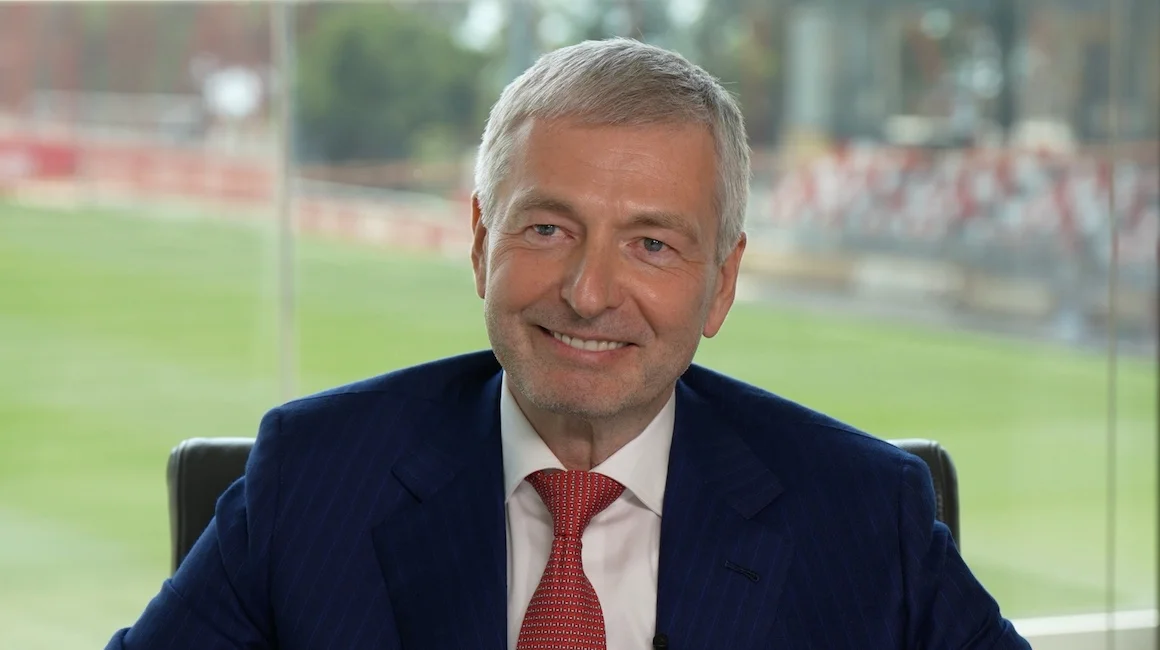
AS Monaco is controlled through Monaco Sport Investment Ltd, associated with Dmitry Rybolovlev, with an established ownership split of roughly two-thirds for MSI and one-third for the Princely family. Rybolovlev is also the club president. This guide separates shareholding from executive management, explains the investment and development project, and puts sale reports in date order. Facts were checked on 20 October 2026.
Who owns AS Monaco?
AS Monaco’s controlling ownership is associated with Dmitry Rybolovlev through Monaco Sport Investment Ltd, usually abbreviated to MSI. The established shareholding split is approximately two-thirds for MSI and one-third for the Princely family. That is a more accurate answer than describing the football club as wholly owned by either Rybolovlev or Prince Albert II.
The controlling share and Dmitry Rybolovlev
The ownership question in a September 2024 interview with CEO Thiago Scuro identifies the split as two-thirds controlled through MSI and the remaining third held by the House of Grimaldi. The familiar decimal presentation is 66.67% and 33.33%. These are two ways to describe approximately the same proportions, rather than separate ownership arrangements.
Rybolovlev also appears as president on the club’s official organizational chart, checked on 20 October 2026. Ownership and presidency overlap in his case, but the words describe different things. An ownership stake concerns an economic interest in the club’s company. The president is a named leadership position. A person can hold one role without that automatically proving the other.
That distinction helps when reading a short news headline. “Monaco owner” is convenient shorthand for the controlling investor, yet it does not mean that every share is held directly in his personal name. Similarly, a photograph of an executive attending a match cannot establish that executive’s shareholding. For the structure, look for explicit shareholder information; for leadership appointments, consult the club’s official announcements.
The Princely family’s continuing place
The Princely family’s relationship with AS Monaco extends beyond a percentage. In his November 2024 centenary interview, Rybolovlev described generations of support and the importance of Prince Albert II’s presence around the team. That gives context to the club’s connection with the Principality without making the Prince its day-to-day chief executive.
Three questions therefore deserve separate answers: who controls the majority interest, who holds formal leadership posts, and whom the club represents. Conflating them makes Monaco’s arrangement appear more mysterious than it is. The team’s identity, the minority stake and the president’s responsibilities can coexist within the same institution.
This guide concerns AS Monaco’s football operation. Reports about another sporting organisation bearing the Monaco name should be checked against the club and competition involved before they are treated as football ownership news.
Who runs the club from day to day?
Thiago Scuro is the chief executive named on AS Monaco’s official organizational chart at the date of this guide. The club’s 2 October 2023 appointment announcement explains the relationship clearly: he reports to president Dmitry Rybolovlev and oversees both the sporting and business activities. He also joined the board of directors.
That remit is broader than a role focused only on recruiting players. A professional football operation needs sporting preparation, commercial relationships and administrative work to function together. The official description makes Scuro the executive reference point across those areas. The president remains a separate position above that executive reporting line.
President, chief executive and football decisions
The current chart also identifies specialist functions, including Carlos Aviña as technical director and Sébastien Muet as academy director. Those titles help explain why a club cannot sensibly be reduced to one person making every decision. First-team recruitment, the development of young players and the running of a business require different kinds of information, even when they contribute to a shared sporting plan.
A recruitment decision illustrates the distinction. Someone has to assess whether a player improves the squad, another part of the organisation must understand the financial commitment, and the coaching staff must consider how the player would be used. The public chart does not disclose every internal discussion or contractual approval. It does show that separate responsibilities exist, which is enough to avoid treating every rumoured signing as a personal instruction from the owner.
The distinction matters when staff change. Appointing a new chief executive alters the management structure; it does not, by itself, transfer shares. Replacing a coach changes the person responsible for preparing the first team, but is not evidence that the club has been sold. An ownership announcement and an employment announcement answer different questions and should be read on their own terms.
Supporters can also judge public statements more accurately by identifying the speaker. An academy director discussing a youth pathway provides information about development. A chief executive explaining the club’s broader approach may connect sporting and commercial priorities. A president discussing long-term commitment speaks from another position. Their comments can complement one another without being interchangeable.
For a current answer, the undated organizational chart is useful alongside dated appointment statements. The first describes the club’s public structure now; the second explains when a role began and how it was defined. Reading both prevents an old announcement from being mistaken for a complete account of every current employee.
Why the December 2011 takeover mattered
Rybolovlev became majority shareholder and president on 23 December 2011. AS Monaco’s official tenth-anniversary retrospective places the team nineteenth in Ligue 2 at that moment. The starting point was therefore a club trying to recover from relegation, rather than an established Champions League contender simply seeking another expensive signing.
The first major sporting step was a return to Ligue 1 in 2013. Champions League group-stage football followed in 2014. These landmarks show why the early period is remembered as a rebuilding project: promotion changed the level of domestic competition, while returning to Europe restored another part of the club’s sporting visibility. Neither step should be confused with the later achievement of winning the French title.
That championship arrived in 2017 under Leonardo Jardim. Monaco secured it with a 2–0 victory over Saint-Étienne on 17 May, ending a seventeen-year wait. UEFA’s contemporary account also records the team’s run to the Champions League semi-finals. Winning a long league campaign while advancing that far in Europe made the season a particularly strong sporting reference point.
The sequence matters more than presenting those events as a single instant transformation. The takeover, promotion and championship occurred at different stages. A club needs to assemble a squad, establish working relationships and cope with opponents responding to its strengths. Investment can make those processes possible, but the competitive work still has to happen through players, coaches and staff.
It is also important to distinguish the conditions for success from proof of one exclusive cause. An owner can provide support and a strategic direction; the score of a particular game still depends on events on the pitch. A strong ownership story should recognise the infrastructure and organisation behind the team while leaving room for the judgement of a coach and the execution of the players.
The 2017 title gives supporters a benchmark for ambition, but it does not establish an annual entitlement to finish first. League positions reflect the strength of rivals, the balance of a squad and the ability to repeat performances across months. Remembering a peak season is useful when evaluating a project; assuming that the same result must follow from the same ownership is much less useful.
This history explains the significance of December 2011 without relying on a rumoured purchase price or equating the owner’s personal wealth with money available for every transfer window. The relevant football story is the move from a difficult second-division position back to domestic and European competition.
How investment connects to Monaco’s football model
The most visible evidence of investment is often a new signing, but a football project also depends on the environment in which players develop. Monaco’s academy and Performance Centre provide two useful examples. One is a long-standing institution with a history that predates the present majority shareholder. The other is a major facility developed during his presidency.
An academy with roots before the takeover
Monaco’s academy was established in the 1975/76 season under Jean-Louis Campora’s presidency. The club marked its fiftieth anniversary in 2026 with a roundtable bringing together former players, educators and club leaders. This history is important: modern investment supports and develops an existing tradition; it did not create that tradition in December 2011.
It also helps to distinguish an academy graduate from a young first-team recruit. Both can improve at Monaco, but their paths are different. A player educated within the youth system has followed one route, while a footballer signed after making professional appearances elsewhere has followed another. Grouping every successful young player under the academy label would hide the separate contributions of coaching and recruitment.
For supporters, the academy’s value can be seen in opportunities as well as eventual transfers. A young player needs a pathway into demanding football, appropriate support and time to handle mistakes. A strong reputation is useful, but the practical question is whether development leads to meaningful involvement rather than simply another name on a youth squad list.
La Turbie and the Performance Centre
The club’s official Performance Centre guide records €55 million invested in the facility, three pitches and a complete handover in September 2022. It identifies training, nutrition and recovery as central elements of the project. The complex at La Turbie is a different type of commitment from paying for an individual player’s registration.

Facilities affect the working week rather than only the spectacle of a match. Players need spaces for preparation and recovery, and staff need an environment in which those activities can be coordinated. A building cannot make a correct pass or win a defensive duel. Its value lies in supporting the repeated work that allows a squad to prepare for those moments.
The published investment figure describes this specific project. It should not be treated as a current annual transfer budget, a valuation of the club or a measure of the owner’s personal fortune. Keeping those categories separate gives the number a clear purpose and avoids making it answer questions it was never intended to answer.
Developing players while competing
In his September 2024 interview, Scuro identified player trading as an important income source and explained the benefit of developing replacements internally when leading players leave. That was a statement of the club’s approach at the time, rather than a publication of its current financial accounts. It helps explain why development and competitive ambition are discussed together.
The sporting challenge is timing. Selling an established player can create an opportunity for someone younger, but the replacement still has to cope with the demands of the role. Keeping experience can help a team compete immediately, while opening a pathway can benefit the next stage of the squad. Neither choice works automatically; the balance has to be judged player by player.
A transfer headline alone cannot measure that balance. Supporters should also look at whether the next player receives suitable minutes, whether the squad retains complementary skills and whether results remain competitive. Those observations connect ownership strategy to football without assuming that the largest reported sale necessarily represents the strongest sporting decision.
What sale reports mean for supporters
Search results about Monaco’s ownership can lead to articles published at very different stages of the same story. The date is essential. A report that an investor is considering an offer does not remain a complete description of the situation years later, and a headline about a potential sale cannot establish that the club has already changed hands.
Exploring a sale is different from completing one
In January 2024, reports described a review of strategic options for the majority stake, with Raine Group acting as financial adviser. The 22 January account included a family-office statement about that process and explicitly distinguished it from a guaranteed sale. The relevant fact was that possibilities were being explored, rather than that a new owner had taken control.
There is also a more recent reporting update. On 9 October 2026, MadeInFOOT reported, attributing its information to L’Équipe, that the sale project was no longer current. That is a dated press account of the process, rather than a club announcement identifying a completed transaction. The official leadership chart checked for this guide still names Rybolovlev as president.
A useful way to read any future announcement is to identify what actually happened. Does it describe discussions, an agreement to proceed, or a completed change? Does it identify a buyer and the stake involved? Those details carry more information than a headline saying that a club is attracting interest. Without them, a story may describe the market around an asset rather than a change in control.
A change of sponsor is another separate event. A company appearing on a shirt has a commercial relationship with the club, but that appearance alone does not establish a share purchase. Likewise, the sale of an individual player changes a squad and can affect its finances; it does not mean that ownership of the club has transferred.
Following the team and checking ownership updates
For the immediate football picture, use the matches today page and the 2026/27 Ligue 1 table. They answer questions about the next game and the consequences of results. Ownership coverage answers a different question about the institution behind the team. One should not be used as a substitute for the other.
Over a longer period, supporters can follow whether academy players gain responsibility, whether the squad remains balanced after departures and how the team performs against its rivals. These are observable football outcomes. They provide a better basis for discussing the club’s direction than inferring an entire strategy from one transfer fee or one difficult afternoon.
For ownership updates themselves, combine a dated report with the latest official club information. Keep the majority shareholder, the president and the executive management distinct, and check whether a claimed change concerns shares or staff. That approach preserves the clear answer to the original question while allowing it to be updated when a documented change actually occurs.
Loading comments…