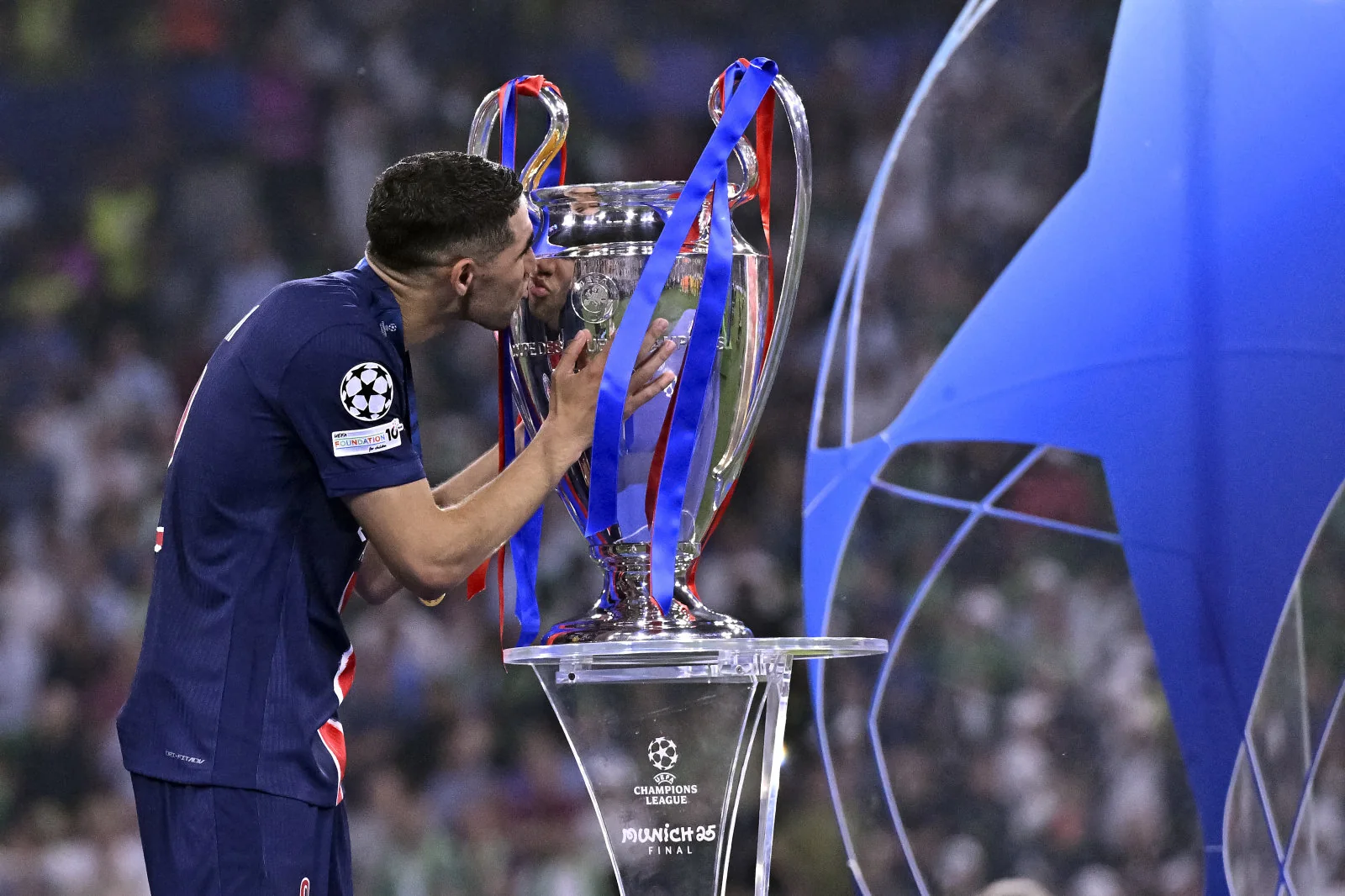
Achraf Hakimi is PSG’s Moroccan right-back, signed from Inter on 6 July 2021. His position begins in defence but gives him an important part in the attack, through runs outside the winger, movement into midfield and arrivals near goal. This guide follows the clubs that shaped him, the evidence behind his Paris role and the goals and assists that made his contribution so visible. Facts checked on 20 October 2026.
Who is Achraf Hakimi at PSG?
Achraf Hakimi is Paris Saint-Germain’s Moroccan right-back, a defender whose contribution reaches far into the attack. PSG’s official player profile lists his full name as Achraf Hakimi Mouh, his height as 181 centimetres and his preferred foot as right. He wears number 2. The simplest positional answer is right-back; the more interesting football question is why he so often appears somewhere a traditional right-back would not.
That does not mean his position is meaningless. It establishes a starting responsibility on the right side of defence, from which different attacking movements become possible. A full-back can overlap outside a winger, move into midfield or arrive in the box while still belonging to the defensive unit when the team retreats. The structure surrounding those movements determines whether they improve the attack or leave an avoidable gap. His speed is one part of that structure, but timing and the support behind him are just as important.
Age, nationality and the number 2 shirt
Hakimi was born in Madrid on 4 November 1998. He is 27 on the guide’s fact-check date, 20 October 2026, and turns 28 on his next birthday. His Spanish birthplace and his Moroccan international career are different pieces of information. PSG records that he was born to Moroccan parents and has represented Morocco’s senior side since 2016. A birthplace search should therefore not be used to reassign his national team.
The number on his shirt is another useful identifier with limited tactical meaning. It helps a new viewer locate him quickly, especially when the camera follows PSG advancing down the right. It does not require him to remain in a narrow strip beside the touchline. Watch the point at which he leaves that strip, the passing option his movement creates and the teammate who covers the vacated area.
Those distinctions make his profile useful beyond a list of personal facts. They help explain how a player can be registered as a defender while participating in moves near the opposing goal. The following career and match examples show how that combination developed and why it became so important to PSG.
The clubs and dates that shaped his career
Real Madrid, Dortmund and Inter
Hakimi’s senior career connects several different football environments. He developed at Real Madrid, belonged to the club’s 2017/18 Champions League-winning squad and then spent two seasons on loan at Borussia Dortmund. His move to Inter followed in 2020. It is important to preserve the loan distinction: Dortmund was a major developmental stage, but it was not the same kind of permanent transfer as the later switch from Inter to Paris.
At Inter, the attacking return was already substantial. The club’s archive records seven goals in 37 league appearances in 2020/21, a season which ended with the Italian title. These are league numbers, separate from the European and domestic cup appearances listed on the same page. PSG did not buy a defender whose attacking contribution was merely theoretical. His previous season contained a significant scoring return within a title-winning side.
Different formations can make use of the same strength in different ways. A wing-back beginning higher up the pitch may have a defender behind him from the outset. A full-back advancing from a back four requires a different covering movement. The career sequence helps explain why the labels right-back and wing-back both occur in descriptions of Hakimi. It does not make those systems interchangeable, or prove that a team can gain the attacking benefit without organising the defensive space.
Joining Paris and extending the project
Hakimi joined PSG on 6 July 2021. Inter’s departure announcement explicitly confirms a permanent transfer and thanks him for his contribution to the Scudetto. That date is the answer to the search for when he joined Paris. It should not be confused with the dates of later contracts, a first league appearance or a milestone match, all of which describe different events.
His Paris story has subsequently become one of continuity. In its 200-appearance retrospective, PSG identifies the match against Toulouse on 3 April 2026 as the landmark. The feature describes the captain and his deputy, placing Hakimi within the leadership of a team whose personnel and ambitions had developed during his time there.
That kind of continuity matters to the football. Repeatedly sharing the right side with teammates can improve the judgement of when to run, when to wait and which passing angle is available. A long stay does not by itself prove excellent form, but it gives relationships time to develop. For a supporter assessing the project, the useful question is how that familiarity translates into coordinated actions, especially when a crowded calendar requires different partners around him.
Why his position is more than a touchline job
Width, inside runs and connections
One of the most revealing descriptions of Hakimi’s Paris role comes from UEFA’s technical analysis of the 2025 semi-final first leg at Arsenal. It identifies the right-back moving inside to help create a central overload while the wingers provided width. That arrangement is more specific than saying he simply attacks a lot. His position helped give the player on the ball another passing option in an area Arsenal had to defend.
An overlap and an inside run create different choices. Going outside the winger can pull a defender towards the touchline and supply a crossing route. Going inside can connect the attack to midfield or threaten the channel between a centre-back and full-back. Neither movement is automatically superior. If the winger has already come inside, another player may need to keep the pitch wide; if the winger stays outside, an interior run can give that player a shorter combination.
UEFA’s examples also show why the relationship extends beyond a two-player partnership. When midfielders change their height, the supporting spaces change with them. A full-back coming inside can help keep a passing connection available rather than leaving the centre empty. For viewers, the useful detail is who moves in response. Several players occupying the same lane can make an attack easier to contain; complementary movement gives the opponent more than one decision to solve.
The defensive cost of an attacking run
Hakimi’s running capacity helps make those tasks possible. UEFA recorded 32 sprints by him in the 2025 Champions League final against Inter, in its review of Paris’ pressing and mobility. This is a single-match measurement, not a claim that every appearance produces the same total. It supplies a concrete example of the physical work behind a role that spans several areas of the pitch.
There is still a cost whenever a defender advances. If possession changes hands, the opponent may try to find the space he has left. A recovery run can help, but preventing the first clean forward pass is often the more important collective task. The nearest midfielder may have to delay the counterattack while a centre-back adjusts across. Those covering decisions are the other half of an exciting run towards goal.
When judging his defending, therefore, distinguish the player’s decision from the team’s response. A planned attacking position can look exposed after a badly timed turnover elsewhere. An unnecessary run can also create a problem that teammates should never have faced. The match sequence, not a freeze-frame alone, helps tell the difference. Look at the moment possession was lost, the players behind the ball and whether the opposition could immediately face forward.
This is why goals and assists cannot provide a complete grade for an attacking full-back. Good support can help an attack without earning either statistic, while disciplined positioning can stop a counterattack before any spectacular tackle is required. Hakimi’s value is clearest when the two directions of his work remain connected.
Goals and assists in the matches that mattered
Hakimi scored four goals and supplied six assists in the 2024/25 Ligue 1 season, according to Opta’s career record. His Champions League return that season was four goals and five assists, as recorded in PSG’s 200-appearance feature. These are two different competitions with different schedules. Combining them without a label would make a league comparison misleading; confusing them with an all-competition season total would introduce another error.
The European goals show why the timing of an attacking contribution matters. PSG’s official biography records goals in the quarter-finals and semi-finals before the opening goal against Inter in the final. The final strike was also against a former club. Its importance came from changing the score in the biggest match of the campaign, rather than from adding decorative weight to a career counter after the outcome had already been settled.
The football significance is the extra problem created by a defender arriving near goal. Opponents already have the forwards to track. A run from deeper can force another handover between markers, especially if the player nearest the ball has drawn attention in one direction. It would be wrong to assume that every such run creates a free chance. The pass has to arrive, the runner has to judge the timing and the team must preserve enough balance to survive a turnover.
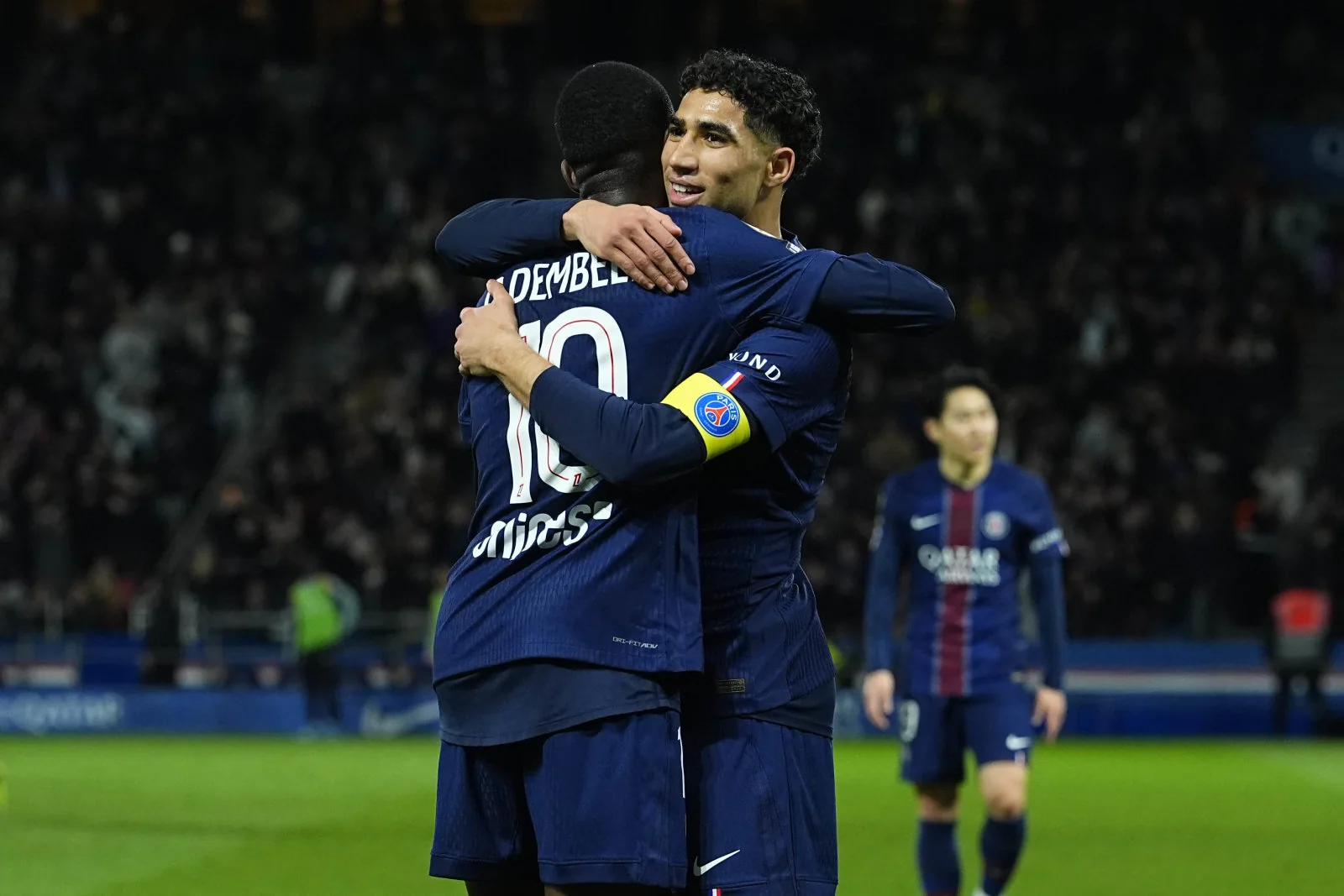
PSG’s retrospective also places the individual output within his years at the club. That is useful historical context, but a milestone article’s totals belong to its publication setting. They should not silently become today’s career figures. A player can add another appearance or assist after the feature is written, while the original article remains perfectly accurate about the landmark it marked.
For the next game, look at the quality of the involvement before judging only the final count. A cutback to an unmarked teammate, a run that takes away a defender and a shot from a difficult angle have different consequences. The first may produce an assist, the second may receive no basic statistic and the third may inflate a shot total without offering the best route to goal. Numbers describe outcomes; following the whole move helps explain the decision.
The same standard should apply when PSG lose. A goal from a full-back does not cancel a defensive mistake, just as a blank scoring line does not prove a poor performance. Hakimi’s established attacking record is a reason to pay close attention to both parts of the job, not a substitute for evaluating them.
Morocco and the next PSG match
A different international assignment
Hakimi’s Morocco career gives his Paris profile another dimension. He was part of the team that reached the 2022 World Cup semi-finals, the first African nation to do so. That achievement remains a major reference point in the club’s biography and in CAF’s account of Morocco’s subsequent World Cup progress. It is an international landmark, separate from the European honours he has won with clubs.
He also captained Morocco to Olympic bronze in 2024. In the 6-0 victory over Egypt in Nantes on 8 August, he scored a late free-kick, as described in the AFC’s match report. The Olympics and the senior World Cup have different team structures and competition histories. Combining their honours without identifying the tournaments would blur two distinct achievements and the different groups with which he earned them.
For a fan comparing club and international performances, the surrounding team matters. A familiar PSG combination may not be available with Morocco, while a national-team role may ask for a different balance between advancing and protecting the flank. The right approach is to compare the task as well as the outcome. The same player can make a useful contribution through a restrained performance in one setting and a more adventurous one in another.
How to assess his next appearance
Use the Ligue 1 matches today to find PSG’s current fixture, then wait for the actual team sheet before assuming Hakimi will start. Profile information and historical milestones cannot guarantee selection, fitness or a full match. If his minutes are limited, that changes what an attacking total can reasonably tell you. A substitute trying to help chase a goal faces a different situation from a starter protecting a lead.
Next, consider the opponent’s approach. A team that presses PSG high can leave space behind its first line, but it can also make the initial pass difficult. An opponent defending near its own box may surrender territory while denying clean room to run. Those are different problems for an attacking full-back. The most informative comparison is between similar tasks, rather than between isolated goals or clips taken from unrelated matches.
Finally, return the performance to the league table and the team’s objective. Was PSG trying to break a stalemate, manage an advantage or recover after conceding? Hakimi’s career makes him an obvious player to follow, but those match conditions explain how his abilities are being used. The reward for watching him closely is seeing how a defender’s decisions can reshape the whole team’s attack while still carrying responsibility for what happens behind it.
Loading comments…